
Introduction
The strange thing about IB exams is that confidence often comes from a number you can’t control. You can’t choose the questions. You can’t choose the topics. But when you know the IB History SL grade boundaries for 2025 (Timezone 2), your revision stops being a fog and starts becoming a map.
This guide gives you the full 2025 TZ2 boundary ranges for IB History SL (Internal Assessment, Paper 1, Paper 2, and the final mark out of 100) and shows you how to use them without obsessing over them.
Quick checklist before you revise
-
Know the IB History SL grade boundary ranges (so you can set realistic targets).
-
Prioritise marks you can reliably earn (structure, evaluation, focused evidence).
-
Train by paper (Paper 1 source skills vs Paper 2 essay argument).
-
Use one platform to loop: learn, practise, grade, fix.
If you want a clean dashboard for comparing boundaries, start with IB Grade Boundaries.
IB History SL Grade Boundaries 2025 (Timezone 2)
Below are the boundary ranges you can use to plan your IB History SL push for a 7.
Internal Assessment grade boundaries (out of 25)
-
7: 20-25
-
6: 16-19
-
5: 13-15
-
4: 9-12
-
3: 6-8
-
2: 3-5
-
1: 0-2
Paper 1 grade boundaries (out of 24)
-
7: 20-24
-
6: 17-19
-
5: 15-16
-
4: 12-14
-
3: 9-11
-
2: 5-8
-
1: 0-4
Paper 2 grade boundaries (out of 30)
-
7: 23-30
-
6: 20-22
-
5: 16-19
-
4: 13-15
-
3: 11-12
-
2: 6-10
-
1: 0-5
Final IB History SL grade boundaries (out of 100)
-
7: 77-100
-
6: 64-76
-
5: 53-63
-
4: 41-52
-
3: 31-40
-
2: 15-30
-
1: 0-14
To explore boundaries across sessions and subjects, use RevisionDojo’s grade boundaries hub.
How to use IB grade boundaries without spiralling
Grade boundaries in the IB are not a promise. They’re a signal. They tell you what “good enough” looked like after marking for your paper set, in your timezone.
Here’s the calmer way to use them:
-
Build a buffer. If Paper 2 needs 23/30 for a 7, don’t aim for 23. Aim for 25 on a good day and 23 on a tired day.
-
Chase dependable marks. In IB History, structure and evaluation are less fragile than “one more fact.”
-
Treat each component as a different sport. Paper 1 is technique (source analysis). Paper 2 is endurance (argument + evidence). The IA is precision (method + evaluation).
If you need a broader explanation of what boundaries actually mean, read What Are the Grade Boundaries for IB Subjects?.
Component-by-component tactics to climb the boundaries
Internal Assessment: make evaluation obvious
A strong IB History IA usually feels “over-explained” in the best way. Don’t just describe what happened. Explain why your evidence is reliable, limited, and relevant. If you want syllabus-aligned content support while you draft, start with IB History Resources.
On RevisionDojo, students often pair Study Notes with the Coursework Library (to reduce uncertainty) and then use Grading tools to check whether evaluation is actually landing.
Paper 1: win marks with method, not memory
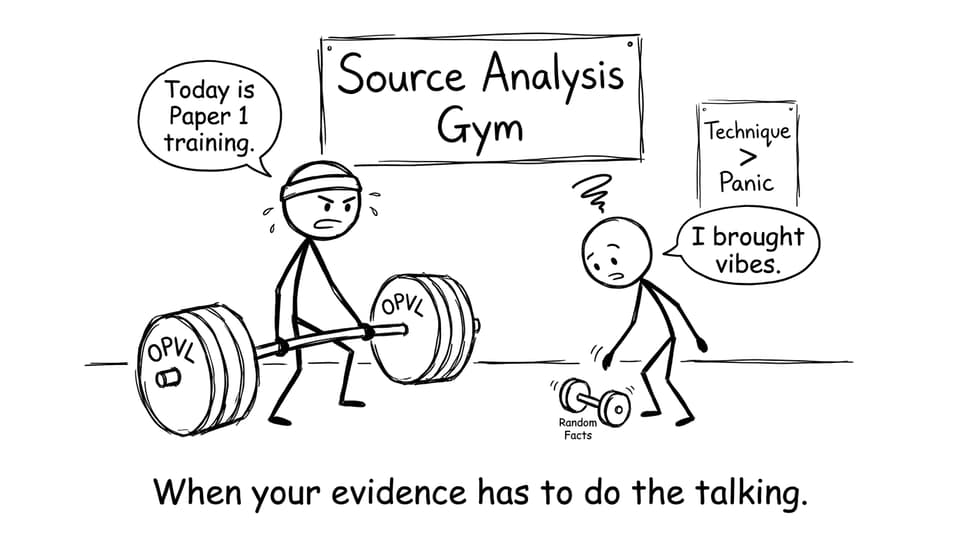
Paper 1 rewards students who can read like a careful skeptic. Practise OPVL-style thinking, spot provenance and purpose quickly, and keep answers tight.
For targeted practice, use IB History Paper 1: Conflict and Intervention and then drill weak spots in RevisionDojo’s Questionbank. When you get stuck, AI Chat can walk you through what the markscheme is really asking.
Paper 2: turn knowledge into an argument
Paper 2 essays are where many IB students lose marks quietly: they know the content, but the argument is soft.
A simple fix: write a thesis that answers the question directly, then make every paragraph prove one slice of that thesis with focused evidence. Use Flashcards for case-study recall, then run timed attempts in Mock Exams or Predicted Papers to build speed and stamina.
If you’re building your practice routine, IB Question Bank | How to Use It Effectively is a strong starting point.
FAQ
Why do IB grade boundaries change each session?
In the IB, boundaries are set after exams are marked, not before. That’s because the IB needs real evidence of how difficult the paper was and how the global cohort performed. Even if the syllabus is the same, question phrasing and source selection can shift difficulty. Boundaries adjust to keep standards consistent across sessions. That means your job isn’t to predict the exact boundary. Your job is to prepare so your performance is strong even if the paper feels unfamiliar.
Do the IA, Paper 1, and Paper 2 all matter equally?
They all matter, but not in the same way. Each component tests a different skill set: investigation writing (IA), source analysis (Paper 1), and extended argument (Paper 2). A common IB mistake is assuming strength in one component will automatically “carry” the others. In practice, a weak paper can drag your total down because the final grade is based on the combined mark out of 100. The smart approach is balance: secure your reliable marks in every component, then push your best component for extra buffer.
What’s the fastest way to move from a 5 to a 6 or 7 in IB History SL?
Usually it’s not “learn twice as much content.” It’s to stop leaking method marks. In Paper 1, that means consistently evaluating sources instead of summarising them. In Paper 2, it means planning for two minutes so your thesis and paragraphs actually match the question. In the IA, it means making your evaluation explicit rather than implied. On RevisionDojo, students speed this up by using Questionbank sets by topic, checking understanding with Study Notes, locking recall via Flashcards, then simulating pressure with Mock Exams and Predicted Papers.
Conclusion: use the boundaries, then outgrow them
Knowing the IB History SL grade boundaries for 2025 (Timezone 2) helps you set targets for your IA, Paper 1, Paper 2, and your final mark. But the real win is using those numbers to study with intention: fewer guesses, more focused practice, and a buffer above the line.
If you want one place to run that whole loop, RevisionDojo is built for IB students: Questionbank, Study Notes, Flashcards, AI Chat, Grading tools, Predicted Papers, Mock Exams, Coursework Library, and Tutors. Start with RevisionDojo for IB and build a plan that makes exam day feel familiar.