
If you’ve ever revised IB ESS and thought, “This subject connects everything… which means I have to remember everything,” you’re not alone. The IB ESS syllabus update for 2025 onward is meant to make the course clearer and more future-facing, but it also changes what you should prioritise when you study.
Below are the biggest shifts you need to understand (without spiralling), plus how to turn them into a practical exam plan.
IB ESS syllabus 2025 at a glance
Here’s your quick checklist for IB ESS:
-
ESS now has SL and (for the first time) HL routes.
-
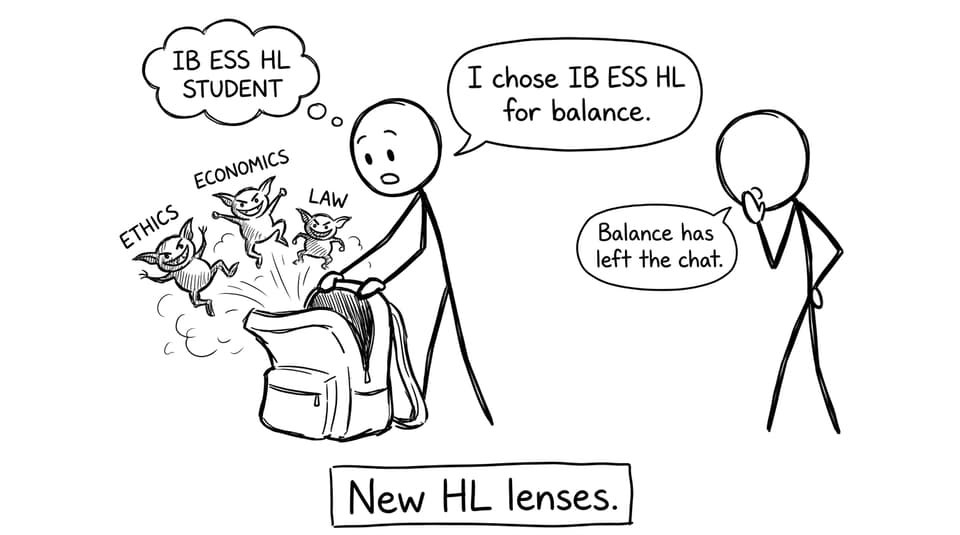
HL adds new “lenses” like environmental law, ethics, and economics.
-
The course leans harder into systems thinking and sustainability decisions.
-
Assessment still includes exams and an IA, but expectations are more explicitly skills-based.
For the full hub of aligned resources, start with IB Environmental Systems and Societies Resources.
SL vs HL: what changed for IB ESS?
The headline update to IB ESS is simple: you can now take ESS at HL. That matters because it changes the type of thinking you’re rewarded for.
SL and HL still share the core environmental foundations (ecosystems, biodiversity, pollution, human-environment interactions, sustainability). But HL goes further by asking you to evaluate environmental decisions through additional lenses, including law, ethics, and economics.
If you want a focused breakdown (and how to aim for top marks), read How to Score a 7 in IB ESS (2025 onward) and browse the All IB ESS posts when you need targeted refreshers.
Systems thinking becomes the default (not the bonus)
In IB ESS, memorising definitions is still useful, but it’s no longer the whole game. The updated syllabus emphasises systems thinking: boundaries, feedback loops, and unintended consequences.
A practical way to revise is to turn every topic into three questions:
-
What are the storages and flows?
-
Where are the feedback loops?
-
Which stakeholders “win” or “lose” under different strategies?
To study this way, use Approaches to Environmental Systems and Societies in IB alongside RevisionDojo’s Study Notes, Flashcards, and AI Chat to test whether you can explain links, not just labels.
Practical skills and assessment: what to prepare for
The new direction of IB ESS makes skills more visible: interpreting data, evaluating methods, and applying real-world case evidence.
Your IA remains a major chunk of your grade (25% at SL, 20% at HL), and it rewards originality, good-quality data, and calm evaluation language. RevisionDojo’s tools make this easier to manage:
-
The IB ESS IA Grader (great for self-checking drafts)
And when you’re ready to switch from learning to scoring, use the Questionbank, Mock Exams, and Predicted Papers on RevisionDojo to practise under time pressure.
FAQ
When does the new IB ESS syllabus take effect?
The updated IB ESS syllabus begins teaching from August 2024, with first assessments in May 2026. That timeline matters because it changes which students are examined on the new structure. If you are sitting exams in 2026, you should assume you’re on the new pathway unless your school confirms otherwise. The safest move is to align your revision to the new syllabus topics and skill emphasis early. That reduces the risk of studying content that won’t be assessed. RevisionDojo’s IB Environmental Systems and Societies Resources is the easiest “single source of truth” to keep you on track.
Is IB ESS now available at HL, and what does that change?
Yes, IB ESS now includes an HL option for the first time. The biggest difference is not just “more content” but more structured evaluation through additional lenses like environmental ethics, economics, and law. That means HL responses often need clearer stakeholder framing and more explicit justification of strategies. It also means your examples and case studies should be adaptable to debates, not just descriptions. If you’re unsure how HL-style answers read, RevisionDojo’s Study Notes and AI Chat can help you practise turning facts into arguments. You can also build confidence with HL-aligned practice in the Questionbank.
Has the ESS IA changed in what examiners want?
The IA still rewards good science and clear communication, but in IB ESS the expectations are increasingly explicit: real data, transparent method choices, and honest evaluation. Examiners care about whether your conclusion matches your evidence, and whether you understand limitations without panic or padding. A strong IA reads like a thoughtful investigation, not a perfect one. Start by choosing a focused topic and a realistic data plan, then write with the rubric in mind from day one. RevisionDojo supports this with the IB Environmental Systems and Societies (ESS) IA Guide and the IB ESS IA Grader to spot weaknesses early.
Closing: turn the update into an advantage
The 2025 onward shift in IB ESS is a reminder that the subject isn’t about knowing everything -- it’s about seeing what connects, what changes, and what trade-offs matter. If you revise with systems thinking, practise decision-style questions, and build IA skills steadily, the new syllabus can actually feel more predictable.
To study smarter, use RevisionDojo’s updated IB ESS hub, then layer in Study Notes, Flashcards, AI Chat, the Questionbank, Grading tools, and Mock Exams to convert understanding into marks: IB Environmental Systems and Societies Resources.
