


The question every literature student quietly asks
In the first week of revision season, most students don’t panic because they can’t read. They panic because they can’t tell what counts as analysis. You highlight a line, write “imagery” in the margin, and still feel like you’re describing the text instead of thinking with it.
That’s why the comparison between IB English and A-Level English keeps coming up. Both courses teach you to argue, to evidence, to write under pressure. But they train different muscles. One leans toward building a wide-angle lens on meaning; the other sharpens a microscope.
If you’re an IB student preparing for exams, this matters for a simple reason: the kind of “deep critical analysis” your course rewards is the kind you should practice.
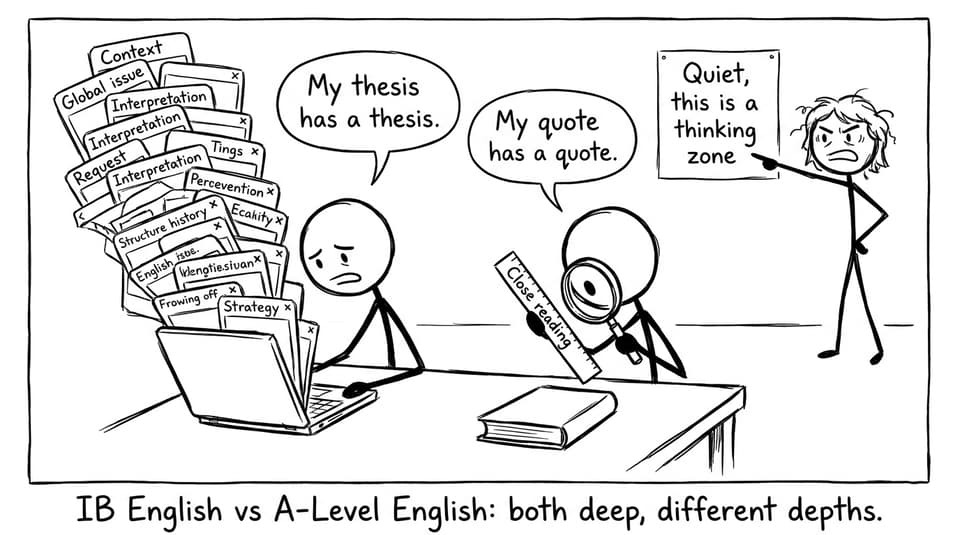
Quick comparison checklist (save this before you scroll)
Use this as a fast decision map for what “deeper critical analysis” means in each system.
-
Curriculum feel
-
IB English: global, comparative, interpretive
-
A-Level English: text-specific, tradition-heavy, precision-first
-
-
What analysis usually looks like
-
IB English: meaning + context + multiple interpretations
-
A-Level English: close reading + technique + structured argument
-
-
Assessment pressure points
-
IB English: oral + timed papers + synthesis across works
-
A-Level English: exam essays + coursework emphasis (board-dependent)
-
-
Best suited for
-
IB English: students who like connecting ideas across culture, ethics, and politics
-
A-Level English: students who thrive on focused textual mastery and tightly defined responses
-
If you want an exam-focused plan for IB English, keep this open: Preparing for IB English A: Literature Exams.
What “deep critical analysis” really means (and why definitions matter)
Students often use “deep” to mean “complicated.” Examiners usually mean something more practical: your interpretation is precise, defensible, and aware of alternatives.
In IB English, that depth is frequently demonstrated by:
-
making an interpretive claim that goes beyond plot or theme
-
showing how authorial choices create meaning
-
linking meaning to a wider human concern (a “global issue” in the IO sense)
-
acknowledging complexity (tension, ambiguity, irony) rather than forcing a neat answer
A-Level English can absolutely reach that level too, but it often gets there via a different route: sustained close reading, conceptual frameworks, and highly disciplined essay structure.
The best question is not “Which course is harder?” It’s “Which course repeatedly trains the habit of analysis that I want to own?”
IB English: how it trains deeper critical analysis
IB English builds analysis by expanding the frame
A useful way to picture IB English is this: you are rarely rewarded for seeing only what is happening on the page. You’re rewarded for explaining how meaning travels between text, reader, and context.
That’s why comparison is baked into the course design. Even when you’re focused on a single extract, the skill you’re building is transferable: interpretive agility.
If you’re studying Language and Literature, start with the hub that organizes skills and resources: IB English A Lang & Lit Resources. If you’re in Literature, this overview helps you navigate what to practice: IB English A Lit Resources.
IB English uses assessment to force independent thinking
The big reason many students experience IB English as “deeper” is the assessment mix. You don’t just write essays. You also speak your analysis, defend it, and connect it to a wider issue.
For Literature students, the structure is made explicit in RevisionDojo’s topic guidance, including:
Here’s what that assessment mix does to your brain (in a good way): it makes you practice synthesis. You learn to carry an idea across extracts, across works, and across contexts without losing precision.
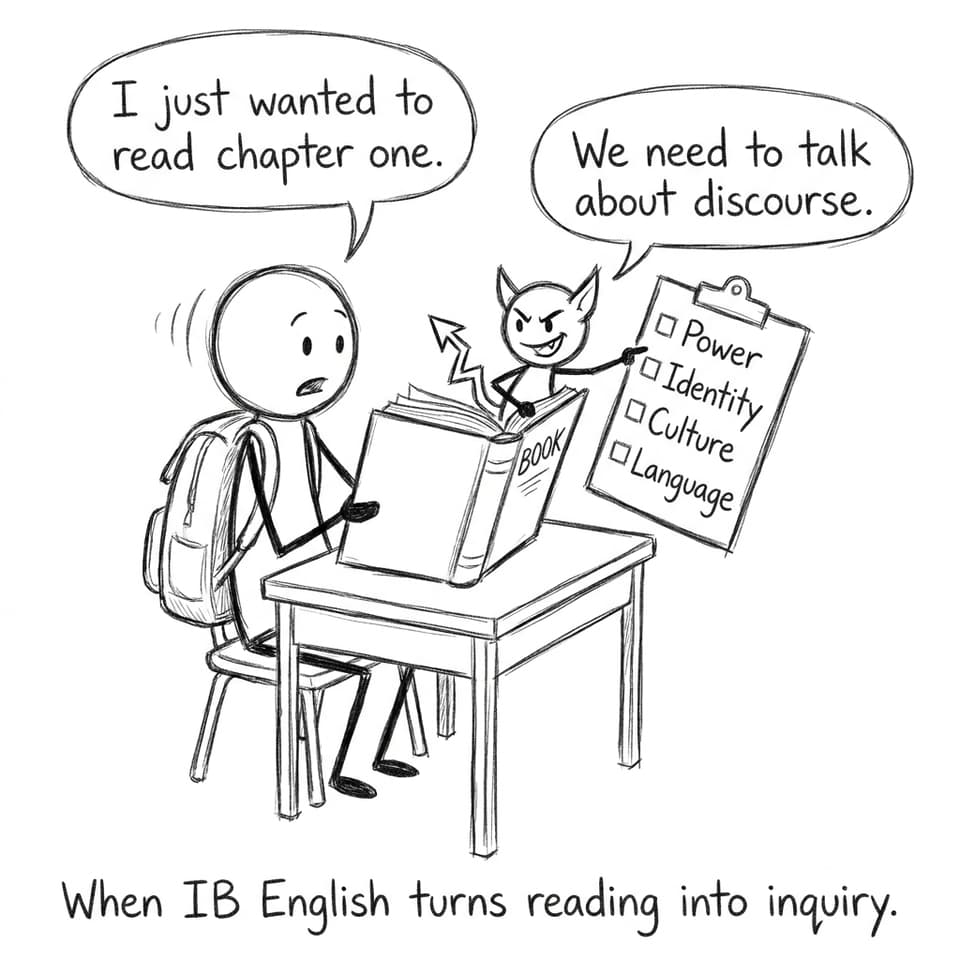
IB English rewards “interpretation with receipts”
Students sometimes hear “personal response” and assume it means “opinions.” In IB English, personal response is only powerful when it’s anchored in textual evidence and shaped by a clear line of reasoning.
A practical way to train this is to use targeted practice rather than vague rereading. The IB English A Lang & Lit Questionbank is built for that: you can drill by paper type, get feedback, and learn what your paragraphs are missing.
A-Level English: where its analysis goes deepest
A-Level English turns close reading into a craft
A-Level English is often at its best when it teaches you to slow down. Not just to notice a metaphor, but to show how a metaphor interacts with structure, voice, tone, and argument.
That kind of training is real critical analysis. It’s just a different flavor than IB English. Many A-Level students learn to build essays that are extremely controlled: fewer leaps, more proof.
In other words, A-Level analysis can feel like: precision first, interpretation second.
A-Level English often rewards mastery of a set path
Depending on the exam board and school approach, A-Level English can become very efficient: you learn the text deeply, learn the typical question types, and practice shaping responses in a predictable structure.
That predictability can be an advantage. But it may also reduce how often you practice generating your own interpretive framework from scratch. That’s one reason IB English tends to feel more “open” and, for many students, more conceptually demanding.
So which teaches deeper critical analysis?
If “deeper” means a broader, more flexible critical lens, IB English usually has the edge because it repeatedly trains:
-
comparing viewpoints
-
connecting text to context without flattening it
-
defending interpretations in both writing and speaking
-
recognizing that multiple readings can be valid, but not equally supported
If “deeper” means technical precision and sustained close reading, A-Level English may feel deeper because it can train:
-
extremely detailed textual commentary
-
tightly controlled academic argument
-
confident use of critical vocabulary and frameworks
For IB students preparing for exams, the key takeaway is simple: you win marks by demonstrating the kind of depth your course defines. For IB English, depth is usually “interpretive clarity + complexity + evidence,” not just technique spotting.
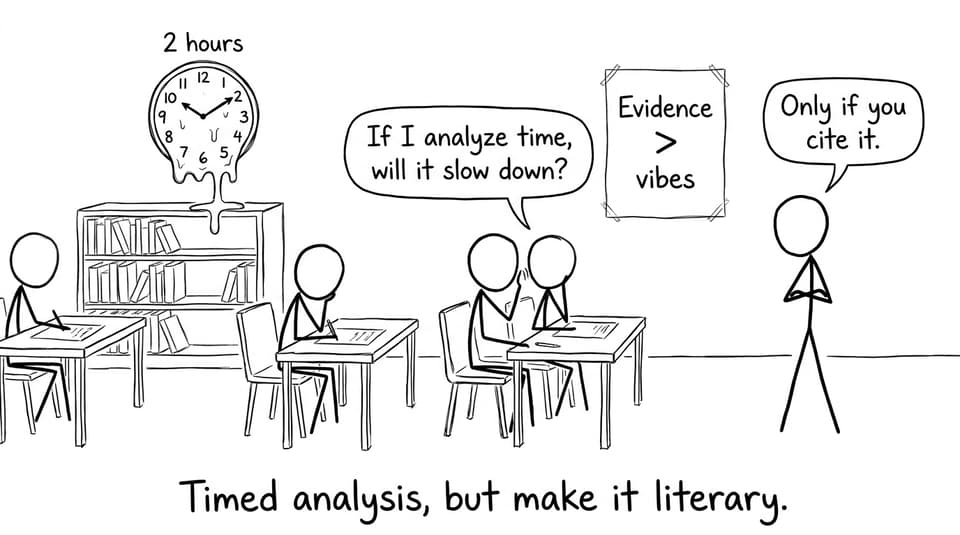
How to turn IB English depth into exam marks (a simple routine)
Here’s a routine you can run weekly for IB English that stays measurable.
Build a “two-paragraph depth” habit
-
Pick one skill target (for example: “link technique to global issue”)
-
Write two timed paragraphs (15 minutes each)
-
Underline your interpretive claim in each paragraph
-
Highlight your evidence (quotes or precise moments)
-
Add one sentence that addresses an alternative reading
If you need a stronger note system to support this, use: Effective Note-Taking Strategies for IB English Language and Literature.
Use RevisionDojo to close the loop
A lot of students “revise” by collecting information. Critical analysis improves faster when you practice and get feedback.
RevisionDojo is designed around that loop:
-
Study Notes to clarify concepts fast: Study Notes
-
Flashcards to keep key authorial choices, quotes, and frameworks retrievable
-
Questionbank to practice under exam conditions: Questionbank
-
AI Chat to quickly debug confusion without losing an hour
-
Grading tools to see what your writing is missing in rubric terms
-
Predicted Papers and Mock Exams to train stamina and decision-making: IB Predicted Papers
-
Coursework Library to reduce background stress when deadlines stack
-
Tutors when you want a human to pinpoint what’s holding your analysis back
If you want a broader look at how the platform fits together, this is the clean overview: RevisionDojo App: The Smarter Way to Prep for IB Exams.
FAQ
Does IB English actually teach deeper critical analysis than A-Level English?
Often, yes, but the “why” matters. IB English pushes you to justify interpretation across contexts, not just identify techniques. The Individual Oral in particular forces you to connect a text to a wider issue and defend your reasoning out loud, which quickly exposes shallow thinking. In timed papers, you’re rewarded for making a conceptual argument that stays grounded in evidence. A-Level English can reach the same depth, especially with strong teaching and ambitious students, but it may emphasize a narrower set of texts and more predictable response structures. For many students, IB English feels deeper because it repeatedly trains interpretation as a skill, not content as a list.
How can I show “deeper critical analysis” in IB English exam essays?
Start by writing fewer points but developing each one further. In IB English, depth usually means you can explain how a choice creates meaning and why that meaning matters in the broader argument of the text. Use evidence precisely: short quotations, specific moments, and clear references to structure. Then add one layer many students forget: acknowledge tension, ambiguity, or an alternative reading and explain why your interpretation still holds. This makes your argument feel less like a template and more like genuine thinking. Finally, practice under time using tools like the IB English A Lang & Lit Questionbank so depth becomes something you can reproduce on command.
I’m good at spotting techniques, but my analysis still feels shallow. What should I do?
Technique spotting is a starting line, not the finish. The fix is to build a habit of writing “because” sentences: “This choice matters because…” and then connecting it to a larger claim about character, power, identity, or perspective. In IB English, you also need to move between micro and macro: zoom into a word or image, then zoom out to the text’s overall meaning. Another helpful step is to practice one alternative interpretation per paragraph, even if it’s brief, because it forces you to think in layers. If your notes are part of the problem, tighten your system with Effective Note-Taking Strategies for IB English Language and Literature. And if you want feedback fast, RevisionDojo’s Grading tools and AI Chat can show you whether your paragraph has an actual argument or just commentary.
Closing: choose the depth your exam rewards
If you’re preparing for exams, you don’t need a philosophical winner between systems. You need clarity. IB English tends to teach deeper critical analysis by repeatedly asking you to connect interpretation, context, and evidence in ways that hold up under questioning. A-Level English often builds extraordinary precision through close reading and controlled essay craft.
Your advantage as an IB student is that depth is trainable. Build a weekly loop: learn with RevisionDojo Study Notes, retain with Flashcards, practice with the Questionbank, and rehearse under pressure with Predicted Papers and Mock Exams. If you do that consistently, IB English stops feeling like an abstract subject and starts feeling like a skill you can rely on in any exam room.
For more targeted guidance and practice pathways, browse: All IB English Posts.