
Starting the Diploma Programme can feel like being handed six subjects, three core components and dozens of deadlines at once. The reassuring truth is that they do not all arrive at once.
The IB diploma timeline usually moves through four stages: building foundations in DP1, beginning major coursework, using the break between years wisely, and completing assessment in DP2. Your school controls its internal calendar, so exact months vary. The sequence, however, is broadly predictable.
Understanding that sequence matters because IB pressure often comes from overlap. A draft, a test and a CAS reflection may each feel manageable. Put all three in the same week, and the experience changes.
The IB Diploma explained in one checklist
A full Diploma Programme student normally takes six subjects, generally three at Higher Level and three at Standard Level, alongside the DP core:
- Theory of Knowledge (TOK): exploration of how knowledge is produced, justified and challenged
- Extended Essay (EE): an independent research project culminating in an essay of up to 4,000 words
- Creativity, Activity, Service (CAS): sustained experiences and reflection outside normal academic study
Your final diploma score can reach 45 points. Six subjects contribute up to 42 points, and TOK and the Extended Essay together can add up to three core points. CAS does not add points, but must be completed. Reaching 24 points is the basic threshold, although additional passing conditions mean that 24 is not an automatic guarantee.
| Stage | Main focus | Best action |
|---|---|---|
| Early DP1 | Adjust to six subjects and begin CAS | Build routines and diagnose weak areas |
| Later DP1 | Start TOK assessment, EE research and some coursework | Record school deadlines in one calendar |
| DP1-DP2 break | Consolidate content and advance approved projects | Finish defined tasks |
| Early DP2 | Complete major drafts and deepen exam preparation | Work backwards from internal deadlines |
| Final DP2 | Submit remaining work and prepare for examinations | Shift to timed application |
| After examinations | Await results and review options | Follow your coordinator's instructions |
For the opening weeks, read What to Expect in Your First Month of the IB Diploma.
Early DP1: build the system before the workload grows
Teachers introduce course expectations, assessment language and the difference between SL and HL depth. Early tests reveal gaps, but also provide evidence about how your study methods perform.
Your priority is not perfect notes. It is a repeatable weekly system:
- Review each subject within a few days of the lesson.
- Convert important ideas into retrieval questions or Flashcards.
- Practise applying knowledge through a Questionbank.
- Record errors and revisit them after one week.
- Reserve a regular block for CAS administration.
Suppose you score 11 out of 20 on a chemistry test. Recording only 55% tells you little. Instead, divide the lost marks: four from incomplete explanations, three from calculations and two from misunderstood content. Next week can then include a calculation set, a written-response exercise and targeted concept review. That is how a score becomes a plan.
RevisionDojo's Study Notes and Flashcards support review, while AI Chat can help unpack difficult concepts. Grading tools can help identify where an answer does not meet the command term.
Use this guide to set realistic goals for your first IB term.
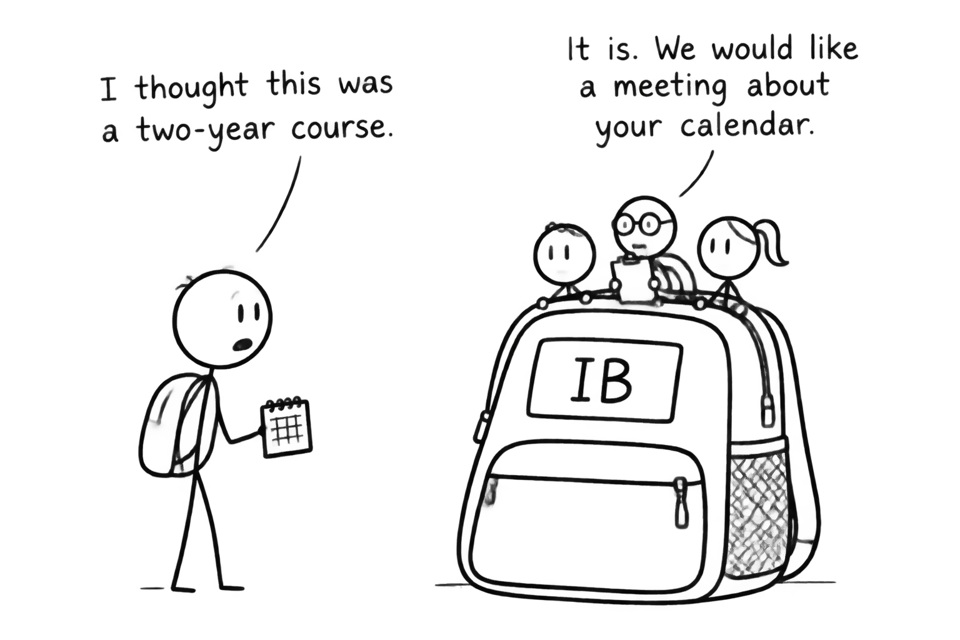
The calendar often becomes the most important item in the bag.
Mid-to-late DP1: the core becomes real
During DP1, the core becomes a collection of active projects. Schools set their own milestones, so your coordinator's calendar is authoritative.
TOK commonly develops through classroom discussion before students prepare the exhibition and, later, the prescribed-title essay. The exhibition is internally assessed and moderated, while the essay is externally assessed. Your school may complete the exhibition in DP1 or schedule it elsewhere.
The Extended Essay usually begins with subject exploration, preliminary reading and a workable research question. Students assessed from May 2027 onward follow the updated EE course, so use guidance for your examination session rather than an older checklist. The DP1 goal is not simply thousands of words. It is a focused question, credible sources, a planned argument and productive supervisor meetings.
CAS should be sustained across the programme rather than compressed into a final burst. Keep evidence and reflections current, explaining learning, choices and challenges rather than merely listing events.
Give core work recurring appointments: 25 minutes of EE reading on Tuesday, 15 minutes updating CAS evidence on Thursday, and 40 minutes developing a TOK task on Saturday. Adapt these blocks to your school's expectations. For the wider picture, see How to Use a Planner That Fits the IB Workload.
Internal assessments follow your school's calendar
Many subjects contain internally assessed work, often called IAs, although tasks and weightings depend on the subject guide. Teachers mark this work before samples are moderated by the IB. Some courses use oral, practical, investigative, performance or project-based components instead of conventional written investigations.
Distinguish school deadlines from IB submission deadlines. Students normally submit much earlier so teachers have time for authentication, permitted feedback, marking and administration. An unofficial date online should never override your teacher's instructions.
If your mathematics exploration is due on 10 February, you might schedule a complete draft four weeks earlier, analysis two weeks before that, and initial exploration another two weeks earlier. Working backwards turns one intimidating date into visible actions.
Use an IB IA deadline term-by-term planner to map overlap. RevisionDojo's Coursework Library can help clarify structure and standards, while Tutors can provide guidance within academic-integrity boundaries. The work and final decisions must remain your own.
The break between DP1 and DP2 is a bridge
The break lets you consolidate understanding without regular lessons. It is not an invitation to complete the second year alone.
Choose bounded outcomes: organize EE sources, complete an approved draft section, revise two weak units and update CAS records. “Revise biology” is vague. “Complete 30 cell-respiration questions, correct every error and make ten Flashcards” can be scheduled and checked.
A balanced weekly plan might include:
| Weekly commitment | Example task |
|---|---|
| Two 60-minute blocks | EE research or an approved draft milestone |
| Three 30-minute blocks | Retrieval and mixed subject questions |
| One 30-minute block | CAS evidence and reflection |
| One flexible block | Coursework planning or unresolved DP1 content |
Leave genuine rest in the plan. A schedule assuming maximum productivity every day is unlikely to last. If the EE is your main task, explore how to balance Extended Essay research with other commitments.
DP2: deadlines converge and priorities narrow
Early DP2 often feels different because long-term work becomes final work. Coursework, oral assessments, TOK, the EE and subject tests may overlap. University applications can add another calendar.
Each Sunday, list tasks by deadline, consequence and next action. “Work on EE” is not specific enough. “Evaluate source five and write 250 words comparing its evidence with source three” is.
Revision should also become cumulative. Continue learning current units, but revisit DP1 material through spaced retrieval and mixed questions. RevisionDojo's Questionbank can expose gaps, while Predicted Papers and Mock Exams offer assessment rehearsal. Treat predicted material as practice, not a promise about what the IB will ask.
If your recent mathematics scores are 62%, 68% and 71%, improvement is encouraging. But if functions improved while probability remained weak, target probability rather than repeating everything evenly.
For a school-level view, consult IB DP Timetabling: A Two-Year Plan That Works.
Final examinations and results
As examinations approach, move from creating resources to using them. Timed questions, complete papers, mark analysis and correction become more valuable than repeatedly rewriting notes.
Build stamina gradually: attempt one timed section, combine sections, then complete full Mock Exams under conditions your school recommends. Classify lost marks as knowledge, interpretation, method, timing or communication errors. Use that evidence to decide what to practise next.
Results follow marking and grade-award procedures, with access normally coordinated through your school. For questions about remarks, retakes or university conditions, contact your coordinator. Options and deadlines depend on your session and circumstances.
Your timeline needs checkpoints, not constant panic
Important IB work grows quietly. The solution is not constant urgency, but noticing the right things early: establish routines in DP1, map coursework deadlines, use the break for defined outcomes, and shift towards timed application in DP2.
RevisionDojo brings together the Questionbank, Study Notes, Flashcards, AI Chat, Grading tools, Predicted Papers, Mock Exams, Coursework Library and Tutors to support those stages. Explore RevisionDojo for IB DP1 Students, then choose the resource that addresses your next concrete task. A useful timeline does not do the work for you. It makes the next step clear.