



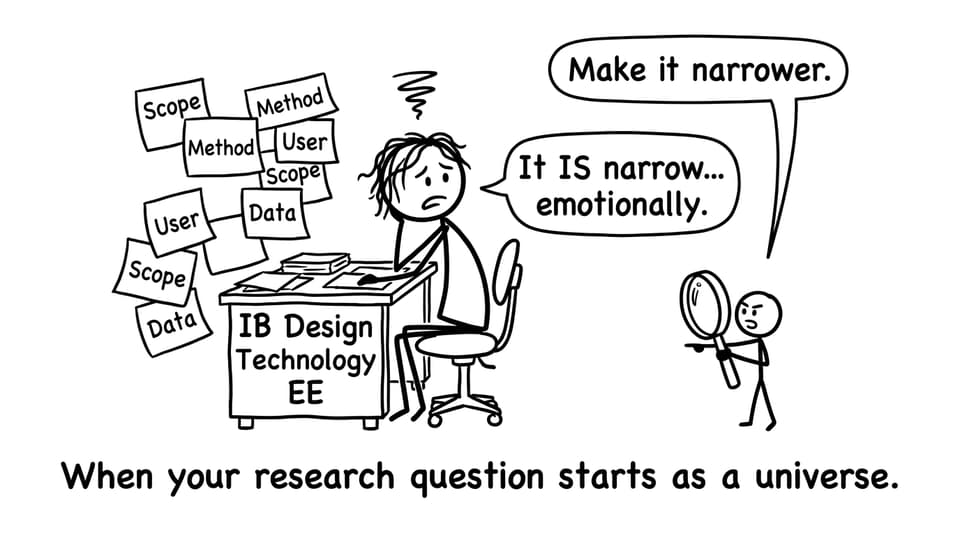
If you have ever stared at a blank document titled IB Design Technology Extended Essay and felt your brain quietly exit the room, you are not alone. The hardest part is not writing 4,000 words. It is choosing an IB Design Technology question that is narrow enough to answer, rich enough to analyse, and practical enough to support with evidence.
High-scoring EEs tend to feel simple from the outside. But that simplicity is usually the result of one good decision early: a topic built around a real design problem, a defined user, and a method you can actually carry out.
Want a strong starting point? Keep the IB Design Technology home base open as you brainstorm: IB Design Technology Resources.
A quick checklist for an IB Design Technology EE topic that scores well
Before you commit to a title, run your idea through this filter:
-
One clear user group (not “everyone”).
-
One context (a specific environment, age group, or constraint).
-
One measurable outcome (time, comfort rating, strength, waste, cost, energy use).
-
A method that includes primary data (tests, surveys, interviews, usability trials).
-
Enough credible sources for secondary research (materials science, ergonomics, sustainability, design theory).
If you need help turning a big interest into a precise research question, the broader EE structure guidance on RevisionDojo is useful: IB Extended Essay Guide Hub.
IB Design Technology EE topic ideas by theme
These IB Design Technology ideas are phrased like research questions. Treat them as templates you can personalise.
Sustainability and materials (high-scoring because you can test)
-
To what extent can biodegradable polymers match conventional plastic for a specific packaging requirement (e.g., moisture barrier for snacks)?
-
How does using recycled vs virgin material affect strength-to-weight ratio in a small furniture component?
-
To what extent does modular design reduce electronic waste for a chosen consumer device category?
For syllabus-aligned terminology (so your writing sounds like DT, not a general blog), build definitions early and revise them often. RevisionDojo helps you do that with structured content inside the IB Design Technology Resources hub.
Human factors and ergonomics (high-scoring because users create data)
-
To what extent do ergonomic changes to a student study setup improve perceived comfort and productivity (measured with a simple survey + timed task)?
-
How effectively can anthropometric data inform the redesign of seating for one public space (bus stops, school library, etc.)?
-
To what extent does applying universal design principles improve usability for a specific group of users?
If you want exam-style clarity on how to write and apply concepts (not just describe them), RevisionDojo’s DT exam writing guidance is a strong complement: What Command Terms Appear Most in IB Design Technology Exams.
Innovation and technology (high-scoring when the method is realistic)
-
To what extent does 3D printing improve prototyping access for a defined local user group (measured via time, cost, and iteration count)?
-
How effective are wearable health devices at changing one measurable behaviour (steps, posture reminders), based on user feedback and logged data?
-
To what extent can smart home energy features reduce energy use in a small household scenario model?
When you are unsure whether your DT knowledge matches the new course expectations, skim this overview and align your essay language to it: IB Design Technology Assessment: New 2027 Syllabus.
Design and society (high-scoring when you avoid being vague)
-
To what extent do cultural values shape product design choices in one urban setting (analysed through a small product sample and user interviews)?
-
How does inclusive design change access to learning tools for a specific community or school environment?
-
What role can participatory design play in improving one community-based product or service?
Classic and contemporary design (high-scoring when you compare with criteria)
-
How relevant are classic design principles in modern minimalist furniture, based on a comparison framework you define (function, manufacturability, user feedback)?
-
To what extent has biomimicry influenced product innovation in one industry category?
-
In one product category, what is the trade-off between aesthetics and function, based on user preference data?
How to refine your IB Design Technology EE topic fast
A good IB Design Technology topic usually gets sharper through subtraction.
Make the scope smaller than you think you need
Pick one material, one user group, one environment. “Sustainable packaging” becomes “biodegradable film for snack packaging in humid conditions.” The second version gives you a method.
Design your method before you fall in love with the idea
If you cannot explain your primary data plan in four sentences, the topic is probably still too broad. The best EEs feel like a calm sequence: question, method, evidence, judgement.
Use examiner-style feedback early
RevisionDojo’s grading and drafting support can save weeks of guessing. If you are building an EE alongside exam prep, it helps to keep everything connected: IB Coursework Grader and the guidance in IB EE Feedback Tool: Improve Your Extended Essay Score.
How RevisionDojo supports an IB Design Technology EE (and your exams)
A lot of students treat the EE like a separate universe. In reality, strong IB Design Technology work is one ecosystem: knowledge, terminology, application, reflection.
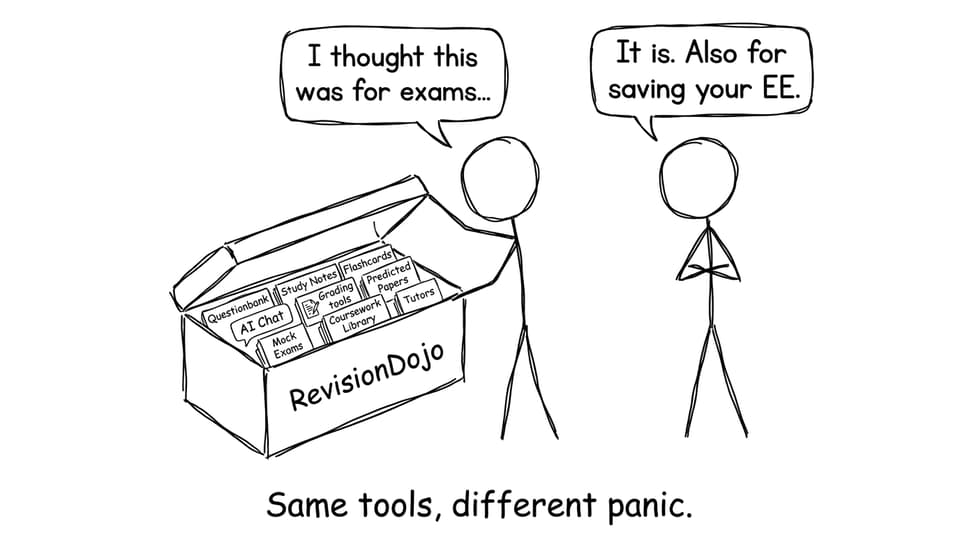
RevisionDojo is built to support that loop:
-
Study Notes and Flashcards to lock in DT theory fast.
-
Questionbank practice to keep exam technique alive while you draft.
-
AI Chat to pressure-test your research question and argument structure.
-
Grading tools to get criteria-aligned feedback before your supervisor meeting.
-
Predicted Papers and Mock Exams to stay sharp for assessments.
-
Coursework Library for exemplars and structure cues.
-
Tutors when you want a human second opinion.
If you are also trying to improve your DT study routine, pair EE work with a consistent revision system: Best Study Strategies for IB Design Technology Students.
FAQ
What makes an IB Design Technology EE topic “high scoring”?
A high-scoring IB Design Technology EE is usually built around a question you can answer with evidence, not opinions. That means you have a defined user, a defined context, and a measurable variable you can test or evaluate. Examiners reward clear decision-making: why you chose this material, why this user group, why this testing method, and what the limitations are. The strongest essays also show that you can evaluate trade-offs instead of trying to “prove” one perfect solution. Finally, your writing needs DT language and DT structure: design principles, constraints, testing, iteration, and justified evaluation. If you want to keep your terminology aligned, start from the IB Design Technology Resources hub.
Do I need to build a prototype for an IB Design Technology EE?
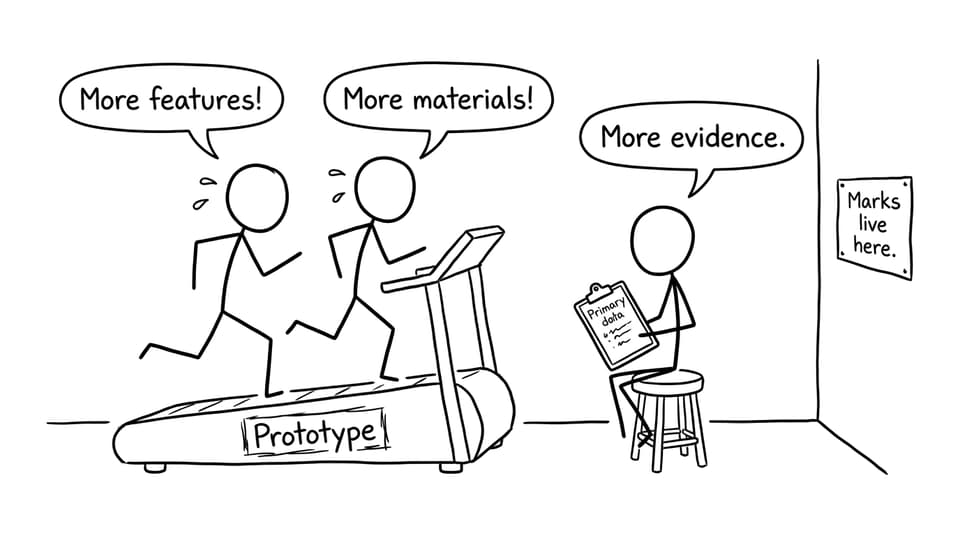
Not necessarily, and in IB Design Technology that can be a relief. A prototype can strengthen your EE, but it is only valuable if it generates useful data. Many high-quality EEs rely on smaller-scale models, material tests, usability trials, surveys, or comparative analysis with clear criteria. The risk with prototyping is spending weeks making something impressive that does not answer your research question. Instead, design your data plan first, then build only what you need to measure. If you want to practice writing evidence-based evaluation like an examiner expects, use What Command Terms Appear Most in IB Design Technology Exams.
How narrow should my research question be for IB Design Technology?
In IB Design Technology, narrow is a feature, not a weakness. If your question covers multiple materials, multiple user groups, and multiple environments, you will spend the essay describing instead of analysing. A practical test is this: can you sketch your method and data tables on one page? If not, your scope is still too big. The goal is to create a small, controlled investigation that lets you make a justified judgement with limitations clearly explained. If you want a structured way to develop the question and keep it aligned to EE expectations, use the IB Extended Essay Guide Hub and then run drafts through the IB Coursework Grader.
Closing: choose the topic that stays testable
The best IB Design Technology EE topic ideas are not the fanciest. They are the ones you can actually test, analyse, and evaluate with calm confidence.
Pick a user. Pick a context. Pick a variable. Then build your evidence like an engineer and tell the story like a designer.
When you are ready to turn a rough idea into a scoring plan, use RevisionDojo as your home base: start with the IB Design Technology Resources, lean on the IB Extended Essay Guide Hub, and get criteria-aligned feedback with the IB Coursework Grader.