
IB coordinator burnout is rarely solved by becoming more efficient at enduring an impossible workload. The durable answer is to reduce unnecessary demands, clarify responsibility, protect recovery time, and secure meaningful support from school leadership.
That is difficult because the Diploma Programme coordinator often becomes the place where every unfinished conversation lands. Assessment administration, curriculum alignment, student concerns, parent questions, teacher support, academic integrity, professional development, and examination logistics can all converge on one person.
Burnout does not mean you have stopped caring. Often, it develops because you have cared without enough recovery, authority, or institutional support for too long.
A quick coordinator burnout checklist
Consider whether several of these patterns have become normal:
- You are tired before the working day begins.
- Small requests trigger disproportionate frustration or dread.
- You feel responsible for problems belonging to the wider school.
- Strategic leadership time disappears into urgent administration.
- You check messages late because silence feels unsafe.
- Important achievements bring little satisfaction.
- Weekends are used primarily to become functional again.
- You cannot explain where your role ends.
One difficult week is not necessarily burnout. A persistent pattern of exhaustion, detachment, and reduced professional confidence deserves attention. The World Health Organization describes burnout as an occupational phenomenon arising from chronic workplace stress that has not been successfully managed. That framing matters because the workplace, not only the worker, must be part of the solution.
Why the coordinator role becomes overwhelming
The coordinator role sits between leadership and service. You may be expected to shape pedagogical direction while checking registrations, answering procedural questions, managing deadlines, supporting anxious students, and translating IB requirements for families and colleagues.
You also carry invisible work. You remember which teacher needs reassurance, which student is approaching overload, which family needs a careful explanation, and which administrative detail cannot fail. Emotional vigilance consumes energy even when it produces nothing visible on a task list.
Official IB programme standards offer a useful reality check. They describe the coordinator as part of the pedagogical leadership team and indicate that the role should have a job description, release time, necessary support, and an appropriate organizational position. Sustainable coordination is meant to be resourced. If the programme depends on unpaid evenings and constant availability, the problem is not simply time management.
For a practical view of role structure, explore the RevisionDojo guide for IB coordinators.
Separate pressure from IB coordinator burnout
Busy periods are built into the academic year. Burnout is different because the pressure does not resolve when the deadline passes.
Ask yourself three questions:
- Can I recover? Does rest restore some energy, or do you return equally depleted?
- Can I care? Are patience and curiosity still available, or has cynicism become your protection?
- Can I influence the work? Can you prioritize, delegate, or change failing processes?
The third question is easily overlooked. Coordinator workload becomes especially corrosive when responsibility is high but control is low. You may be accountable for deadlines while lacking authority over staff time, budgets, communication systems, or competing priorities.
If exhaustion affects daily functioning or accompanies anxiety, low mood, sleep disruption, or physical symptoms, speak with a qualified health professional. Burnout language should not dismiss symptoms needing clinical attention.
Map the coordinator workload
A crowded mind tends to label everything urgent. A written workload map gives you something more useful: evidence.
For two typical weeks, record work under four headings:
- Programme leadership: curriculum coherence, staff development, evaluation, and improvement planning.
- Compliance and administration: registrations, records, deadlines, procedures, and official communication.
- People support: meetings with students, families, teachers, counsellors, and leaders.
- Tasks inherited by default: cover, duplicated reporting, general administration, or work without a clear owner.
Estimate the time spent in each category. Mark every task as retain, delegate, simplify, schedule, or stop. The purpose is not to prove you are busy. It is to expose the difference between the role the school believes it designed and the role you actually perform.
Ask leadership for decisions, not sympathy
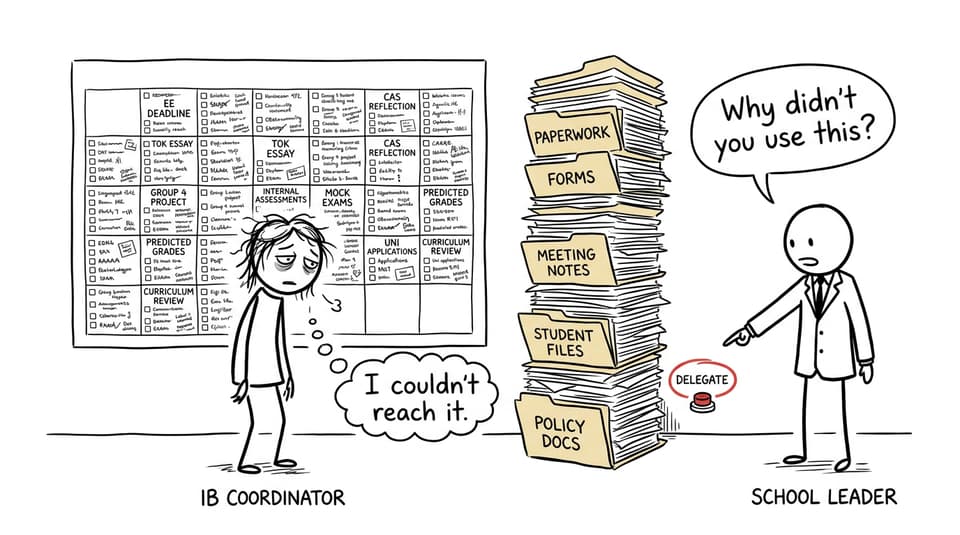
A vague conversation about feeling overwhelmed may produce kindness without change. Bring your workload map and request concrete decisions.
You might say:
“The programme requires more operational time than my allocation allows. Here are the responsibilities, weekly hours, and risks created by the gap. We need to remove work, transfer ownership, or increase protected coordination time.”
Useful proposals include:
- Protecting coordinator release time from routine cover.
- Assigning operational ownership for examination logistics or data administration.
- Supporting CAS and Extended Essay leaders appropriately.
- Creating one route for routine parent and student questions.
- Removing duplicated reporting already captured elsewhere.
- Establishing who decides when programme and school priorities conflict.
- Reviewing staffing, deadlines, and coordinator capacity each term.
This is responsible risk management, not refusal. A programme dependent on one exhausted person is fragile, regardless of that person’s commitment.
Build boundaries that survive busy weeks
A boundary works only when it changes behaviour. “I should answer fewer messages at night” is an intention. “Messages received after 6 p.m. are reviewed the next working day” is a boundary.
Choose a few rules colleagues can understand:
- Publish response times and genuine emergency channels.
- Hold office hours for non-urgent student questions.
- Batch email at two or three points each day.
- Protect one weekly block for strategic work.
- Use templates for recurring explanations while personalizing sensitive communication.
- Schedule recovery before peak periods arrive.
There will be exceptions. The purpose is not rigidity but protection from treating every request as exceptional. The same principle helps students and staff. RevisionDojo’s guide to balancing academic rigor and wellbeing explains how high expectations can coexist with humane working practices.
Reduce repeated work across the programme
Technology cannot repair understaffing, unclear authority, or an unhealthy culture. It can reduce repeated work when introduced deliberately.
A shared platform prevents each teacher from rebuilding similar revision materials, practice sets, and feedback routines. RevisionDojo helps departments establish a common cycle: diagnose a weakness, assign focused practice, review evidence, and retest. The guide to data-informed IB coordination shows how this can work across students, classes, subjects, and cohorts.
RevisionDojo brings the Questionbank, Study Notes, Flashcards, AI Chat, Grading tools, Predicted Papers, Mock Exams, Coursework Library, and Tutors into one IB-focused environment. Students can find explanations and structured practice without every question becoming a new teacher resource. Departments can share materials while retaining professional judgment over syllabus alignment, assessment, and intervention.
The important word is common. Adding a platform without retiring old systems creates another layer of work. Start with one recurring burden, such as building topic tests or identifying cohort weaknesses, and replace the existing workflow. The RevisionDojo guide for IB teachers and departments can help teams choose a focused starting point, while the IB resources hub shows the support available by subject.
Protect the person outside the role
Burnout narrows identity. You stop feeling like a person who coordinates the Diploma Programme and begin to feel like the programme itself. Every unresolved issue follows you home because it seems personally attached to you.
End the day by writing tomorrow’s first three actions, then close the list. Keep part of each week free from routine work contact. Maintain a relationship, activity, or place unrelated to school performance.
Peer support matters too. Speak honestly with another coordinator, trusted leader, counsellor, union representative, or professional network. The goal is perspective and relief from carrying confidential complexity alone. For wider school conversations, use RevisionDojo’s guidance on preventing student burnout and talking about mental health in IB.
Sustainable coordination is a programme standard
The best coordinators often make difficult systems look effortless. That competence can become a trap because hidden effort attracts more work.
Your task is not to become endlessly available. It is to build a programme that remains coherent, compliant, and humane without consuming the person leading it. That requires boundaries from you, resources from leadership, shared ownership from colleagues, and systems that reduce repetition.
RevisionDojo can serve as the programme’s academic infrastructure, giving teachers and students one place for practice, notes, feedback, coursework support, and realistic exam preparation. It cannot define your job description or conduct a difficult leadership conversation. It can remove avoidable friction, leaving more of your attention for the decisions and relationships that genuinely require an experienced coordinator.