
The moment your IA stops being “good” (and starts earning marks)
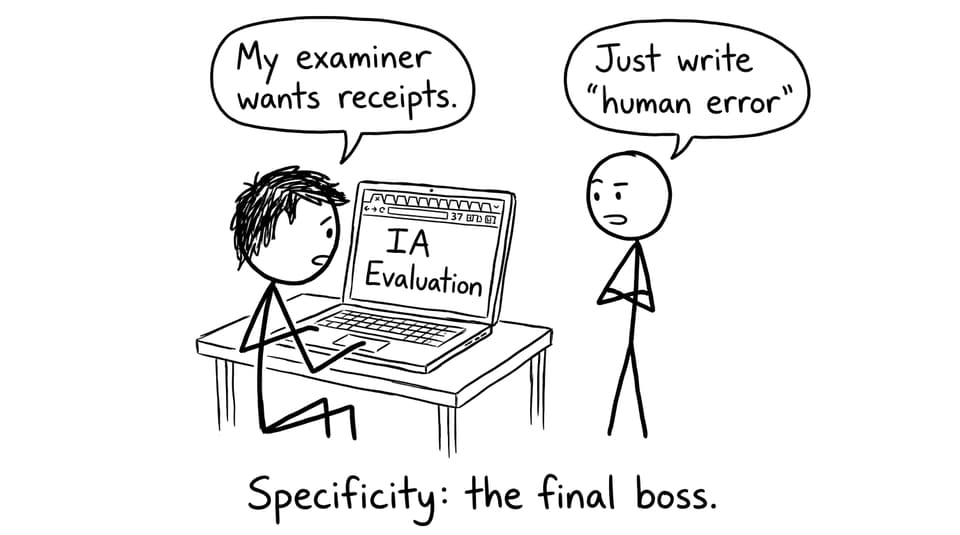
Most IA drafts don’t lose marks because the investigation was “bad.” They lose marks because the evaluation reads like a generic apology written at 1 a.m.: human error, small sample size, more trials next time. Examiners aren’t hunting for self-criticism. They’re looking for judgment.
A strong IA evaluation is the part where you prove you understand your own work: what happened, why it mattered, and what a realistic upgrade would look like. That’s how evaluation turns into marks.
IA evaluation checklist (the fast version)
Before you write, make sure every evaluation point includes:
-
A specific limitation from your IA (method, data, assumptions, measurement)
-
Impact: how that limitation changes reliability/validity and the conclusion
-
A realistic improvement that directly fixes the limitation
-
A brief, balanced judgment (what still worked and why)
If you want a longer walkthrough, keep a tab open to How to Write a Compelling IA Evaluation Section.
Relevance: tie every sentence to your IA evidence
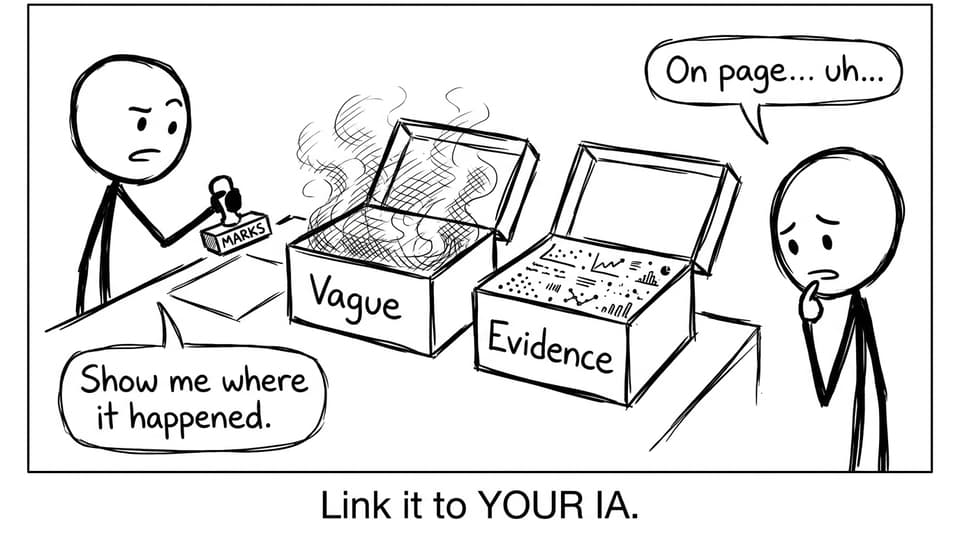
The easiest way to spot weak evaluation is this test: could you copy-paste your paragraph into someone else’s IA without changing much? If yes, it’s too vague.
In a high-scoring IA, evaluation points name the exact step, variable, instrument, assumption, or sampling choice that caused the weakness. You don’t just say “measurement uncertainty.” You say which measurement, how large the uncertainty was, and where it shows up in your results.
When you’re unsure what “counts” as relevant, anchor yourself with subject-specific criteria guidance from IB Internal Assessment Guides.
Impact: explain the consequences, not just the flaw
A limitation without impact is just description. Impact is analysis.
Try this sentence frame in your IA:
- This limitation likely caused ____, which would ____ the slope/trend/mean. Therefore, confidence in the conclusion is ____.
Notice what’s happening: you’re linking the limitation to the pattern in your data and then linking that to your conclusion. That chain of reasoning is where marks live.
If your IA is drifting long but still feels “thin,” the problem is often missing impact statements. This perspective is unpacked well in Can an IA Be Too Long? The Real IB Answer.
Balance: don’t sabotage your own IA
Many students accidentally cap their score by making their IA sound broken beyond repair. Evaluation is not a confession. It’s a professional diagnosis.
A useful rule: for every major limitation, write one sentence stating what still supports your conclusion (controls you did manage, a consistent trend, agreement with theory, or data processing that reduces noise). Balanced judgment signals control.
If you’re nervous about moderation and how your teacher’s mark travels, it helps to understand the process: How IA Moderation Works (and How to Protect Your Grade).
Improvements: make them precise, realistic, and mechanical
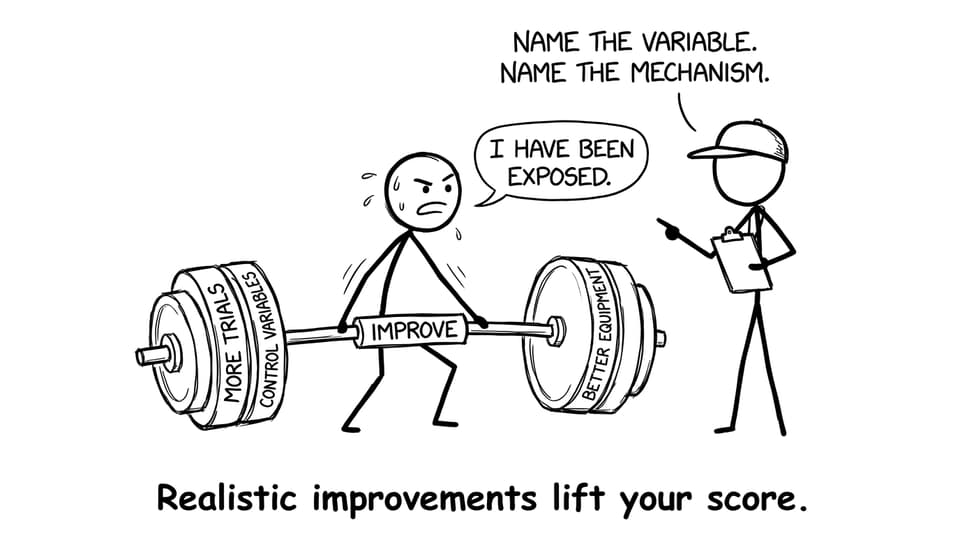
Examiners don’t reward “do more trials” unless you specify what that fixes.
A strong IA improvement has three parts:
-
Action: what you would change
-
Mechanism: how it reduces the limitation
-
Payoff: what would become more reliable/valid
Example (better than “control variables better”):
- Use a thermostatically controlled water bath to keep temperature within ±0.5°C, reducing rate variation not caused by the independent variable, improving reliability of the trend.
To pressure-test your improvement ideas quickly, RevisionDojo’s IB Coursework Grader is built for criterion-by-criterion feedback on IA drafts, and it pairs naturally with AI Chat follow-ups.
A simple structure that keeps your IA evaluation clean
Use this repeating pattern (it reads like an examiner’s checklist):
-
Limitation (specific)
-
Impact (data/conclusion)
-
Improvement (realistic)
-
Expected effect (validity/reliability)
Then do it again for your 2-4 biggest issues. Small issues don’t need paragraphs.
If you want models to calibrate what “good” looks like, browse subject exemplars such as IB Biology IA Examples, and compare the evaluation tone to your own.
The quiet goal: make your IA sound like someone worth trusting
The best IA evaluation doesn’t sound dramatic. It sounds calm, specific, and earned. You’re not trying to prove your investigation was perfect. You’re proving you understand its limits and can design a better version.
If you want a clean workflow, combine RevisionDojo’s IA Guides, Study Notes, Flashcards, AI Chat, Questionbank practice, and the Coursework Library with the Grading tools to turn evaluation into consistent marks, not a last-minute guess. Your IA deserves that level of clarity.