

Choosing an investigation can feel harder than conducting one. The possibilities are broad, but time, equipment and measurable variables are not. For a DP1 student, the best physics IA ideas produce interpretable data, connect to physics and leave room for thoughtful evaluation.
Under the IB Physics course with first assessment in 2025, the internal assessment is an individual scientific investigation. The report has a maximum length of 3,000 words and contributes 20% of the final grade at both SL and HL. Four criteria, research design, data analysis, conclusion and evaluation, are each worth 6 marks, producing a total of 24.
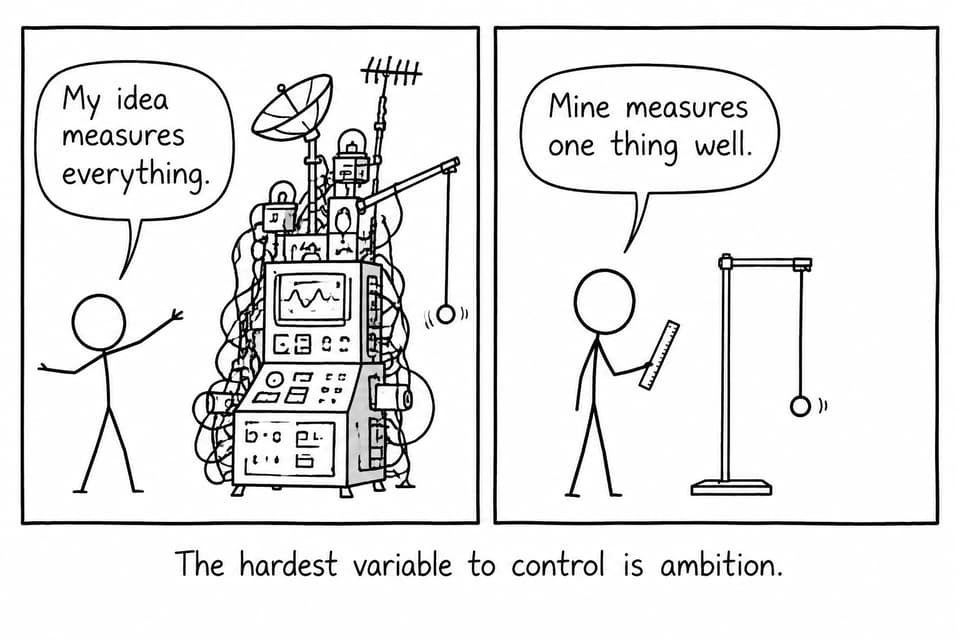
A clever topic cannot compensate for weak measurements. A modest experiment, designed carefully, often gives you more physics to discuss.
A quick checklist before choosing an idea
A promising investigation should let you answer yes to these questions:
- Can I identify one clear independent variable and one measurable dependent variable?
- Is there a physical model against which I can compare results?
- Can I collect repeated measurements across a useful range?
- Can I estimate uncertainty and manage important control variables?
- Is the equipment available, safe and precise enough?
- Can I complete a trial before committing?
- Will the analysis go beyond calculating an average?
Refining an idea is scientific thinking, not evidence that you chose badly.
Physics IA ideas organised by topic
These examples are starting points rather than ready-made research questions. Your final question should reflect your apparatus, measurement range and model. Confirm safety and practical suitability with your teacher before collecting data.
Mechanics and motion
Pendulum amplitude and period: Investigate how initial angular displacement affects a pendulum's period. Move beyond the small-angle approximation and compare measurements with an established model.
Cantilever length and oscillation: Explore how the free length of a clamped ruler or beam affects oscillation frequency. Video analysis may improve timing precision; material consistency and clamping position need control.
Mass and terminal speed: Examine how the mass or arrangement of nested paper filters affects terminal speed. Consider drag models, but verify that terminal motion is actually reached.
Ramp angle and acceleration: Test how track angle influences trolley acceleration. Wheel friction, rotational motion and angle uncertainty can make the analysis more interesting than the ideal equation suggests.
Waves and oscillations
String tension and frequency: Investigate how tension affects a string's fundamental frequency. Theory predicts frequency proportional to when length and linear density remain constant.
Air-column length and resonance: Explore the relationship between resonating air-column length and frequency. End correction, ambient noise and identifying resonance provide meaningful sources of uncertainty.
Water depth and sloshing frequency: Investigate how water depth influences oscillation frequency in a container. Control container geometry and initial disturbance; pilot the method to check measurement reliability.
Electricity and magnetism
Wire length and resistance: Determine how conductor length affects resistance. Contact resistance, heating and wire diameter create opportunities for careful experimental design.
Coil turns and magnetic field: Investigate how coil turns affect magnetic-field strength at fixed current. A sensor can simplify measurement, although probe alignment and background fields require attention.
Coil separation and induced voltage: Explore how distance between two coils affects induced electromotive force. Use a reproducible alternating input and consistent alignment to isolate distance.
Temperature and resistance: Examine how temperature changes a thermistor's or metal conductor's resistance. Allow thermal equilibrium at each temperature and record temperature uncertainty.
Energy and thermal physics
Surface colour and cooling: Investigate whether surface finish affects cooling in otherwise identical containers. Convection, conduction and radiation occur together, so avoid attributing every energy transfer to colour.
Insulation thickness and cooling rate: Explore how one material's thickness affects thermal energy loss. Control container dimensions, initial temperatures and exposed surface areas.
Solar-cell angle and electrical output: Investigate how incidence angle affects photovoltaic power output. A stable lamp is easier to control than sunlight; measure both voltage and current for .
Turn a topic into a focused research question
A topic names an area. A research question establishes a measurable relationship.
A useful template is:
How does [independent variable, range and unit] affect [dependent variable and unit] in [defined physical system], under [important controlled conditions]?
For example, “How does tension affect string frequency?” could become:
How does increasing the tension in a fixed-length steel string from 10 N to 50 N affect its fundamental frequency?
Choose the range through a pilot, not guesswork. Low tensions may produce unstable vibrations; high tensions may exceed safe operating limits. Let those findings change your design.
Explain the physical model, identify variables and justify why the system can test the relationship. RevisionDojo's IB Physics Study Notes can help you revisit the theory before choosing a method.
Design for evidence, not just completion
An experiment can generate numbers without answering its question convincingly. Five readings recorded once are vulnerable to random variation. Twenty readings without calibration or controlled conditions are not automatically better.
Use a pilot to check whether the dependent variable changes enough to distinguish the effect from measurement uncertainty. Establish practical limits, suitable intervals and the time required for repeats.
Build the design around four priorities:
- Range: Cover enough of the independent variable to reveal a trend.
- Intervals: Choose sensible spacing and sufficient distinct values.
- Repeats: Repeat where variation is expected and justify processing choices.
- Controls: Explain how significant control variables are maintained or monitored.
Record instrument resolution and uncertainty while working. Reconstructing details later is difficult. Keep a lab log, and use RevisionDojo Flashcards to review random error, systematic error and uncertainty.
Plan the analysis before collecting data
Think about your graph before the experiment. What relationship does the model predict, and what transformation would test it?
If theory suggests , plotting against may produce a linear relationship. Alternatively, a log-log graph can help estimate a power-law exponent. Do not linearise automatically; explain why the transformation follows from the physics.
Include processed data, units, uncertainties and appropriate graphs. Use error bars, gradients and uncertainty propagation when they help answer the question. RevisionDojo's Questionbank supports graph-interpretation practice, while its AI grading tools can prompt you to inspect explanations for gaps.
An unexpected graph is not a failed IA. It may reveal an unsuitable model, uncontrolled effects or a limited valid range. Honest interpretation is stronger than forcing a straight line through inconvenient evidence.
Write toward the four assessment criteria
The criteria reward a connected chain of reasoning.
Research design concerns the question, scientific context and methodology needed to collect relevant evidence. Data analysis considers clear, accurate recording, processing and interpretation, including uncertainty. Conclusion requires an answer supported by results and comparison with accepted scientific context. Evaluation addresses methodological strengths, limitations and realistic improvements.
Avoid generic lists of human errors. Identify how each limitation affected measurements or conclusions, then propose a feasible improvement that addresses that effect.
Your teacher remains the authority on school procedures, milestones and permitted equipment. For shared data, simulations, databases or overlapping group methods, confirm compliance with the current official guide before proceeding.
A realistic DP1 preparation timeline
Early preparation means reducing uncertainty, not immediately writing the final report.
During your first term, keep a list of phenomena that raise genuine questions. Use Study Notes and AI Chat to examine the governing models. Shortlist two or three measurable ideas, discuss feasibility with your teacher and pilot the strongest approved option.
Once work begins, preserve raw data, apparatus photographs, calibration information and method changes. Distinguish original observations from corrected or processed values so another reader can follow your decisions. Note unexpected behaviour immediately rather than relying on memory when writing the evaluation.
Set aside time after analysis to check that every conclusion answers the research question and every proposed improvement addresses an identified limitation. This final review is more useful than adding another decorative graph or repeating the theory.
The goal is not to predict every problem. It is to encounter important problems early enough to solve them.
Start with one measurable question
A strong investigation begins with curiosity narrowed by constraints. Choose one relationship, test it on a small scale and let evidence shape your next decision.
RevisionDojo brings together the Questionbank, Study Notes, Flashcards, AI Chat, Grading tools, Predicted Papers, Mock Exams, Coursework Library and Tutors. Use coursework support to strengthen scientific communication and exam resources to reinforce underlying physics, without replacing your own decisions.
When you have a draft question or evaluation paragraph, create a free RevisionDojo account and ask Jojo whether your reasoning is specific, measurable and physically justified. Examine that feedback critically, then confirm important methodological decisions with your physics teacher.