
Starting an Economics internal assessment can feel strangely difficult. The world offers too much material, not too little. Every tax announcement, interest-rate decision and housing policy seems possible, yet relatively few news articles make useful commentaries.
The best economics IA ideas are narrow, recent policy stories that let you apply one clear model, use a key concept as an analytical lens and evaluate consequences for identifiable stakeholders. You do not need the most dramatic event in the news. You need an article with an economic change you can explain.
Under the Economics guide for first assessment in 2022, SL and HL students complete the same internal assessment: a portfolio of three commentaries based on published news extracts. Your teacher controls the schedule and approval process, so confirm all dates and choices with them.
Your DP1 idea checklist
Before saving an article, ask:
- Does it report a specific economic event, policy or change?
- Can I identify the relevant syllabus unit and theory?
- Can I draw at least one accurate, useful diagram?
- Does the article provide details to analyse rather than merely summarize?
- Are there effects on consumers, producers, workers or government?
- Can I evaluate the policy using evidence from the extract?
- Does the event connect naturally to one key concept?
- Is the source and publication date acceptable?
If several answers are uncertain, keep looking. Abandoning a weak article early is easier than rescuing it after 600 words.
What the IB Economics IA requires
The official guide specifies that each commentary must not exceed 800 words. The three extracts must concern different syllabus units, excluding the introductory unit, and come from different sources. A different key concept must be used for each commentary. Extracts must also have been published no earlier than one year before the commentary is written.
Each commentary is marked against five criteria:
| Criterion | What your work needs to demonstrate |
|---|---|
| Diagrams | Relevant, accurate and fully explained economic diagrams |
| Terminology | Appropriate economic language used correctly |
| Application and analysis | Theory applied directly to the article through developed analysis |
| Key concept | A clear explanation of how the concept connects to the article |
| Evaluation | Supported judgments recognizing consequences, assumptions and perspectives |
The complete portfolio also has a rubric requirement. Because school deadlines and approval processes vary, treat your teacher's instructions as operational rules alongside the official guide.
Economics IA ideas for microeconomics
Microeconomics often suits a first commentary because the affected market can be clearly defined. Prices, quantities and stakeholders are usually visible.
Indirect taxes on harmful goods
Look for a government introducing or increasing a tax on sugary drinks, cigarettes, alcohol, plastic bags or high-emission products. You could analyse higher production costs, a leftward supply shift, a higher consumer price and a lower equilibrium quantity.
Evaluation might consider price elasticity of demand, the tax's size, unintended markets, administrative costs and how revenue is used. Possible key concepts include intervention, change and sustainability.
Subsidies for beneficial goods
Articles about subsidies for public transport, renewable energy, vaccinations or education can support analysis of positive externalities. Examine how the subsidy changes costs, output and consumption.
Do not assume every subsidy succeeds. Ask whether suppliers can expand capacity, whether consumers respond to lower prices and whether the opportunity cost of government spending is justified.
Price ceilings and minimum wages
Rent controls create opportunities to discuss a maximum price, shortages, non-price allocation and effects on landlords and tenants. Existing tenants may receive lower rents while prospective tenants experience reduced availability or quality.
A new minimum wage can be analysed through labour-market demand and supply. Its effects may depend on labour-demand elasticity, the wage's position relative to equilibrium, enforcement, productivity and the time period considered.
Choose an article reporting an actual policy change rather than a general debate. The narrower the event, the more precise your analysis can become.
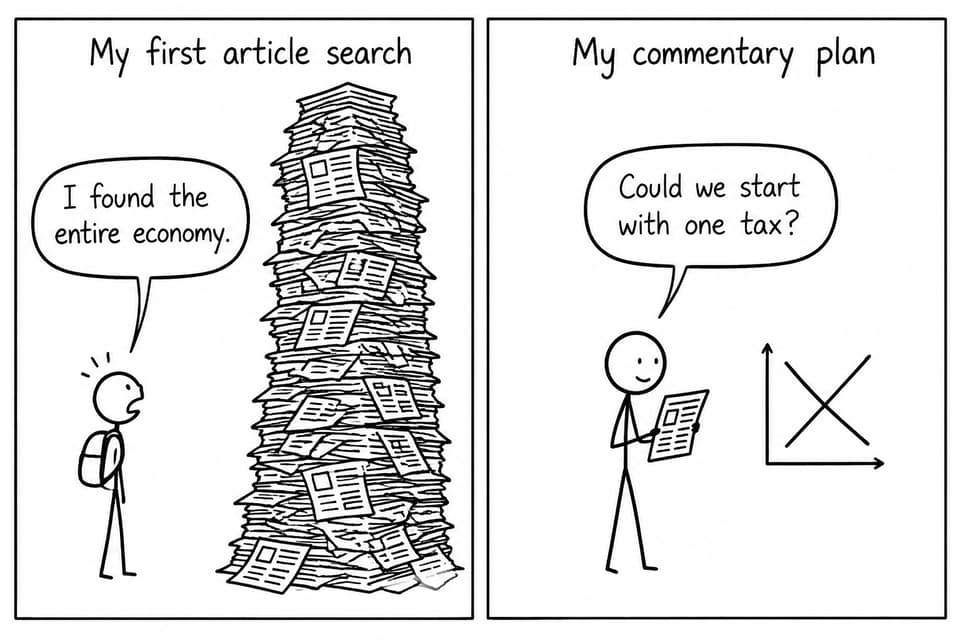
One focused policy is usually more useful than the entire economy.
Macroeconomics commentary possibilities
Macroeconomic articles can be excellent, but they often mention many variables at once. Choose one central policy and resist explaining every national problem in 800 words.
Central bank interest-rate decisions
A rate increase or reduction can support analysis through aggregate demand and an AD-AS model. Trace the causal chain carefully: interest rates influence borrowing, saving, consumption, investment and possibly exchange rates before affecting aggregate demand.
Evaluation could address time lags, confidence, indebtedness, supply-side inflation and conflicts between inflation and growth objectives. Interdependence, change or economic well-being may provide a suitable lens.
Fiscal and supply-side policies
Search for a government changing taxes, transfer payments or public expenditure. A good article identifies the measure and its intended objective, such as reducing unemployment or supporting growth. Evaluation could consider the multiplier, crowding out, public debt, delays and current economic conditions.
Training schemes, infrastructure investment and incentives for business investment can support long-run analysis. Specify how the measure might affect productivity, production costs, labour mobility or productive capacity. Then evaluate its fiscal cost and likely time lag.
Global economy ideas
Global topics become manageable when the article has an obvious policy instrument and a defined relationship between countries.
Tariffs and trade protection
A newly imposed or removed tariff offers a strong basis for analysis using a tariff diagram. Discuss changes in domestic production, consumption, imports, government revenue and stakeholder welfare.
Evaluation might examine retaliation, protected employment, higher costs for downstream firms and the difference between short-run adjustment and long-run competitiveness. Interdependence is often relevant, but develop the connection rather than merely naming it.
Exchange rates and development policies
An article about a central bank buying or selling currency may support a foreign-exchange diagram. Explain the change in currency demand or supply and connect it to imports, exports, inflation or debt. A currency appreciation makes exports more expensive to foreign buyers and imports cheaper domestically, other things being equal. Outcomes still depend on elasticities, contracts and time.
Development subjects might include targeted aid, infrastructure, microfinance or education initiatives. Avoid writing a broad essay about poverty. Identify the intervention, analyse its mechanism and evaluate whether its benefits are accessible, sustainable and fairly distributed.
How to choose between promising articles
Do not choose by headline appeal. Score each candidate against practical criteria.
| Question | Strong sign | Warning sign |
|---|---|---|
| What changed? | One identifiable policy or market event | A broad discussion with no new action |
| What can I model? | A clear diagram connected to the story | Several unrelated diagrams seem necessary |
| What evidence exists? | Prices, dates, groups or policy details | Mostly opinion and prediction |
| What can I evaluate? | Trade-offs, elasticities, periods or alternatives | An obvious, one-sided conclusion |
| Is the scope workable? | One market, measure or country relationship | An entire budget or global crisis |
Before requesting approval, complete four sentences:
- The event is...
- The economic model is...
- The main causal chain is...
- The policy's success depends on...
If sentence three becomes a collection of disconnected ideas, the topic may be too broad. If sentence four has no credible answer, the article may offer too little material for evaluation.
Turn an article into an analytical plan
Once your teacher approves the extract, annotate the event, affected market, policy objective, numerical evidence, stakeholder claims and signs of uncertainty. Then build a concise plan:
- Context: Identify the event without retelling the article.
- Theory: Define only terminology needed for the analysis.
- Diagram: Label it accurately and explain every movement shown.
- Application: Connect each analytical step to the extract.
- Key concept: Use it to interpret the event, not as an isolated definition.
- Evaluation: Compare assumptions, time periods and stakeholder outcomes.
- Judgment: State what the policy's success depends on.
A diagram is not decoration. If a tax shifts supply left, explain why costs rise, how equilibrium changes and what this implies in that market. Evaluation should also test the analysis as it develops, not appear only in a final paragraph beginning with “however.”
Common first-commentary mistakes
The first mistake is choosing a topic rather than an article. “Inflation” is a topic. A central bank raising its policy rate in response to inflation is an event you can analyse.
The second is summarizing journalism. The examiner already has the extract, so your words should add economic reasoning. The third is drawing every diagram you know. One thoroughly relevant diagram can outperform several loosely connected ones because it leaves room for explanation and evaluation.
Finally, do not treat the key concept as a label or outsource authorship. RevisionDojo's Questionbank, Study Notes, Flashcards and AI Chat can help you test definitions and causal chains. Its Coursework Library and Grading tools can support review, while Predicted Papers, Mock Exams and Tutors strengthen your wider course preparation. Your submitted commentary must remain your own work and follow your school's academic-integrity requirements.
Build the habit before the deadline
DP1 gives you a quiet advantage: time to notice economics before you need to submit it. Create a weekly article folder for microeconomics, macroeconomics and the global economy. Save stories reporting a specific change, then add one possible diagram and one evaluation question.
Most saved articles will never become commentaries. That is not wasted effort. It trains the central skill the IA assesses: seeing how theory illuminates a real event without pretending that one model captures everything.
When you have an approved candidate, use RevisionDojo to check your terminology, causal chain and evaluation questions. Verify feedback against the official guide and your teacher's advice, then keep the final reasoning and judgment unmistakably yours.