
The first mark you receive for an internal assessment can feel strangely permanent. It is written beside your work, calculated from a rubric, and awarded by the teacher who knows the subject. Yet that mark is not necessarily the final mark used by the IB.
IB IA moderation is the process through which an external IB examiner checks whether your school has applied the official assessment criteria at the correct standard. The examiner reviews a sample of student work and compares their judgement with the marks awarded by the teacher. If the school's marking is appropriately aligned, the marks are accepted. If it is too generous or too severe, the IB can adjust the marks submitted by the school.
For an IB DP1 student, the practical lesson is reassuringly simple: your task is not to predict the moderator. Your task is to produce work that clearly satisfies the published criteria, regardless of who reads it.
IB IA moderation at a glance
Here is the process in plain language:
- You complete an internal assessment under your subject's current requirements.
- Your teacher evaluates it using the official assessment criteria.
- The school submits marks and a selected sample of student work to the IB.
- An external examiner reviews the sample against the same criteria.
- The IB compares the examiner's judgement with the school's marking standard.
- The submitted marks may be accepted or adjusted.
- Your moderated IA mark contributes to your final subject result according to that subject's assessment weighting.
The precise format, criteria, marks and weighting depend on the subject and examination session. If you are still learning how coursework fits into the programme, start with the full breakdown of IB internal assessments.
Where moderation fits into the IB Diploma explained
The Diploma Programme combines externally assessed components with internally assessed work. An IA is called internal because your teacher marks it first. It is not purely internal, however, because the IB checks the school's marking through external moderation.
That distinction matters. Your teacher understands your course, watched your project develop and may have given feedback within the permitted limits. The moderator sees the submitted work and assesses how accurately the criteria were applied. Moderation creates a common standard between schools whose teachers may interpret a rubric slightly differently.
Without that check, a mark of 18 at one school might represent noticeably different work from an 18 elsewhere. Moderation is designed to make results more comparable. It evaluates the accuracy and consistency of the school's marking rather than rewarding or punishing a particular school.
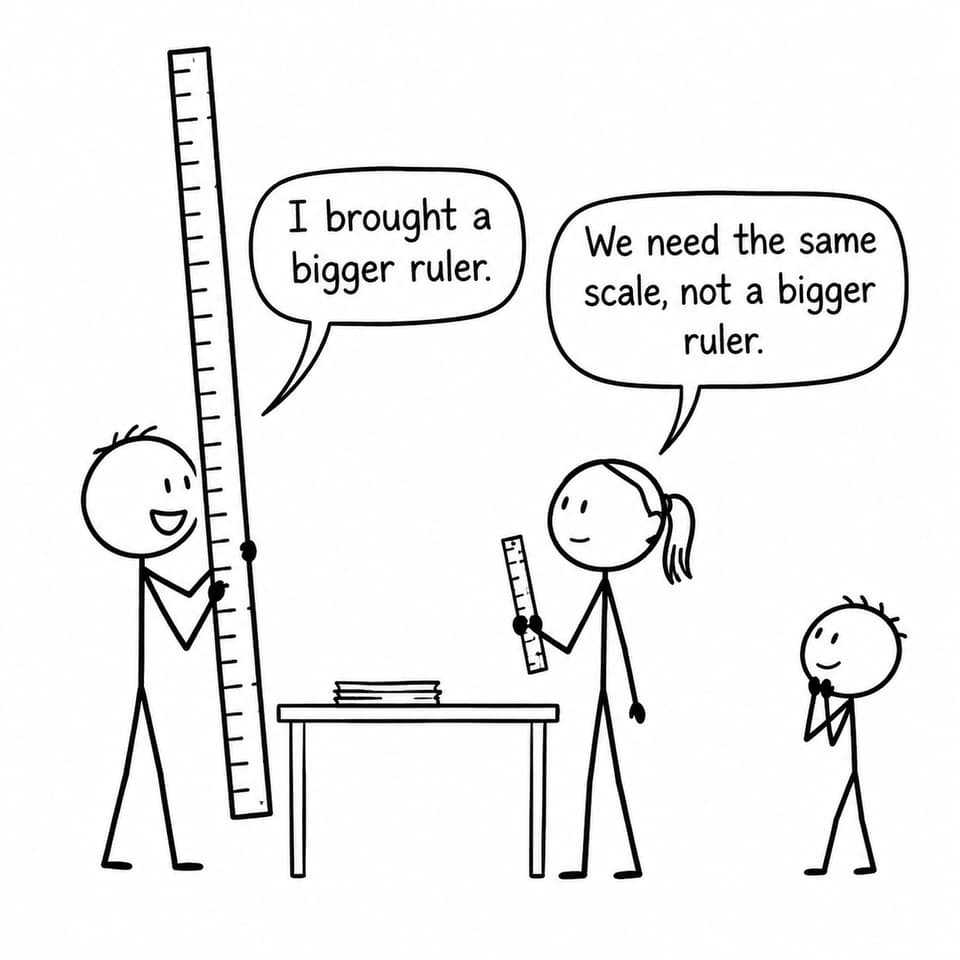
Two teachers discover that consistent measurement matters more than having the biggest ruler.
How the moderation process works
Your teacher begins by marking every IA in the class according to the relevant subject guide. Schools often conduct internal standardization before submitting marks, particularly when several teachers teach the same subject. This involves teachers comparing selected pieces of work and agreeing on how the criteria should be interpreted.
Internal standardization and IB moderation are related, but they are not identical. Standardization happens within the school. External moderation is conducted for the IB. Coordinators and teachers can learn more from the RevisionDojo guide to internal moderation.
The school then submits a sample representing work from its cohort. An examiner independently reviews the sampled work. The purpose is not simply to remark those students in isolation. The sample provides evidence of whether the teacher's marking standard is aligned with the IB standard across the submitted range.
If the differences are small and the teacher's decisions are reasonable, the marks may be accepted. If the evidence shows a meaningful pattern of generous or severe marking, an adjustment can be applied to the school's submitted marks. The exact calculation is handled by the IB, and students should not assume that any adjustment will be a simple fixed number in every case.
A simplified worked example
Imagine a hypothetical Biology class with 20 students. Their teacher submits IA marks, and selected work is reviewed externally. The following table is illustrative rather than a reproduction of the IB's calculation system.
| Sampled IA | Teacher mark | Examiner judgement | Difference |
|---|---|---|---|
| Student A | 20 | 18 | -2 |
| Student B | 16 | 14 | -2 |
| Student C | 12 | 10 | -2 |
In this simplified example, the examiner consistently judges the sampled work two marks lower. That pattern could indicate that the teacher applied the criteria too generously. The IB may therefore adjust the school's submitted marks downward to bring them into line with the expected standard.
Now imagine the differences were mixed:
| Sampled IA | Teacher mark | Examiner judgement | Difference |
|---|---|---|---|
| Student A | 20 | 20 | 0 |
| Student B | 16 | 15 | -1 |
| Student C | 12 | 12 | 0 |
This pattern suggests much closer alignment. Minor differences do not automatically mean every mark changes. Examiners are expected to judge whether the teacher's standard is reasonable, not search for reasons to reduce marks.
The important point is that moderation can leave marks unchanged, move them downward or move them upward. It is a quality-control process, not an automatic deduction.
What moderation means for your own IA
Students sometimes hear about moderation and conclude that their individual effort no longer matters because the class is adjusted together. That is the wrong lesson.
A well-supported IA still earns a stronger teacher mark and gives the moderator clear evidence of achievement. If the school's marks are adjusted, the relative quality of your work remains important. You should therefore concentrate on decisions you can control:
- Use the correct guide and rubric for your examination session.
- Translate every criterion into visible evidence in your work.
- Follow the required structure, length and academic integrity rules.
- Keep analysis connected to your research question.
- Check that conclusions follow from the evidence presented.
- Submit drafts and final work by your school's internal deadlines.
Those deadlines may be earlier than anything shown on a general IB calendar because schools need time for marking, standardization and submission. The term-by-term IA deadline planner can help you work backwards without leaving every major task to DP2.
How to make your marks moderation-resistant
No piece of work is literally immune to moderation. Still, some work is easier to mark consistently because the evidence for each criterion is explicit.
Suppose a criterion rewards evaluation. Writing more pages does not necessarily strengthen your result. A clearer approach is to identify a limitation, explain how it affects the interpretation of your findings, and propose a realistic improvement connected to that limitation. The chain of reasoning is visible. A teacher and an external examiner are then more likely to reach similar conclusions.
Use a criterion tracker while drafting. For each criterion, record:
- What the descriptor requires
- Where your work provides that evidence
- What remains incomplete
- What feedback you are permitted to act upon
RevisionDojo's rubric-aware History IA Grader, for example, can provide provisional criterion-level feedback. Such tools do not issue official marks and should never replace your teacher or current subject guide. Their value lies in helping you locate unsupported claims, weak evaluation or missing connections before submission.
For subject-specific differences, compare the criteria carefully. The IB History IA criteria guide demonstrates why students must check both their subject and examination session rather than relying on a generic IA template.
What IB DP1 students should do now
DP1 is the best time to build systems because the workload is still arriving in pieces. Begin by saving the current criteria for each subject and recording every school deadline in one place. When a teacher introduces an IA, identify the assessed skills before becoming attached to a topic.
A useful weekly rhythm combines coursework with ordinary subject learning. RevisionDojo brings that work together through its Questionbank, Study Notes, Flashcards and AI Chat. Grading tools and the Coursework Library help you compare a draft with criterion expectations, while Predicted Papers and Mock Exams support the externally assessed side of each course. When individual guidance is needed, Tutors can help clarify difficult concepts without taking ownership of your work.
The guide to starting strongly with RevisionDojo in DP1 offers a practical way to organize these tools. New students may also find the first month of the IB Diploma guide useful for understanding how coursework, CAS, TOK and subject study begin to overlap.
Moderation can sound mysterious because most of it happens after your work leaves your hands. Its purpose, however, is straightforward: a mark should mean roughly the same thing wherever it was awarded. Build work around the criteria, make your reasoning visible and let consistency work in your favour.
You can create a free RevisionDojo account to save provisional IA scores and track how they develop across DP1. That record is useful not because an early estimate is final, but because improvement becomes easier to manage when you can see it.