


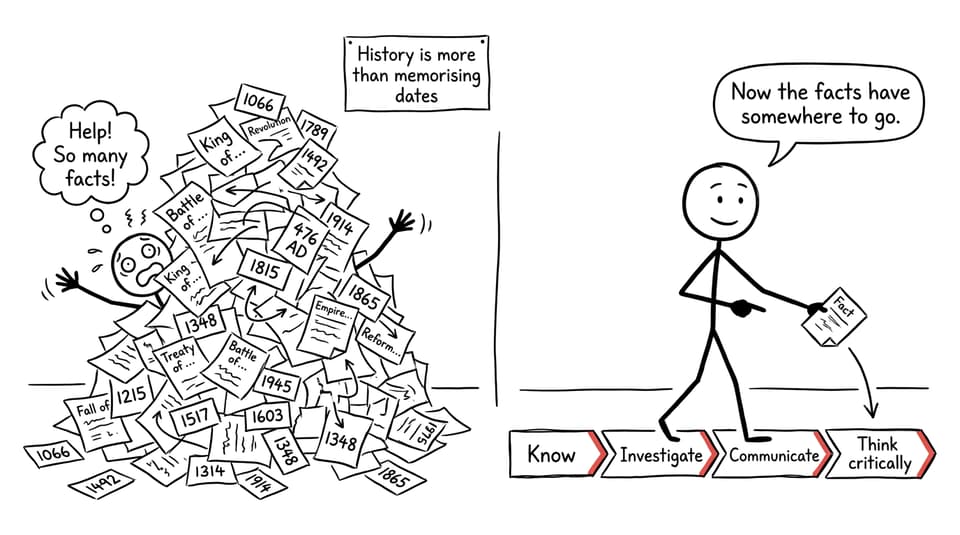
Studying History can feel deceptively simple. You read a chapter, recognise the names, and assume the knowledge is secure. Then a question asks you to evaluate why an event happened, and recognition suddenly proves less useful than it seemed.
The best answer to how to study for MYP History is to use a repeated cycle: learn a small amount, retrieve it without notes, apply it to a historical task, examine the feedback, and try again. You need factual knowledge, but the real goal is using it to explain causation, analyse sources, compare perspectives, and construct supported arguments.
Your MYP History revision checklist
A productive study system should help you:
- identify the topics and assessment criteria your school is using;
- organise events through chronology, causes, consequences, change, and continuity;
- recall essential evidence without looking at notes;
- analyse sources and answer the precise command term;
- write focused arguments, review mistakes, and repeat weak skills.
The RevisionDojo MYP History resource hub brings these stages together through Study Notes, Lessons, Flashcards, key definitions, questions, and feedback. That matters because effective revision is rarely one activity. It is a sequence.
Start with the MYP History criteria
MYP History usually sits within Individuals and Societies. Under the current MYP framework, students are assessed through four equally weighted criteria, each with a maximum achievement level of 8.
| Criterion | What your revision should train |
|---|---|
| A: Knowing and understanding | Accurate terminology, knowledge, explanations, and examples |
| B: Investigating | Focused research questions, planning, relevant evidence, and reflection |
| C: Communicating | Clear organisation, appropriate formats, and correct source documentation |
| D: Thinking critically | Analysis, source evaluation, perspectives, and supported arguments |
Schools may teach different historical units or adapt tasks to local requirements. Begin with your teacher's unit outline, task sheet, and rubric. The guide to topics covered in MYP History explains broader themes, but your classroom materials remain the final map.
Translate the relevant criterion into a visible action. “Thinking critically” is abstract. “Compare two perspectives, use evidence from both, and explain why they differ” is something you can practise.
A same-day method for studying MYP History
You can begin this method today with one topic, one blank sheet, and about 60 minutes. Do not wait for a perfect timetable.
Choose one narrow target
Select a manageable issue rather than an entire era. Choose “working conditions during industrialisation” instead of “the Industrial Revolution,” then write a guiding question such as: Why did industrialisation change urban life?
RevisionDojo's Industrial Revolution resources provide focused chapters, definitions, lessons, and questions.
Retrieve before you review
Without opening your textbook, write what you remember under five headings:
- key events and chronology;
- causes;
- consequences;
- important people or groups;
- evidence and perspectives.
Leave gaps visible. A blank area is not failure. It diagnoses what to study and forces you to produce knowledge instead of merely recognising familiar wording.
Repair only the gaps
Consult your class materials or RevisionDojo Study Notes. Correct inaccurate details and add only what helps answer your guiding question. Build a compact evidence bank containing key developments, precise examples, essential terminology, and at least two perspectives.
Use AI Chat when an explanation remains unclear, but verify its response against teacher materials and reliable sources. Try asking: “Explain the difference between a cause and a trigger in this topic, then test me with three questions.”
Build a timeline with meaning
For every event, add why it mattered. Link developments using labels such as caused, accelerated, weakened, or led to opposition. This turns chronology into causal reasoning and reveals when an essay is becoming a list rather than an argument.
Apply the knowledge
Complete one task without notes: answer a short question, evaluate a source, or plan an extended response. The MYP History Questionbank helps you move from reviewing information to producing an answer.
Check the response carefully:
- Did I answer the command term?
- Did I use accurate, precise evidence?
- Did I explain how the evidence supports my claim?
Record one error rule
Finish with one instruction for your future self:
When asked to evaluate, I will consider strengths and limitations before reaching a judgement.
Schedule a short retest two or three days later. This turns one revision session into a continuing learning cycle.
Use active MYP History revision techniques
Rereading helps when a topic is unfamiliar, but it should lead into retrieval and application. Strong MYP History revision techniques make you generate an answer, expose uncertainty, and improve it.
Turn notes into historical questions
Replace descriptive headings with questions. “The Treaty of Versailles” becomes “Why did groups disagree about the Treaty of Versailles?” Questions direct attention toward argument and perspective.
Flashcards should test relationships, not only dates. Alongside “When did this occur?”, ask “Why was this a turning point?” RevisionDojo Flashcards support recall, while Study Notes repair the gaps that recall uncovers.
Practise source analysis as a routine
Consider each source's origin, purpose, content, value, and limitations. A source is not useless because it is biased. Its bias may reveal what the creator wanted an audience to believe.
Use this sequence:
- Identify the source's main message and select a precise detail.
- Place that evidence in historical context.
- Explain how origin or purpose affects its value.
- Identify a limitation for the particular question.
- Compare it with other evidence where possible.
The RevisionDojo guide to historical primary sources explores this reasoning in greater depth.
Write arguments, not information dumps
A reliable paragraph begins with a claim, supports it with precise evidence, explains the connection, and returns to the question:
- Claim: State the factor or interpretation.
- Evidence: Provide a relevant event, policy, quotation, or statistic from your course.
- Reasoning: Explain why the evidence supports the claim.
- Link: Connect the analysis to the question or judgement.
Grading tools can identify where explanation becomes description. For larger assessments, the Coursework Library provides structural models, while a RevisionDojo Tutor can offer human guidance on persistent weaknesses.
Build a weekly MYP History routine
Consistency usually matters more than one heroic weekend. A sustainable week could include two short recall sessions, one source drill, one written response, and one review of earlier mistakes.
The MYP revision guide offers a wider planning framework, while the 30-day MYP study plan helps when several assessments are approaching.
As an assessment gets closer, combine topics and introduce realistic timing. Use Mock Exams, an exam builder, or Predicted Papers where available. These tools should test readiness, not replace learning. Review every attempt through the criteria, then return to targeted practice when a weakness appears.
Make every session produce evidence
The most useful MYP History study tips share one principle: every session should leave evidence that your thinking improved. That might be a corrected timeline, a stronger source evaluation, a rewritten paragraph, or an error you can now explain.
RevisionDojo works as the ultimate all-in-one IB resource because it keeps that progression connected. Study Notes and AI Chat clarify. Flashcards retrieve. The Questionbank applies. Grading tools diagnose. Mock Exams build stamina. Coursework resources and Tutors provide deeper support when independent revision reaches its limit.
History becomes manageable when you stop trying to hold an entire century in your head at once. Choose one question. Retrieve what you know. Repair the gaps. Produce an answer. Then make the next attempt slightly better.