
Presentation is the first thing an examiner experiences in your IB Math IA. Before they decide whether your modelling is elegant or your calculus is correct, they decide something quieter: Is this going to be easy to follow?
That decision happens fast. Not because examiners are impatient, but because mathematics is a trust exercise. Clean structure, calm formatting, and careful labels signal that you know where you’re going. And once the reader trusts the map, they stop fighting the page and start engaging with your ideas.
This guide shows you how to present a professional Math IA with confidence in the IB style: clear signposts, consistent notation, and a layout that makes your reasoning feel inevitable. Along the way, you’ll see how RevisionDojo helps you practice the skills that make your writing sound more mathematical and less like you’re apologizing for it.
Quick presentation checklist for an IB Math IA
Use this as your final 20-minute sweep before submission. In IB Math IA terms, it’s the difference between “good work” and “good work that reads like good work.”
-
One structure from start to finish (no surprise sections)
-
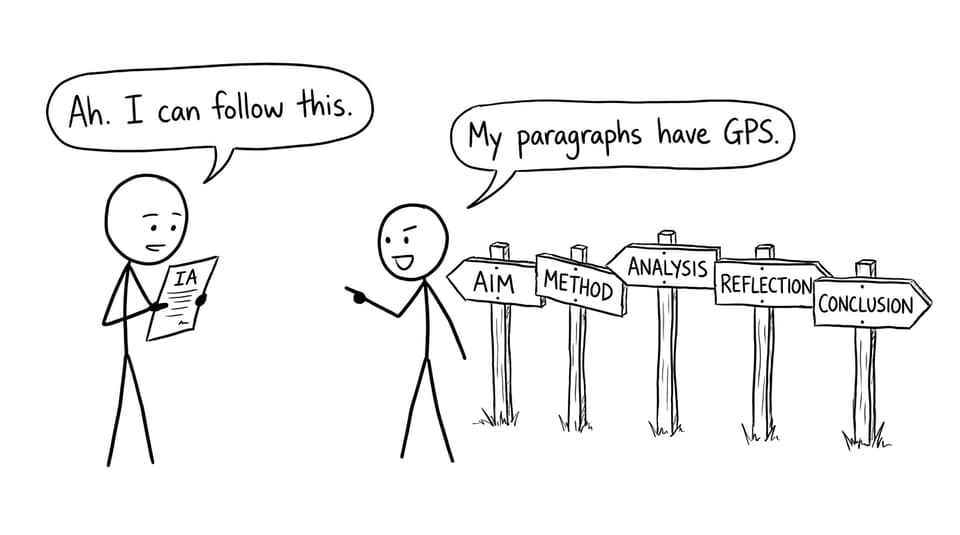
Headings that match your logic (Aim, Method, Analysis, Reflection)
-
Equations formatted consistently (same style, same variables)
-
Figures and tables labelled and referenced in text
-
Graphs include axis labels, units, and a short interpretation
-
Notation stays consistent (a symbol means one thing only)
-
A final proofread for spacing, alignment, and page flow
If you want a rubric-aligned benchmark for what “finished” looks like, the Math AI IA checklist is a strong reference point even if you’re in AA.
Why IB Math IA presentation matters more than you think
In the IB, presentation isn’t decoration. It’s communication.
Criterion A (Presentation) rewards explorations that are logically organised and easy to follow. That sounds obvious until you remember what an examiner actually sees: dozens of IAs, each claiming to be about modelling or optimisation, each containing graphs and formulas and paragraphs that may or may not connect.
Professional IB presentation does four quiet things:
-
It reduces cognitive load, so your mathematics feels clearer.
-
It prevents misreading, so you don’t lose marks to confusion.
-
It signals care, which makes your reasoning feel more credible.
-
It turns complexity into sequence: “first this, then that, therefore this.”
For a deeper breakdown of how the IB descriptors are interpreted across criteria, use Unpacking the IB Math IA Assessment Criteria.
A clean IB structure examiners can follow on the first read
Different topics need different emphasis, but most high-scoring IB explorations feel familiar because they follow a dependable spine.
Title page and navigation
Keep it simple. A professional title, candidate details as required by your school, and clean pagination. A table of contents is optional; include it only if it genuinely helps.
Introduction (Aim + context)
Your introduction should do three jobs quickly: state the aim, explain the context, and hint at the method. If you want your IA to feel confident, avoid long backstory. Two tight paragraphs beat a page of scene-setting.
Mathematical background (only what you use)
Include theory only if you will actively apply it. In IB terms, background should be functional, not ornamental.
Method / approach (how you’ll proceed)
This section is where you earn trust. Explain what you’re going to do and why it fits your aim. A reader should be able to predict your next step.
Analysis and discussion (the mathematical heart)
This is where formatting becomes crucial: every equation should be readable, every graph should be placed where it’s discussed, every result should be interpreted.
Reflection and evaluation (limitations + improvements)
Reflection is not self-criticism. It’s mathematical maturity: assumptions, constraints, sensitivity, and how your model could be improved.
Conclusion (answer the aim)
Don’t introduce new math here. Summarise what you found and what it means.
References and appendices
Cite data, tools, and any external ideas. Appendices should support, not replace, explanation.
If you want to compare two strong structural frameworks, RevisionDojo’s guides are helpful: How to Structure the IB Math IA for Maximum Clarity and How to Structure Your IB Math IA Logically.
Step-by-step: how to present a professional IB Math IA
Keep formatting boring (so your math can be interesting)
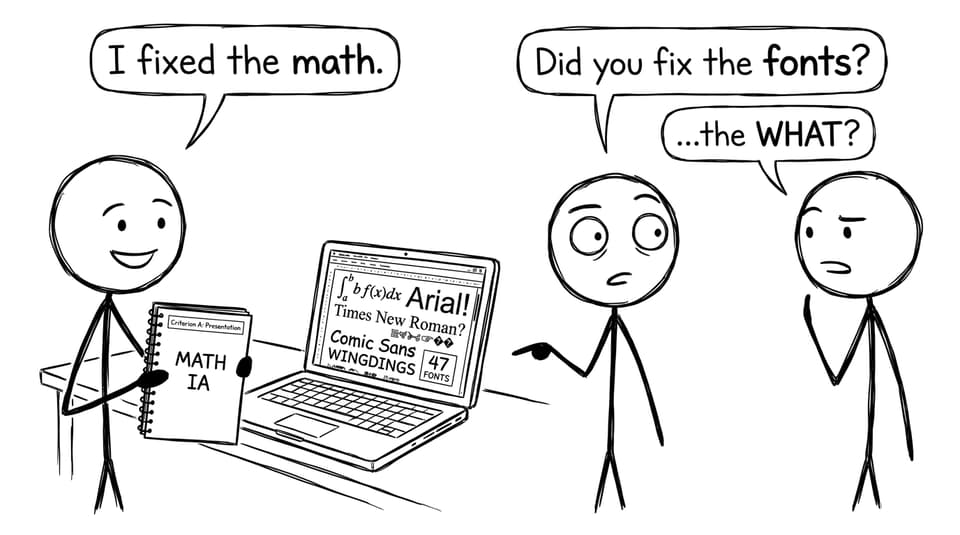
Pick one font (11 or 12), one spacing style (readable), and keep it consistent. “Professional” in IB writing often means “nothing surprises the eye.”
Practical rules that work:
-
Use consistent margins and alignment across pages.
-
Use headings that look like headings (not bold sentences).
-
Use an equation editor for anything more complex than a fraction.
-
Avoid over-styling: no heavy colour blocks, no decorative icons.
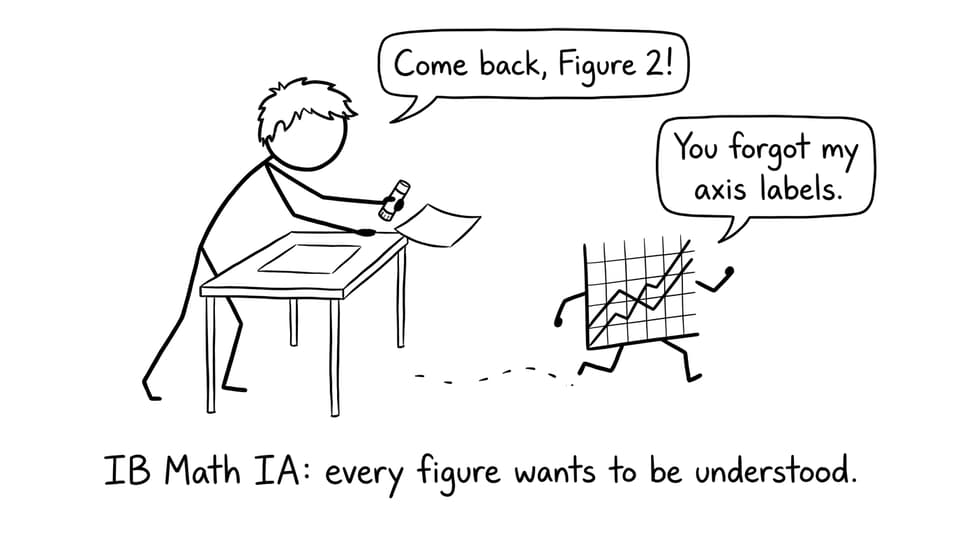
Label every figure like it’s evidence in a trial
Every graph, diagram, or table should have:
-
A figure number and short title
-
Axis labels and units
-
A reference in the text (“As shown in Figure 2…”)
-
One or two sentences explaining what the reader should notice
This is where many IB students lose easy marks: they include a beautiful graph and assume it speaks for itself. It doesn’t. The examiner needs you to translate it.
Number equations when you actually reuse them
If your analysis relies on several key equations, number them and refer back clearly.
Example language that sounds confident:
-
“Using Equation (3), I substitute the estimated value of k…”
-
“Equation (5) shows the turning point occurs when…”
This is IB mathematical communication at its best: traceable reasoning.
Put explanations next to the math they explain
A common layout mistake is separating the “story” from the “working.” In a professional IB Math IA, commentary should sit directly under the calculation or directly below the graph.
If a reader has to flip pages to find what a graph means, you’ve created friction. Friction is the enemy of clarity.
Treat notation as a contract
Decide early:
-
What symbols represent which variables
-
Whether vectors are bold or arrowed
-
How parameters are defined
-
Whether you use degrees or radians
Then keep it fixed. In IB marking, inconsistent notation is one of the quickest ways to make correct math feel unreliable.
Make the tone calm, not timid
Confidence in an IB Math IA is mostly sentence-level.
Try:
-
“This model suggests…”
-
“The regression indicates…”
-
“A limitation of this method is…”
Avoid:
-
“I think maybe…”
-
“This is probably…”
-
“I’m not sure but…”
You’re not pretending your model is perfect. You’re showing you understand what it does and doesn’t do.
For students who want to build this voice across the whole exploration, Personal Engagement in the IB Math IA is a useful companion: it shows how to sound original without sounding informal.
Common IB Math IA presentation mistakes (and simple fixes)
-
Crowded pages: add white space, break long derivations into steps, and narrate the purpose of each step.
-
Inconsistent fonts or spacing: fix with a single style set, then apply it everywhere.
-
Unlabelled visuals: label, reference, interpret.
-
Graphs pasted without context: put them where you discuss them, not where you “found space.”
-
Too much colour or effects: keep it printable and readable.
A surprisingly effective fix is to run one timed “read-through” where you only check flow. If you want to build that skill for exams too, RevisionDojo’s RevisionDojo App: The Smarter Way to Prep for IB Exams explains the practice-first feedback loop that makes clarity repeatable.
How RevisionDojo supports professional IB coursework confidence
Most students don’t lack intelligence. They lack feedback speed.
RevisionDojo is built to shorten the distance between effort and improvement:
-
Coursework Library: compare structure and tone with exemplars like Maths AI IA Examples and IB Math AA Exemplars.
-
Grading tools: check alignment early using the IB Maths AI IA Grader, so presentation issues don’t survive until the final draft.
-
AI Chat: ask for clearer phrasing, notation checks, or “Does this paragraph actually explain the equation?” without waiting days.
-
Study Notes + Flashcards: rebuild shaky theory quickly so your IA explanation stays accurate.
-
Questionbank + Mock Exams + Predicted Papers: strengthen exam performance while you polish coursework. For example, the IB Predicted Papers page connects timed practice to realistic expectations.
And when you want a full, end-to-end roadmap for scoring well, keep How to Write a Top-Scoring Math IA (2025 Guide) open while you draft.
Closing: present your IB Math IA like someone who belongs in the room
A professional IB Math IA isn’t about making your pages look pretty. It’s about making your reasoning feel trustworthy. When structure is clear, notation is consistent, and every figure earns its place, confidence follows naturally. Not the loud kind. The quiet kind that says, “This is what I did, this is why, and this is what it means.”
If you want that calm confidence to carry into both coursework and exams, build your loop with RevisionDojo: use Study Notes and Flashcards to stay sharp, AI Chat to get unstuck fast, Grading tools to align with the rubric, and Questionbank, Mock Exams, and Predicted Papers to make the IB feel familiar.
Your mathematics is already yours. Now make the page prove it.