


A surprising thing happens when someone reads IB Math Internal Assessments all day: the “hard” work doesn’t always feel impressive. The memorable work does.
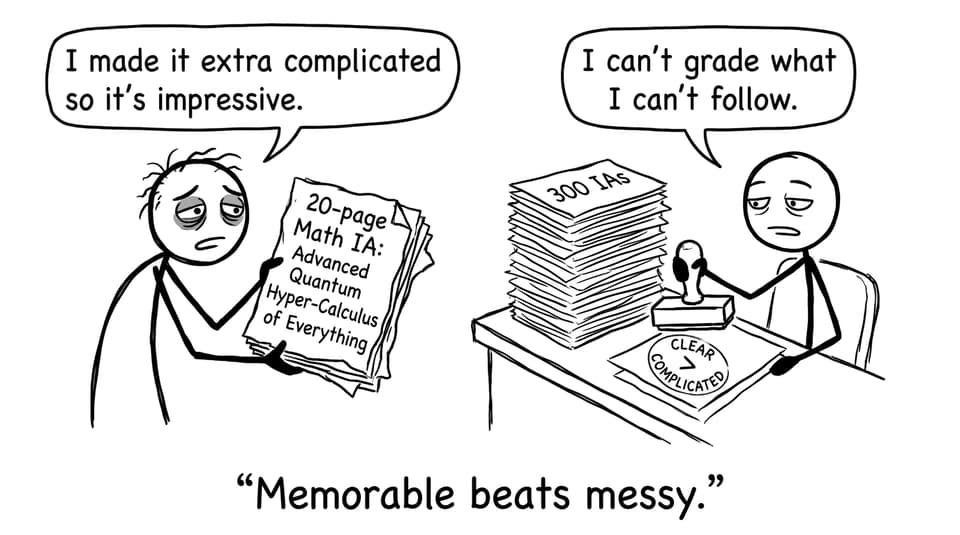
Not because it uses the most advanced techniques, but because it thinks like a mathematician and communicates like a human. The best IB Math IA is the one an examiner can follow at speed, trust at every step, and still remember after lunch.
This guide shows you how to make your IB Math IA memorable to examiners through a simple, repeatable approach: build a clear purpose, make each choice visible, and reflect like you actually care whether your model holds up.
A quick checklist for a memorable IB Math IA
Use this as your fast editing filter. If you can tick most of these, your IB IA is already harder to forget:
-
Your aim is specific and appears early (and again later).
-
Every variable, unit, and symbol is defined once and used consistently.
-
Each section ends by explaining what you learned and what you’ll do next.
-
Your graphs look like they were made for a reader, not for you.
-
You justify method choices (not just perform them).
-
Reflection appears throughout, not only in the conclusion.
-
Your conclusion answers the original aim and comments on limitations.
When you need a structure to compare against, open How to Structure Your IB Math IA Logically and treat it like a map, not a script.
Why “memorable” matters in IB marking
An examiner’s job is partly mathematical and partly cognitive. They are tracking your logic, checking accuracy, and aligning everything to the IB criteria. Under that load, two types of work stand out instantly:
-
Work that is easy to follow.
-
Work that shows independent thinking.
A memorable IB Math IA doesn’t feel like a worksheet turned into paragraphs. It feels like a guided investigation: you set a goal, you make choices, you test them, and you admit what could be better.
If you want the rubric language translated into practical moves, keep How to Write a Top-Scoring Math IA (2025 Guide) open while you revise.
Start with purpose, not a topic
Many IB students start by hunting for a “good topic.” Examiners don’t grade topics. They grade purposeful exploration.
A strong opening does three jobs in a few lines:
-
Context: what real situation or mathematical object are you exploring?
-
Aim: what are you trying to determine, compare, or optimize?
-
Method preview: what tools will you use (regression, calculus, probability, geometry, etc.)?
Instead of: “I chose this because I like basketball.”
Try: “This IB Math IA investigates whether a quadratic or exponential model better predicts my free-throw accuracy over time, using regression and error analysis to justify model choice.”
If you’re still choosing a direction, browse The Best IB Math IA Topics for 2025 and pick ideas that naturally produce decisions (model selection, parameter estimation, optimization, comparison). Decisions create memorability.
Make conceptual clarity your competitive advantage
Examiners rarely reward math that is difficult to read. They reward math that is correct, appropriate, and communicated clearly.
To make clarity feel effortless in your IB IA:
Define once, then stay consistent
-
Put variables in a small table.
-
Use the same notation in equations, graphs, and text.
-
Keep units visible (especially in modeling and statistics).
Introduce math like a story
Don’t drop a wall of algebra and hope the reader catches up. Tell them why the next step exists.
A simple sentence before each method helps:
-
“To estimate the parameter, I will linearize the model…”
-
“To test whether the fit is reliable, I will analyze residuals…”
Use visuals as explanations, not decorations
A graph is most memorable when it answers a question. If it doesn’t, it becomes noise.
For data-heavy explorations, How to Use RevisionDojo to Prepare for IB Math IA Data Analysis is a solid reference for making graphs and interpretation work together.
Personal engagement that doesn’t feel forced
In the IB Math IA, “personal engagement” is not a diary entry. It is evidence that you made thoughtful choices.
Examiners notice engagement when you:
-
Choose a dataset you collected or clearly justified.
-
Explain why you selected one model over another.
-
Adjust your approach after a result surprised you.
-
Compare methods instead of committing blindly to the first one.
A practical trick: write one sentence after every major result beginning with:
-
“This suggests…”
-
“I expected… but…”
-
“This limitation matters because…”
If you want examples of that commentary style, read IB Math: 10 Tips for a Strong IA Commentary and copy the moves (transitions, justification, reflection), not the content.
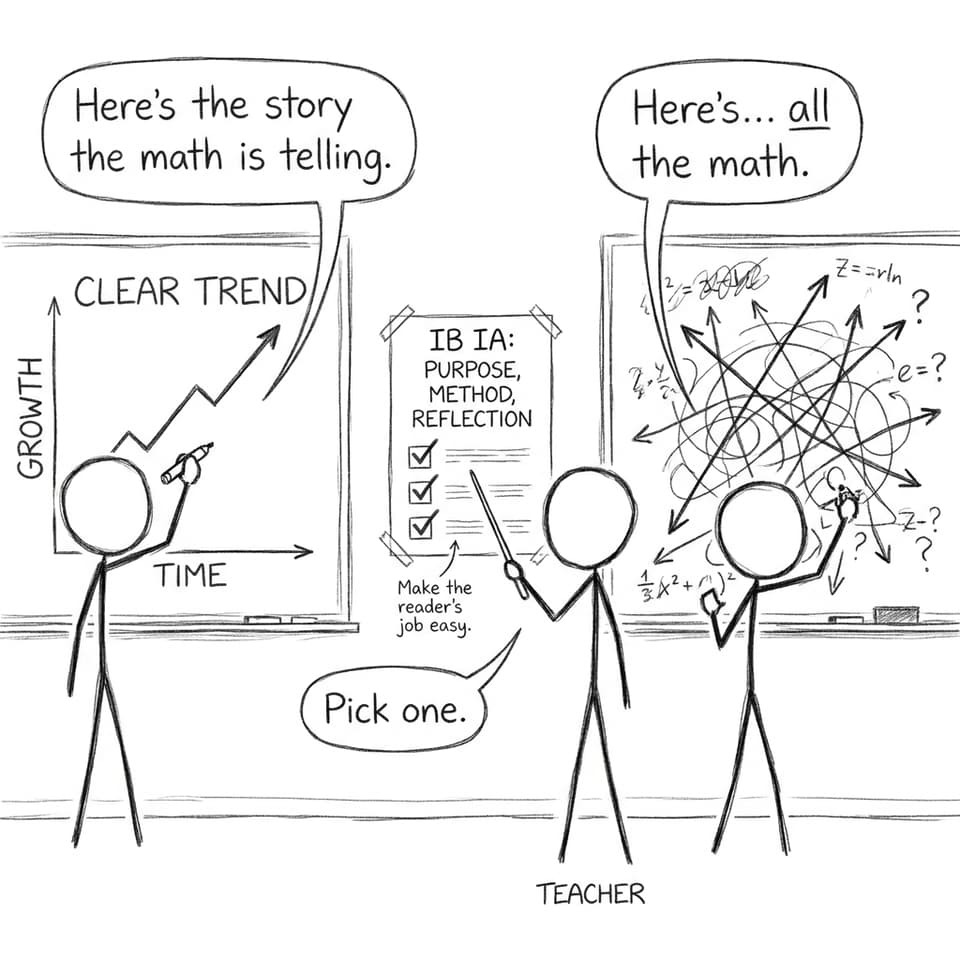
Flow and presentation: make the reader’s job easy
A memorable IB IA reads smoothly. The reader never has to ask, “Why is this here?” or “Where did that variable come from?”
Build a predictable spine
Most high-scoring work follows a familiar flow. You can model it using:
Add signposts
Use small transition lines at the end of sections:
- “Now that the parameters are estimated, I will test the model’s accuracy using residuals.”
This is cheap effort and huge memorability.
Use exam-smart formatting
-
Caption every figure.
-
Put interpretation directly below the figure.
-
Keep equations readable and spaced.
On RevisionDojo, students often pair the Study Notes with Flashcards to keep definitions and notation consistent while writing. When your notation is stable, your writing becomes calmer and your IB IA becomes easier to trust.
Reflection that feels like real mathematics
Weak reflection sounds like: “If I had more time, I would do more.”
Strong IB reflection sounds like a mathematician stress-testing ideas:
-
What assumptions did I make, and what do they imply?
-
Where does the model fail, and why?
-
What would happen if I changed a key parameter?
-
How sensitive are the results to measurement error?
A useful approach is “reflect as you go.” After each method, add a short paragraph:
-
What the method adds
-
What it costs (assumptions, limitations)
-
Whether it was the best choice
If you want to see what high-quality reflection looks like in real student work, browse the IB Coursework Examples: IA, EE and TOK Exemplars and specifically the subject collections like IB Maths AA IA Examples and IB Maths AI IA Examples.
RevisionDojo also helps here in a practical way: use AI Chat to challenge your assumptions, then use the Grading tools to see whether your reflection is actually visible in the rubric language.

Make your ending feel inevitable
A forgettable IB conclusion repeats results. A memorable one explains what the results mean in relation to the original aim.
Your final section should:
-
Re-state the aim in one sentence.
-
Answer it directly with your best-supported conclusion.
-
Mention the most important limitation (not a long list).
-
Suggest one realistic extension that follows naturally.
One simple test: if someone reads only your introduction and conclusion, do they understand the journey and trust the outcome? If yes, your IB IA is already examiner-friendly.
How RevisionDojo helps you polish a memorable IB Math IA
The fastest way to improve memorability is to reduce “reader effort.” RevisionDojo is built to reduce that effort in your draft:
-
Coursework Library: compare your structure against real exemplars in Coursework | RevisionDojo.
-
Grading tools: check criterion alignment early with the IB Maths AI IA Grader.
-
AI Chat: pressure-test assumptions and ask for alternative methods.
-
Study Notes + Flashcards: keep definitions and notation consistent using IB Flashcards with Spaced Repetition (SRS) and course-linked decks like Flashcards for Internal Assessment (IA) - IB.
-
Questionbank: strengthen underlying technique so your math stays accurate under stress, starting from the IB Mathematics Analysis and Approaches Resources hub.
And when exam season overlaps coursework season, tools like Mock Exams, Predicted Papers, and Tutors keep your IB prep moving while you finish the IA.
Conclusion: make your IB Math IA feel human and inevitable
A memorable IB Math IA is not louder than the rest. It’s clearer. It has a purpose you can summarize in one breath, math that arrives in logical steps, and reflection that proves you understand the trade-offs behind your choices.
If you want your IB examiner to remember your IA for the right reasons, use RevisionDojo to tighten the loop: study exemplars in the Coursework Library, pressure-test ideas with AI Chat, check alignment with Grading tools, and keep your core skills sharp with Study Notes, Flashcards, and the Questionbank.
Your goal isn’t to overwhelm the reader. It’s to guide them. That’s what memorable looks like in IB.