


The night before you submit, your analysis section can feel like a crowded room.
Equations talk over each other. Graphs lean against the walls with no introductions. And somewhere in the noise, your original aim, the one you genuinely cared about, is trying to be heard.
For IB students, this is where marks quietly leak away. Not because the math is wrong. But because the analysis is not coherent. It doesn’t read like reasoning. It reads like a scrapbook of correct steps.
This guide is about building a mathematically coherent analysis section: one that flows, justifies, interprets, and earns credit for understanding. You can use it for your IB Math IA, but the same habits also sharpen how you write solutions and explanations in exams.
IB coherence, in one sentence
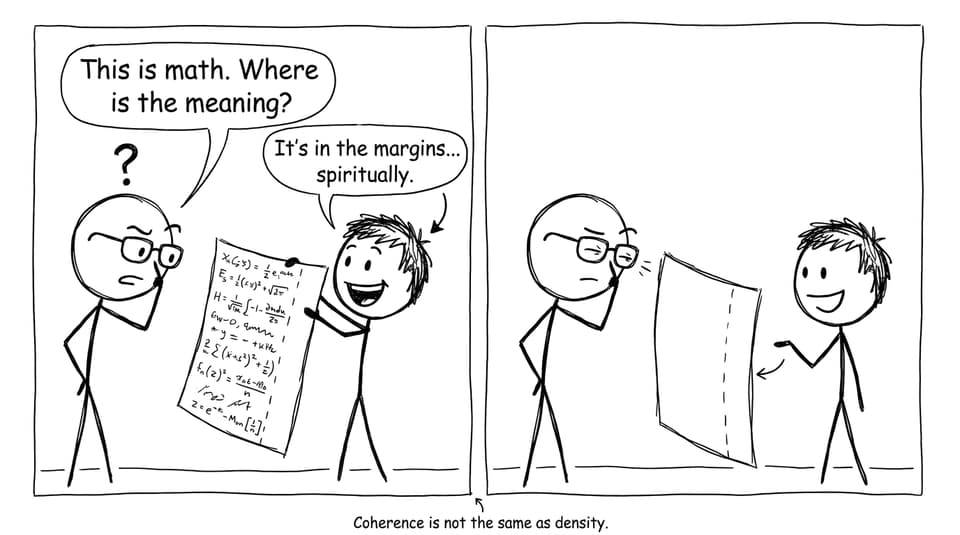
A coherent analysis section is a chain of reasoning where every mathematical choice is explained, every result is interpreted, and every paragraph points back to the aim.
In IB terms, coherence makes your mathematics visible to an examiner. It strengthens mathematical communication, supports reflection, and makes personal engagement believable because your decisions sound like decisions, not accidents.
If you want a quick anchor before you write, keep this mental loop: aim -> method -> working -> result -> meaning -> check -> next step.
Quick checklist before you write your analysis section
Use this as your five-minute setup. It stops you from writing “busy math” that goes nowhere.
-
A one-sentence aim/research question you can repeat without editing.
-
A list of variables with units and definitions (even if you think they are obvious).
-
A plan for the order of methods (what comes first, what depends on what).
-
A decision on notation (choose symbols and stick to them).
-
A place to log checks: reasonableness, error sources, limitations.
If you’re still shaping the overall structure of your IA, it helps to read How to Structure Your IB Math IA Logically alongside your outline.
What “mathematically coherent” means in IB writing
Coherence is not about being impressive. It’s about being followable.
A mathematically coherent IB analysis section usually has four traits:
Logical progression
Each step answers a question created by the step before.
Example: you define a model, estimate parameters, test the fit, interpret what the parameters mean, then check limitations. There’s a reason the reader is walking forward.
Justification at decision points
You don’t need to justify every algebraic line, but you do need to justify:
-
why you chose a model type,
-
why an assumption is reasonable,
-
why a method is appropriate for the data,
-
why you trust (or don’t trust) a result.
Consistent notation and communication
Coherence breaks the moment a symbol changes meaning. In IB Math, notation is part of the grade because it’s part of thinking.
If you want to align your writing with how criteria are actually read, use Unpacking the IB Math IA Assessment Criteria as a calibration tool.
Interpretation woven throughout
A strong analysis section explains what intermediate results mean as you go, not only in a final paragraph.
A structure that makes your IB analysis section coherent
You can treat the analysis like a story, but not a dramatic one. A story where every scene must earn its place.
Restate the aim at the top of the analysis
Start with 1-2 sentences that remind the reader what this section is doing.
Good examples sound like:
-
“This analysis models __ using __ to determine whether __.”
-
“In this section, I apply __ because __, and interpret the parameters in relation to __.”
This feels small, but for an IB examiner scanning quickly, it’s a compass.
If your aim still feels fuzzy, the hub page IB Mathematics Analysis and Approaches (AA) IA Guide is a strong reset.
Introduce the tool before the working
Coherence often fails because students drop a formula like a surprise guest.
Before you compute anything, briefly name:
-
what method you’re using,
-
what it assumes,
-
what output it gives you,
-
why that output matters for the aim.
This is also where you can show personal engagement without forcing it: “I initially considered __, but chose __ because my data showed __.”
To see what examiners tend to reward across subjects, read What IB Examiners Actually Look For in an IA.
Work step-by-step, but only at the right zoom level
In a coherent IB analysis section, the math is neither skipped nor floodlit.
Use three tactics:
-
Define variables before first use.
-
Label key equations you will reference later (Equation 1, Equation 2).
-
Use transitions that say what you’re doing and why.
Try writing short linking sentences like:
-
“To estimate (k), I rearrange Equation 2 because __.”
-
“Substituting the measured value of (x) allows me to compare the model to the observed data.”
That language is not fluff. In IB marking, it’s evidence of understanding.
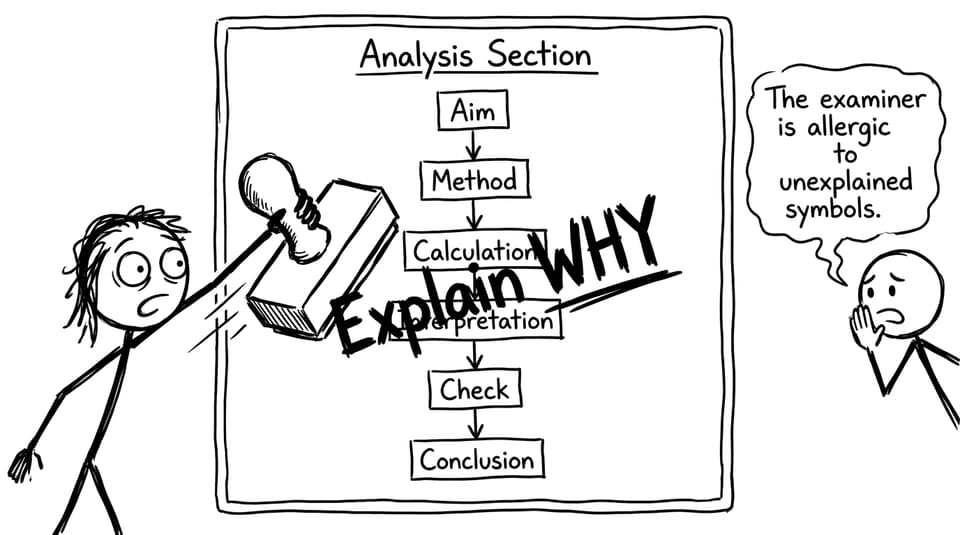
Interpret every major result immediately
After any key output (a parameter value, a gradient, a correlation coefficient, a turning point), write 2-4 sentences:
-
what it means in context,
-
what direction or magnitude implies,
-
whether it seems reasonable,
-
what it suggests you do next.
A simple template:
“This value suggests __ because __. In context, it implies __. This supports/does not support __. Therefore, I proceed by __.”
Evaluate before you conclude
A coherent IB analysis section doesn’t pretend the model is perfect. It earns trust by showing its edges.
Evaluation can include:
-
sensitivity to assumptions,
-
measurement or sampling limitations,
-
alternative models,
-
bounds/uncertainty,
-
comparison to expected behavior.
If you want a focused guide for this part, use How to Reflect on Model Limitations in the IB Math IA.
How to make equations and explanations feel connected
Many IB students write equations as isolated objects. Examiners experience that as: “I did math. Please award marks.”
Instead, treat each equation like a sentence that needs a subject and a verb.
Use “reason sentences” next to equations
Immediately after a key equation, add a reason sentence:
-
“This form is useful because it isolates __.”
-
“I use this model because the data shows __ behavior.”
-
“This substitution reduces the problem to __, which can be solved by __.”
Reference visuals like they matter
If you include a graph, give it a job.
A coherent analysis section does not say “Figure 1 shows the graph.” It says:
-
what feature matters (trend, asymptote, curvature, residual pattern),
-
how it links to the aim,
-
what decision it triggered (keep model, revise model, split domain).
Keep notation consistent like it’s a contract
Coherence dies fast when:
-
(r) is radius on page 2 and rate on page 4,
-
you switch from (f(x)) to (y) to (g(t)) with no warning,
-
units appear and disappear.
A practical fix: keep a small notation table at the start of analysis and update it when you introduce something new.
Technology in IB analysis: powerful, but not persuasive by itself
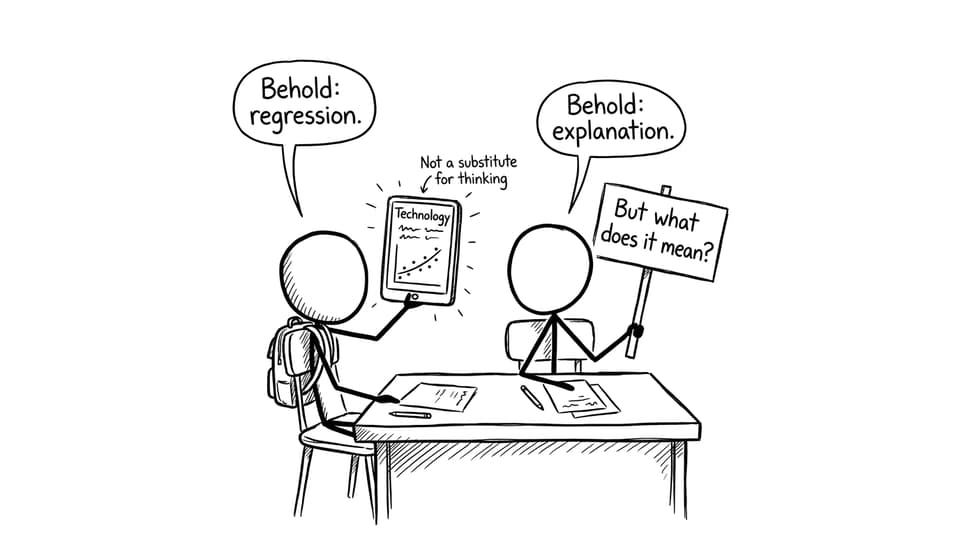
Tools like Desmos, GeoGebra, spreadsheets, or a graphing calculator can make your analysis cleaner. But they can also make it emptier if you outsource thinking.
A coherent IB analysis section uses technology for:
-
generating regression quickly,
-
checking solutions,
-
plotting residuals,
-
exploring parameter changes.
But the student still provides the meaning.
When you use tech, add:
-
what you input,
-
what the tool outputs,
-
how you interpret it,
-
why it answers the aim.
For exam-side practice that trains this explanation habit, targeted question practice helps. RevisionDojo’s Questionbank is built for that workflow, especially when you filter by topic and difficulty.
To practice calculus-heavy reasoning, you can use IB Mathematics Analysis and Approaches Topic Calculus Questionbank.
Common coherence pitfalls IB students make (and quick fixes)
These are the errors that create “mark loss without obvious wrong math.”
Jumping into results without setting purpose
Fix: Before any calculation block, write a one-line purpose statement: “I calculate __ to determine __.”
Overlong algebra with no narrative
Fix: Move routine steps to an appendix only if allowed and appropriate, and keep the analysis focused on decisions and interpretation. If you keep the steps, add short transitions between them.
Unexplained assumptions
Fix: Make assumptions explicit and local. Don’t hide them in a single paragraph. Place them where they first become relevant.
No checks for reasonableness
Fix: After each major result, do at least one check: units, sign, magnitude, boundary behavior, or a comparison to a simple case.
Symbol drift
Fix: Run a “symbol audit” after drafting: highlight each variable and ensure it has one meaning throughout.
Using RevisionDojo to draft a clearer IB analysis section
Coherence is easier when your resources are organized the same way your writing should be organized: by topic, method, and purpose.
Here’s a simple workflow many IB students use on RevisionDojo:
-
Use Study Notes to confirm definitions, method steps, and notation before writing. For a good example of topic-structured notes, see Notes for Functions - IB.
-
Turn the key method steps into Flashcards so your explanations are consistent each time you use a technique.
-
Practice the method using the Questionbank so you learn what a complete solution looks like under pressure. For a practical guide, read How to Use the Questionbank for Targeted Math Revision.
-
Use AI Chat to ask: “Where is my reasoning unclear?” and “Which step needs justification?” (Then you decide what to keep.)
-
Use Grading tools to sanity-check whether your communication matches criteria language. If you’re doing Math AI, the IB Maths AI IA Grader is a helpful self-check.
-
If you’re close to exams, use Mock Exams and Predicted Papers to train coherent explanation quickly under time constraints.
-
If you’re stuck, Tutors can help you fix the structure of the analysis, not just the math.
This is also why RevisionDojo’s broader Coursework Library matters: coherence is a pattern you can learn by seeing how strong work is shaped.
Closing: coherence is the easiest mark to protect
In IB math, coherence is a quiet advantage.
It’s what turns correct methods into visible understanding. It’s what lets an examiner follow your thinking without effort. And it’s what makes your analysis section feel like a single argument instead of a pile of steps.
If you want help building that kind of flow, RevisionDojo is designed for it: Study Notes to keep notation clean, Flashcards to lock in explanations, AI Chat to spot gaps in reasoning, Grading tools to align with criteria, Questionbank to practice method-plus-meaning, and Mock Exams with Predicted Papers to train coherence under time pressure. When you combine those with the Coursework Library and Tutors, your analysis stops being a last-minute cleanup job and becomes the strongest part of your work.
Write like every equation has to earn its place. In IB, that’s what coherence looks like.