


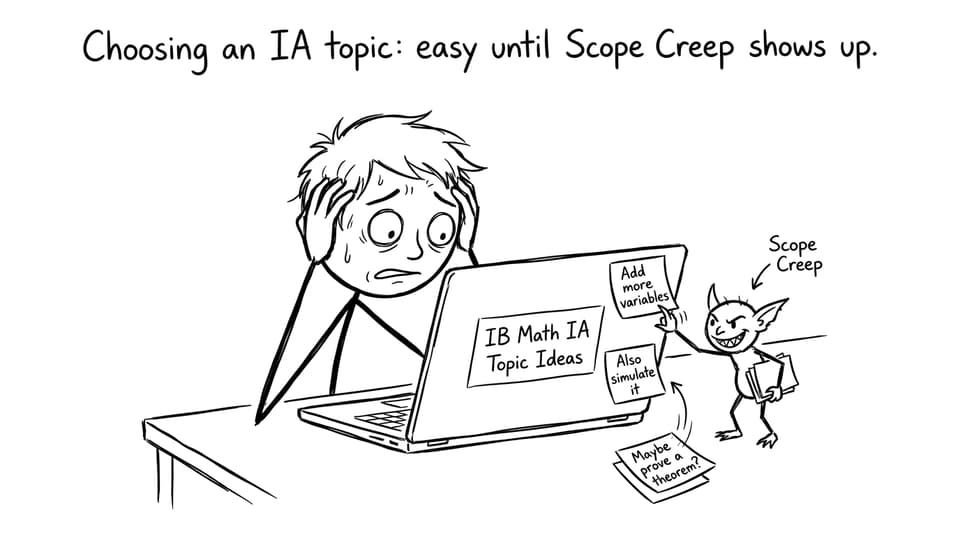
Choosing an IB Math IA topic is the kind of decision that feels small until it quietly starts controlling your whole semester.
One day you tell yourself, “I’ll model something fun.” The next day you’re three tabs deep in a spreadsheet, arguing with your calculator, and wondering why you ever said the words “real-world.” The truth is: the IB Math IA is rarely won by the most impressive-sounding topic. It’s won by the topic you can actually finish, with math you can explain, and reflection that sounds like a human being.
This guide shares the best IB Math IA topics for 2025, grouped by category, with research-question angles that work for both Math AA and Math AI. You’ll also see how to keep scope under control using RevisionDojo resources, so your idea stays interesting without becoming unwriteable.
Quick start checklist for an IB Math IA topic
Before you commit to any IB Math IA topic, run it through this 3-minute filter.
-
One-sentence question: Can you state your aim in one sentence without using the word “and” five times?
-
Math first, context second: Is the investigation driven by mathematics (modeling, calculus, stats, proof) rather than description?
-
Data plan: Do you have data now, or a realistic plan to collect it in under a week?
-
Depth you can defend: Can you explain every method in your own words, at an IB level?
-
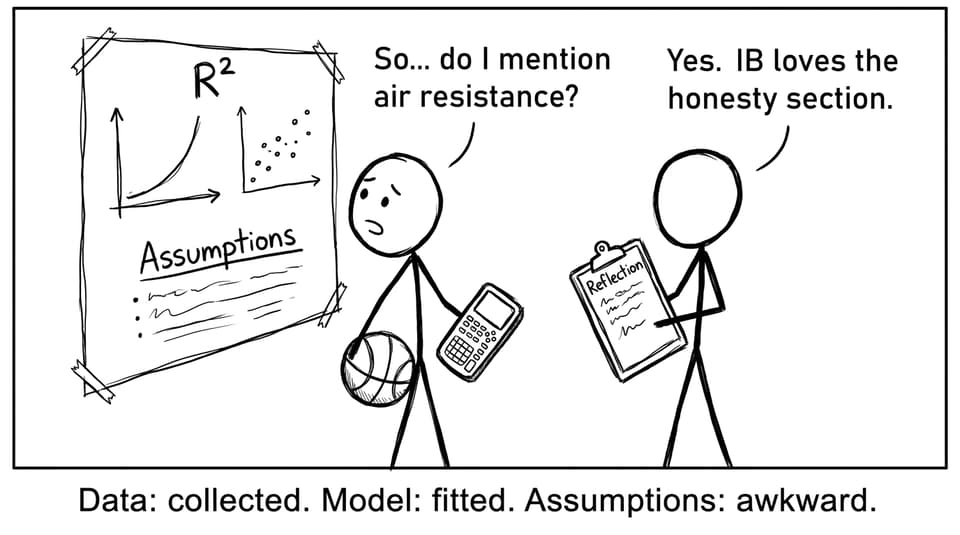
Reflection built-in: Can you evaluate assumptions, limitations, and improvements?
If you want a topic-selection framework that matches the rubric mindset, read How to Choose the Right Mathematical Topic for Your IB Math IA and keep it open while you brainstorm.
What makes a great IB Math IA topic in 2025?
A strong IB Math IA topic has three traits that don’t look exciting on TikTok but matter when the marking happens.
It stays narrow on purpose
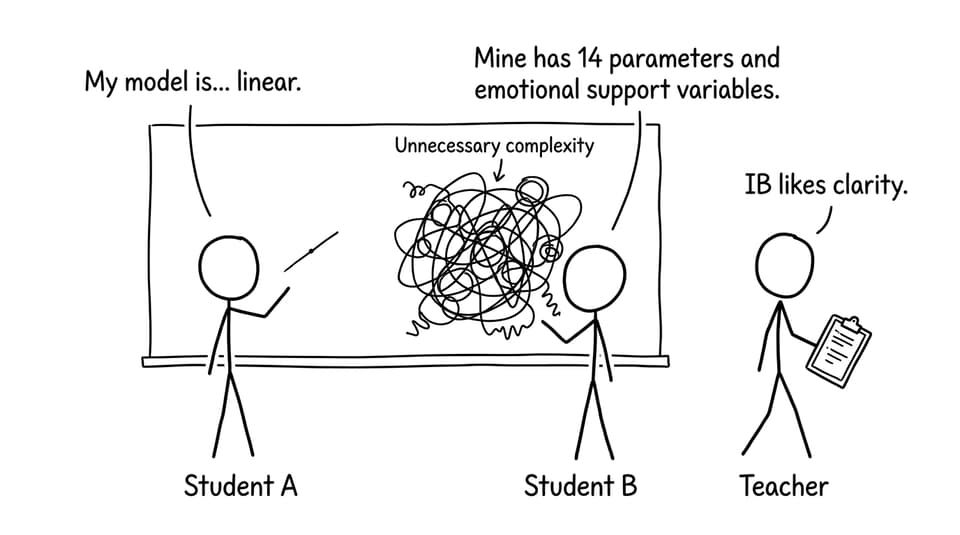
Many students lose marks because the topic becomes a documentary. The best IB explorations choose one phenomenon, one model (or two models compared), and one clear evaluation. If you need reassurance that “simple” can still score well, see Simplest Math IA Topics for IB Math Success.
It has mathematical decisions, not just calculations
Examiners reward choices: why you picked a model, why you rejected another, what assumptions you made, and how the results change if you alter conditions. That’s why exemplar-guided thinking helps early, not just at the end. Use Using IA/EE Exemplars to Improve Your IB Math IA when your first outline feels vague.
It sounds like you
The IB doesn’t require you to reinvent mathematics. It requires you to communicate it clearly with personal engagement. Your “personal” angle can be your dataset, your measurements, your sport, your commute, your music habits, or even a small experiment.
The best IB Math IA topics for 2025 (by category)
Below are modern, workable IB Math IA topic directions that fit 2025 student life: tech habits, sports data access, personal finance, and measurable routines. Each idea includes a research-question angle you can adapt.
Real-world modeling topics (great for IB Math AA and AI)
These work because they naturally lead to assumptions, parameter interpretation, and model limitations.
-
Trend adoption (logistic growth): “How well does a logistic model fit the adoption of a new app in my grade over 30 days?”
-
Battery drain (exponential/segmented models): “Which model best predicts battery percentage drop under different screen-on conditions?”
-
Braking distance (regression + error): “How does speed predict braking distance, and what model explains the residual pattern best?”
-
Urban saturation (differential equation or logistic): “Can a logistic model describe the growth of a local population or school enrollment?”
-
Temperature smoothing (moving averages + forecasting): “How do moving averages change the interpretation of short-term climate variability?”
If you want more curated variations in the same vein, compare with IB Math IA Ideas for 2025 and Beyond: Fresh, Relevant, and High Scoring Topics.
Sports and performance analysis topics (high engagement, strong reflection)
Sports IAs become excellent IB work when you don’t stop at a pretty graph.
-
Basketball shot optimization (trig + modeling): “What launch angle range maximizes scoring probability from my shooting data?”
-
Football curve and spin (projectile modeling): “How does spin correlate with lateral deviation in free kicks?”
-
Running pacing (polynomial vs exponential fits): “Which model best describes fatigue over a 5K training block?”
-
Reaction time and outcomes (statistics): “Is there evidence of correlation between reaction-time drills and batting accuracy?”
-
Ski slope design (optimization): “How do gradient constraints change maximum safe speed in a simplified slope model?”
These are easier to manage if you commit to a small dataset you trust. Use RevisionDojo’s Study Notes to anchor the math before you collect anything messy: start at Study Notes.
Probability and statistics topics (IB Math AI-friendly, still rigorous)
Statistics topics score well when you show diagnostics, bias discussion, and interpretation, not just a p-value.
-
Online reviews reliability (variance + sampling): “How stable is the average rating when sample size changes across platforms?”
-
Bias in officiating (chi-squared): “Is there evidence of bias in foul calls by quarter or home/away status?”
-
Shuffle randomness (simulation + distribution): “How many riffle shuffles are needed before outcomes look random by a chosen metric?”
-
Elections or polls (weighted probability): “How do weighting choices affect the uncertainty of predicted outcomes?”
-
Random number generators (testing distributions): “Do different RNG methods produce meaningfully different frequency patterns?”
If you’re unsure whether your stats explanation sounds like IB language, this is where RevisionDojo’s AI Chat is useful: it can help you rewrite interpretation in a way that matches assessment expectations.
Mathematical patterns and sequences (more ‘pure’ IB Math AA energy)
These topics feel elegant, but you must keep them grounded in a clear aim.
-
Continued fractions and approximations: “How quickly do continued fraction convergents approximate π compared to decimals?”
-
Infinite series convergence: “Under what conditions does a chosen geometric-like series converge, and how fast?”
-
Recursive models in genetics or populations: “How does changing a recursion parameter affect long-term behavior?”
-
Trigonometric periodicity: “What patterns emerge in a defined trig sequence and how can they be proven?”
-
Fibonacci in design (with a twist): “Do proportions in a chosen building/brand layout meaningfully match Fibonacci ratios, and how sensitive is the conclusion to measurement error?”
If you want examples that show what “enough math” looks like, review Successful IB Math IA Topics: Examples That Score.
Economics and finance topics (practical, relevant, naturally evaluative)
Finance topics make strong IB IAs when you compare models and discuss unrealistic assumptions.
-
Loan repayment comparison: “How do repayment totals differ between simple and compound interest under realistic fee structures?”
-
Inflation modeling: “Which model best fits inflation trends across a chosen time window, and how unstable are parameters?”
-
Housing price correlation: “Which variables correlate most strongly with local housing prices, and is the relationship robust?”
-
Stock movement (log transforms): “How does log transformation change interpretability and model fit for daily returns?”
-
Profit optimization: “What production level maximizes profit under a chosen cost model, and how sensitive is the optimum?”
For students who like structure, RevisionDojo’s IA resources hub helps you turn “topic” into “workable plan”: IB IA Guides: Internal Assessment Structure, Rubrics & Tools.
Technology and digital systems topics (modern, 2025-friendly)
Tech topics are great because they are measurable and personally relevant.
-
Internet traffic approximation: “Can polynomial approximations model daily Wi-Fi usage patterns at home?”
-
Compression intuition (logarithms): “How does compression ratio change with file type, and what math explains the pattern?”
-
Bezier curves in design: “How do control points affect curvature and arc length in a simple Bézier curve model?”
-
Cryptographic primes: “What properties make primes suitable for cryptography, and how can we test prime distribution patterns?”
-
Storage efficiency: “How does redundancy change effective information storage in a simplified model?”
If you’re Math AA, start from the official hub to keep methods aligned: IB Mathematics Analysis and Approaches Resources.
Everyday mathematics topics (the quiet high-scorers)
These win because they’re controllable. You can collect data, test models, and reflect honestly.
-
Route optimization (graph theory): “What route minimizes time to school under different traffic assumptions?”
-
Caffeine decay: “Which decay model best fits my measured alertness proxy over 6 hours?”
-
Music harmony ratios: “How do frequency ratios relate to perceived consonance, modeled with logs or simple functions?”
-
Ferris wheel motion: “How accurately can a trig function model height over time from video timestamps?”
-
Melting and temperature: “How does temperature affect melt time, and where does the model break?”
For more manageable directions, browse Simple and Manageable IB Math IA Topics.
A simple way to turn an IB Math IA topic into a research question
Most IB students don’t fail at math. They fail at shaping.
Use this template:
-
Context (1 line): what you’re studying.
-
Variable (specific): what changes.
-
Outcome (measurable): what you predict/optimize/explain.
-
Method (math): regression, calculus, simulation, sequences, trig.
-
Evaluation hook: limitations, assumptions, improvements.
Example:
“I will investigate how screen brightness affects smartphone battery drain by fitting exponential and piecewise models, then comparing fit quality and discussing model assumptions.”
When you get stuck mid-draft, RevisionDojo’s ecosystem helps you keep momentum: Study Notes for methods, Flashcards for quick recall, AI Chat for explanation clarity, Questionbank for skill-building, Grading tools for feedback, Mock Exams and Predicted Papers for exam readiness, and the Coursework Library plus Tutors when you need outside structure.
Common IB Math IA topic mistakes (and quick fixes)
-
Too broad: “climate change” becomes “temperature in my city over 60 days.”
-
Too descriptive: add a model comparison and residual analysis.
-
Too overused: keep the theme, change the dataset and question angle.
-
Too advanced: replace unfamiliar university methods with IB-level tools you can justify.
-
No reflection space: build in an assumption test from day one.
If you want a practical decision guide, keep Tips For Choosing The Right IB Math IA Topic bookmarked.
Conclusion: choose an IB Math IA topic you can finish well
The best IB Math IA topics for 2025 aren’t the fanciest. They’re the ones with a clear question, realistic data, defendable math, and space for honest evaluation.
Pick a direction from this list, narrow it until it feels almost too small, then add depth through modeling choices and reflection. And if you want the process to feel less like guesswork, use RevisionDojo as your basecamp: Notes to learn, Flashcards to remember, AI Chat to explain, Questionbank to sharpen, Grading tools to improve drafts, and Mock Exams plus Predicted Papers to carry that confidence into the final IB exams.
Keep it focused. Make it yours. Do the math carefully. That’s how IB work becomes something you’re proud to submit.