
For IB students sitting exams in May 2028 (started DP1 in August 2026).
Getting a 7 requires more than remembering psychological studies: you must apply accurate knowledge to unfamiliar situations, evaluate research through the course concepts, and make justified methodological decisions. Build those abilities gradually across the two years, practise each assessment format under time pressure, and treat the IA as a research-design argument rather than a descriptive report.
The May 2028 cohort follows the revised IB Psychology course first assessed in 2027. Its structure links six concepts, psychological content, research methodology and four real-world contexts, so revision based only on memorising isolated studies will leave important assessment skills untouched.
What the May 2028 cohort needs to know
The current official IB Psychology subject brief confirms the assessment model first used in 2027. The IB's Psychology curriculum update explains the wider shift toward integration, application and research methodology.
| Assessment | SL weighting | HL weighting | Current format |
|---|---|---|---|
| Paper 1 | 35% | 25% | 1 hour 30 minutes, 35 marks |
| Paper 2 | 35% | 25% | 1 hour 30 minutes, 35 marks |
| Paper 3 | Not taken | 30% | 1 hour 45 minutes, 30 marks |
| Internal assessment | 30% | 20% | Research proposal, 24 marks |
Paper 1 integrates concepts, content and contexts. Paper 2 examines class practicals and the evaluation of unseen research. Paper 3, taken only at HL, requires students to interpret quantitative and qualitative findings connected to an HL extension. The IA asks both SL and HL students to design a research proposal for a population of interest; students do not conduct the proposed research.
As of October 2026, final May 2028 grade boundaries and the session's detailed examination timetable have not been published. No responsible guide can tell you the exact mark needed for a 7 in 2028. Boundaries are determined for examination sessions, so prepare for consistently excellent performance rather than aiming at an invented cutoff.
A practical top-grade checklist
- Explain psychological theories, findings and terminology accurately.
- Select evidence because it answers the question, not because it was easy to memorise.
- Apply knowledge explicitly to the context or unseen stimulus.
- Use concepts such as bias, causality, change, measurement, perspective and responsibility analytically.
- Evaluate implications, assumptions and limitations instead of listing generic strengths and weaknesses.
- Justify research decisions by connecting method, population, ethics and analysis.
- Practise the exact timing and demands of every paper you take.
The RevisionDojo Psychology resources for the new syllabus provide one place to organise this work around the correct course rather than mixing revised and older materials.
What 7-level Paper 1 performance looks like
Paper 1 rewards connected thinking. Section A uses compulsory short-answer questions from two of the three content areas: biological, cognitive and sociocultural. Section B asks students to apply knowledge to unseen situations. Section C offers concept-based extended-response questions set in different contexts.
A weaker response often presents a memorised study and hopes the examiner will infer its relevance. A stronger response makes the chain of reasoning visible:
Illustrative response, not an official IB question: If anxiety is measured only through a self-report scale, measurement becomes part of the conclusion rather than a neutral step. Participants may interpret scale points differently or respond in socially desirable ways. The resulting scores could therefore represent reported anxiety imperfectly, which limits the certainty of any causal claim based on those scores.
This short example does four useful things:
- It identifies the concept of measurement.
- It applies that concept to a specific methodological choice.
- It explains the consequence for interpretation.
- It connects measurement to causality, showing conceptual integration.
A top extended response adds accurately selected psychological research, considers competing explanations or perspectives, and reaches a qualified judgement. Evaluation should change what the evidence allows you to conclude. It should not appear as a detachable paragraph of rehearsed limitations.
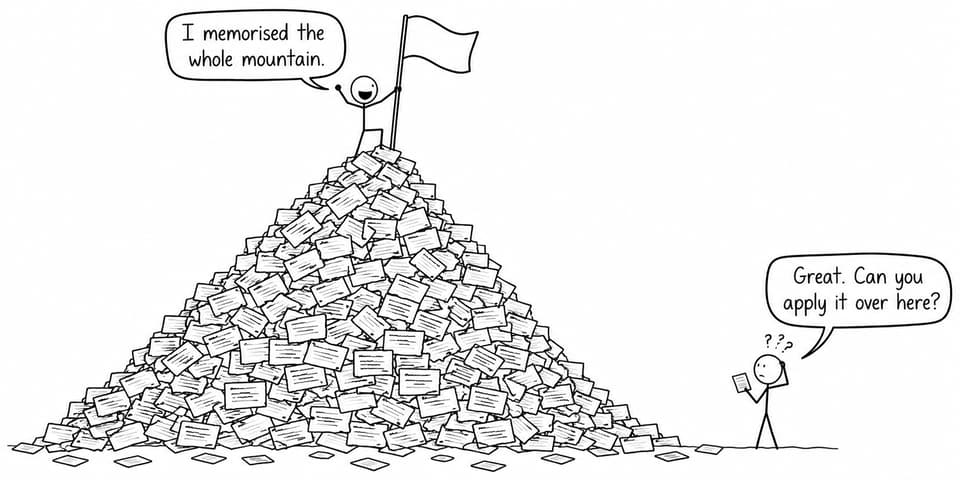
Memorising the mountain matters less if knowledge cannot travel to a new question.
Use RevisionDojo's guide to getting a 7 in IB Psychology alongside Study Notes and Flashcards to build accurate knowledge. Then move quickly into Questionbank prompts, because retrieval becomes useful only when you can reshape it around the command term and context.
What 7-level Paper 2 performance looks like
Paper 2 is where research methods stop being a chapter and become a way of thinking. Section A contains four compulsory questions focused on class practicals. Section B asks you to evaluate an unseen research study with reference to two or more concepts.
Imagine that an unseen study recruits volunteers through a social-media advertisement and later loses many participants. A descriptive answer says, “The sample may be biased.” A more effective answer explains the mechanism:
Illustrative analysis: Volunteer recruitment may produce self-selection bias because people already interested in the topic could be more likely to participate. If attrition is also systematic, the final sample may differ further from the population of interest. This weakens the defensibility of generalising the findings, although it does not automatically make the observed pattern false.
The annotation is simple but important. The response names bias, identifies its source, traces its consequence, and avoids an absolute judgement. That final qualification often separates genuine evaluation from criticism by reflex.
Your class practicals should become methodological reference points. After each one, record the aim, sampling approach, procedure, ethical decisions, possible data, analytical choices and what you would redesign. This creates reusable reasoning rather than a notebook full of definitions.
RevisionDojo's AI Chat can help you interrogate why a methodological decision matters, while Grading tools can identify where an answer describes rather than evaluates. Treat AI feedback as a prompt for judgement, not as a substitute for your teacher or the official guide.
What 7-level Paper 3 performance looks like at HL
HL students also sit Paper 3. Four source-based questions provide quantitative and qualitative findings connected to one HL extension. High performance depends on reading the supplied evidence carefully, interpreting it in context and integrating different forms of data.
For example, noticing that one group has a higher mean is only the beginning. A strong answer considers variation, sample information, the limits of the design and whether qualitative findings support, complicate or contradict the numerical pattern. If interview responses reveal experiences hidden by an average, that difference deserves analysis rather than being treated as an inconvenience.
Build comfort with unfamiliar tables, graphs, extracts and mixed evidence throughout DP1 and DP2. Predicted Papers and full Mock Exams can later test whether you can sustain this reasoning under timed conditions, but they are simulations, not forecasts of exact May 2028 questions.
How to produce a top Psychology IA
The new IA is a research proposal, not the experimental report used in the previous course. The official Psychology guide for first assessment in 2027 states that the report must not exceed 2,200 words. Students select one of four method families: an experiment, interviews, observations, or a survey or questionnaire.
The proposal is marked out of 24 across four areas: introduction, research methodology, data collection and discussion. The RevisionDojo explanation of the Psychology IA criteria and the new-syllabus Psychology IA guide can help translate those criteria into a drafting process.
Consider this illustrative aim:
To investigate the relationship between evening social-media use and self-reported sleep quality among students aged 16-18 at a specified school.
The topic alone does not make the proposal strong. A 7-level approach would define the population precisely, ground the proposal in relevant psychological research, justify why the selected method fits the aim, design a usable data-collection tool, address consent and privacy, and explain how the proposed analysis answers the research question. It would also discuss limitations specific to self-reporting and this population.
The key word is justify. “A questionnaire is quick” is thin reasoning. “An anonymous questionnaire may encourage disclosure about private habits, although retrospective estimates can introduce recall error” weighs suitability against limitation.
Use the Coursework Library to study how successful writing makes decisions visible, including the available Psychology IA exemplar with criterion feedback. An exemplar should reveal principles, not provide language to imitate. Your school's internal deadlines also take priority, although the RevisionDojo Psychology IA timeline offers a useful planning model.
A two-year plan for a 7 in IB Psychology
August-December 2026: build the system
Start by learning how concepts, content and contexts connect. The guide to your first term of IB Psychology explains this revised architecture. After each topic, create one concise evidence card and answer one application question. Do not wait until DP2 to discover that recognition is not retrieval.
January-June 2027: turn knowledge into analysis
Complete weekly mixed practice covering short answers, unseen applications and research methods. Keep an error log with four categories: knowledge, relevance, application and evaluation. Revisit weak areas with Study Notes, then close the notes and reconstruct the answer using Flashcards or a blank page.
HL students should begin regular data interpretation. Both levels should preserve detailed reflections on class practicals, because those experiences feed Paper 2 and the IA.
June-August 2027: consolidate selectively
Audit the syllabus rather than studying everything equally. Repair weak content, organise your evidence bank and complete occasional timed responses. Rest belongs in the plan too; exhausted repetition has diminishing value.
August-December 2027: complete the IA and increase timing
Follow your teacher's IA schedule and draft from the criteria. Test whether every methodological choice serves the aim and population. At the same time, move from individual questions to timed sections. If feedback repeatedly exposes the same weakness, use RevisionDojo Tutors for targeted explanation rather than collecting more general advice.
January-April 2028: simulate the full demand
Complete mixed Questionbank sets each week, then introduce Predicted Papers and Mock Exams under accurate timing. Mark every response against the relevant expectations, rewrite weak paragraphs and track recurring errors. Use the May 2028 IB resource guide to check that every resource matches your syllabus version.
May 2028: protect clarity
Reduce novelty. Review concise evidence, concepts, practicals and established answer structures. Sleep, timing and careful reading now matter more than adding one obscure study at the last minute.
The real route to an IB Psychology top grade
A 7 is not built from one perfect essay. It emerges from hundreds of small decisions: choosing relevant evidence, explaining one implication clearly, correcting one methodological misconception and returning to an unfamiliar question after the first attempt felt uncomfortable.
RevisionDojo brings those decisions together through its Questionbank, Study Notes, Flashcards, AI Chat, Grading tools, Predicted Papers, Mock Exams, Coursework Library and Tutors. The resources matter because they shorten the distance between practice and useful feedback.
Your next step is specific: open the RevisionDojo IB Psychology Questionbank, complete one Paper 1 application question without notes, and record whether your main weakness was knowledge, application or evaluation.