



The first term of IB Psychology often feels manageable until the subject's hidden structure appears. You are not simply learning what psychologists discovered. You must examine how evidence was produced, what conclusions it supports, where bias may have entered, and whether an explanation still works in another context.
For students following the syllabus first assessed in 2027, the course connects six concepts with psychological content, real-world contexts, and research methodology. Schools choose their own teaching order, so there is no universal weekly schedule. Most opening terms nevertheless follow a similar arc: foundational content, research literacy, application, and increasingly structured writing.
Your first-term checklist
By the end of a typical opening term, expect to have:
- explored part of the biological, cognitive, or sociocultural approach
- used concepts such as bias, causality, measurement, and perspective
- analysed research rather than merely memorising findings
- learned basic terminology for methods, sampling, ethics, and evaluation
- applied an explanation to an unfamiliar situation
- written short responses and possibly planned an extended response
- begun a compact, reusable evidence bank
- encountered a class practical, depending on your school's sequence
Confirm that your resources match your examination session. RevisionDojo provides IB Psychology notes for the syllabus first assessed in 2027, organised around concepts, content, contexts, and extensions.
What the first term usually covers
The opening weeks: learning the language
Early lessons often establish what psychology is and what counts as psychological evidence. This may include variables, hypotheses, sampling, ethics, reliability, validity, and the difference between correlation and causation.
Your teacher may simultaneously introduce biological, cognitive, or sociocultural psychology. One class might begin with memory; another may start with the relationship between the brain and behaviour. The order matters less than the habits you develop.
The crucial habit is separating a claim from its supporting evidence. A theory can be plausible without being conclusively proven. A controlled experiment may support causal inference, yet its artificial setting can limit how confidently the result transfers to daily life. Psychology becomes more interesting when these qualifications become part of the subject rather than inconvenient exceptions.
The middle of term: evidence gains weight
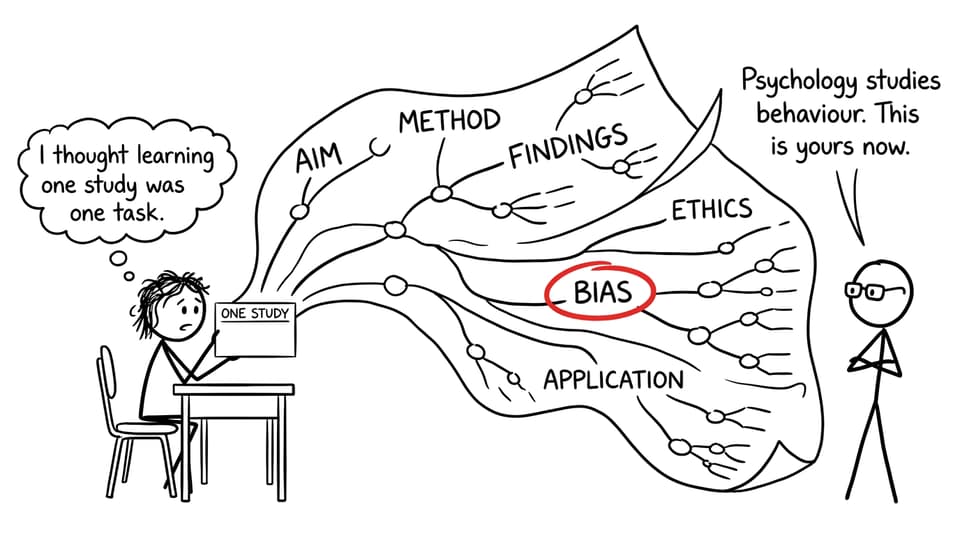
As the term progresses, each topic brings terminology, models, studies, methods, strengths, limitations, and applications. Students who rely on rereading often discover that recognising a study is not the same as retrieving it during a timed response.
For each important study, record:
- its aim, sample, and method
- the essential procedure and findings
- the conclusion justified by the evidence
- one methodological or ethical strength
- one meaningful limitation
- relevant concepts and contexts
The IB Psychology Questionbank reveals the difference between recognition and recall. Answering one focused question after learning a topic is more informative than highlighting the same notes repeatedly.
The final weeks: knowledge becomes argument
Toward the end of term, teachers often expect greater independence. You may apply a model to an unseen situation, compare explanations, evaluate research, or construct a longer argument.
More detail does not automatically produce more marks. Every piece of evidence needs a purpose. Instead of asking, "What do I remember?", ask, "Which knowledge answers this command term in this context?"
The revised course values conceptual understanding and application. Across the full course, Paper 1 integrates concepts, content, and contexts. Paper 2 focuses on research contexts and class practicals. HL students also complete Paper 3, which assesses data analysis and interpretation. You will not master complete papers in term one, but early lessons begin building the necessary skills. The guide to changes in the revised IB Psychology curriculum provides a broader map.
A realistic weekly workload
Psychology's workload usually accumulates through small unfinished tasks: a definition you meant to clarify, a study you understood but did not retrieve, or an evaluation point you copied without explaining.
| Session | Practical focus |
|---|---|
| After each lesson | Condense the material into questions, definitions, and one evidence record |
| Midweek | Retrieve the topic without notes and correct gaps |
| Later in the week | Answer one application or research-method question |
| Weekend | Review earlier material and update an error log |
Two or three focused sessions are often more useful than one long weekly review. The required time varies with your teacher, timetable, reading speed, and whether you study SL or HL. Judge the routine by its output. Can you explain the model, reconstruct the evidence, evaluate the method, and apply the idea without looking?
Use Psychology cheatsheets and visual study guides for compression, not as a substitute for retrieval. The guide to using an IB Questionbank effectively explains how to practise, diagnose errors, and reattempt weaknesses.
What surprises new students
Psychology is not mainly common sense
Some conclusions sound obvious after they have been explained. That does not make them obvious before investigation or make every explanation equally credible. IB Psychology asks how a claim was measured and which alternative explanations remain.
Memorisation is not the finish line
Accurate terminology and evidence matter, but facts become useful only when selected and applied. Strong students organise knowledge by function: evidence for causality, an example of measurement difficulty, a source of bias, or a limitation on generalisation.
Evaluation must be specific
Writing "the sample was small" is insufficient. Explain which conclusion the sample weakens, which population may be underrepresented, and why that matters for the question. Evaluation is reasoning, not a list of negative labels.
Research methods appear everywhere
Methods shape whether you can trust each study. The syllabus includes four class practicals across the course, connected to health and well-being, human development, human relationships, and learning and cognition. Whether one appears in your first term depends on your school's plan.
How to stay ahead without overworking
Build one repeatable cycle:
Learn. Use class material and syllabus-aligned Psychology Study Notes to resolve confusion.
Retrieve. Close everything. Use Flashcards or a blank page to reconstruct key concepts and evidence.
Apply. Complete a small Questionbank set. Early practice can be untimed because the goal is understanding how knowledge earns credit.
Review. Classify mistakes as missing knowledge, inaccurate evidence, weak application, or vague evaluation. AI Chat can clarify concepts, while Grading tools can identify weaknesses in a response. Compare feedback with your teacher's guidance and official requirements.
Return. Reattempt the same skill later with another prompt. A corrected answer helps; a correction you can reproduce independently is learning.
The RevisionDojo Psychology coverage guide explains how resources are separated by course version. This matters because material for the syllabus assessed through 2026 does not always match the structure first assessed in 2027.
Build a system, not a pile of notes
Your first term is when you learn how psychology thinks: claims require evidence, evidence has limits, behaviour has competing explanations, and context changes what conclusions mean.
RevisionDojo brings that process together. Study Notes and Flashcards support understanding and retrieval. The Questionbank develops application, while AI Chat and Grading tools shorten the feedback cycle. Later, Predicted Papers and Mock Exams support timed rehearsal. The Coursework Library and Tutors provide additional structure as independent work becomes more demanding.
Start with the correct IB Psychology resource pathway. Learn one idea carefully, test it, examine the gap, and return. The daily work may look small. By the end of the term, it has become a reliable way of thinking.