
For IB students sitting exams in May 2028 (started DP1 in August 2026).
To learn how to get a 7 in IB Math AI 2028, build accurate mathematical understanding, fluent technology use, clear written reasoning, and an IA that satisfies every assessment criterion. A top grade does not come from collecting tricks; it comes from repeatedly turning unfamiliar contexts into defensible mathematical conclusions.
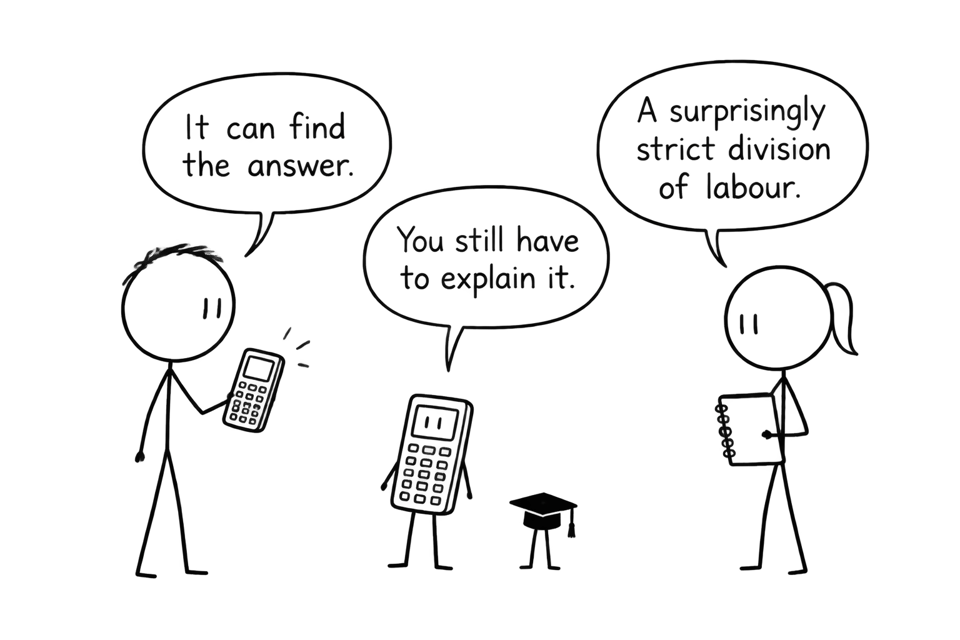
That distinction matters in Mathematics: Applications and Interpretation. Technology can calculate a regression, solve an equation, or evaluate an integral. It cannot decide whether the model is appropriate, explain what a parameter means, or notice that an answer makes little sense in context. Those are the habits that separate calculator use from mathematical judgment.
The essential checklist for a 7 in IB Math AI
A strong May 2028 candidate should be able to:
- recall and connect ideas across number and algebra, functions, geometry and trigonometry, statistics and probability, and calculus
- use an approved graphing calculator efficiently under timed conditions
- show enough mathematical setup and reasoning for a marker to follow the method
- interpret numerical results in the language of the question
- test assumptions, domains, units, accuracy, and reasonableness
- complete mixed, timed questions rather than revising only by chapter
- develop the IA steadily and respond carefully to teacher feedback
- diagnose errors by cause instead of merely recording the correct answer
The RevisionDojo IB Math AI hub brings together Study Notes, Questionbank practice, videos, and Flashcards for both SL and HL. Used properly, it turns this checklist into a repeatable routine rather than a hopeful intention.
What is confirmed for the May 2028 cohort
The important syllabus distinction is easy to miss. Students taking examinations in May 2028 remain under the current Mathematics: Applications and Interpretation course, first assessed in 2021. The revised course is scheduled for first assessment in May 2029, so its changed paper lengths, marks, and IA criteria should not be used to plan for May 2028.
Under the current assessment model, all Math AI examination papers require technology. The structure for May 2028 is:
| Level | External assessment | Weighting | Internal assessment |
|---|---|---|---|
| SL | Paper 1: 1 hour 30 minutes, short-response, 80 marks. Paper 2: 1 hour 30 minutes, extended-response, 80 marks | 40% per paper | Mathematical exploration, 20% |
| HL | Paper 1: 2 hours, short-response, 110 marks. Paper 2: 2 hours, extended-response, 110 marks. Paper 3: 1 hour 15 minutes, two extended problem-solving questions, 55 marks | 30%, 30%, and 20% | Mathematical exploration, 20% |
The IB has announced that the revised May 2029 assessment model reduces paper marks and shortens HL Paper 3 to one hour. Those changes do not apply to May 2028.
As of October 2026, the detailed May 2028 examination timetable has not been published on the IB examination schedule page. Final May 2028 grade boundaries are also unavailable and cannot be known in advance. Boundaries can vary by session, so do not build a study plan around an invented target percentage. Your school should confirm the final timetable, permitted calculator model, required examination mode, and administrative rules when the IB releases the relevant documents.
What 7-level performance actually looks like
A 7-level response is not necessarily long. It is complete in the places where completeness earns marks.
Suppose a question gives a regression model
for the population of an organism, measured in thousands, where is the number of years after 2020.
A weak response might calculate and stop. A stronger response would communicate the result as follows:
. Therefore, the model predicts a population of approximately 27,600 organisms in 2026.
The annotation is simple:
- Substitution shown: the marker can identify the method.
- Appropriate accuracy: the unrounded calculator value is retained until the end.
- Units restored: 27.6 thousand becomes approximately 27,600 organisms.
- Context interpreted: the result is described as a prediction from the model, not an observed fact.
If asked about reliability in 2045, a 7-level answer would go further. It might note that this is a long extrapolation beyond the observed data and that indefinite exponential growth may be unrealistic because environmental constraints are ignored. The calculation matters, but the judgment completes it.
Paper 1 rewards precise, economical thinking
Paper 1 contains short-response questions, but short does not mean superficial. You may need to identify a method quickly, use technology correctly, and communicate the decisive steps without burying them.
For example, imagine that a sample has mean and standard deviation , and the question asks for the standardized value of . A strong written solution is:
This is better than writing only 1.90. It identifies the method and values while staying concise. If the question asks for an interpretation, add that 64 is approximately 1.90 standard deviations above the mean.
Train these compact chains through topic-filtered questions. The Math AI SL self-study resource guide is useful for SL planning, while HL students can compare tools in the Math AI HL self-study resource guide. Study Notes can repair a concept, Flashcards can strengthen retrieval, and the Questionbank should then test whether you can apply it.
Paper 2 tests whether your reasoning survives a longer journey
Paper 2 questions develop through connected parts. An early value may become a parameter, graph, probability, or conclusion later. The danger is not merely making one mistake. It is losing the structure of the problem.
Use a four-step discipline:
- Define variables and record units.
- State the model, formula, or calculator operation being used.
- Keep full calculator precision between parts.
- Interpret the final result in context.
Imagine fitting a linear regression . If your calculator returns and , do not write only the equation. State what the slope means in the context, such as: “For each additional unit of , the model predicts that decreases by approximately 0.418 units.” If asked whether the model should be used outside the data range, discuss extrapolation and the situation itself.
The IB Math AI Paper 2 strategy guide offers a focused framework for calculator fluency, timed practice, and extended responses. AI Chat can help unpack a confusing step, while Grading tools can identify missing communication. Neither should replace attempting the entire problem independently first.
HL Paper 3 requires controlled exploration
HL Paper 3 gives two extended problem-solving questions. The questions can place familiar mathematics inside an unfamiliar structure, so memorizing recognizable templates is not enough.
A strong approach is to treat each question like a compact investigation:
- identify what earlier parts establish
- test a plausible pattern or representation
- explain calculator outputs rather than copying screens
- use previous results even if one numerical value is uncertain
- distinguish evidence from proof
- check whether the conclusion satisfies the original conditions
Suppose several computed values suggest that a sequence approaches . Writing “the calculator shows ” is weak. A stronger response states the observed behavior, forms an appropriate limiting equation when justified, solves it, and checks that the resulting value is compatible with the sequence and its domain.
This paper particularly rewards calmness. If one part is inaccessible, record useful observations and continue. Later parts may supply information or allow follow-through reasoning. The broader guide to getting a 7 in IB Math AI HL can help HL students turn that principle into a paper-specific routine.
How to build a 7-level Math AI exploration
For May 2028, the mathematical exploration remains worth 20% and is assessed out of 20 using the current five criteria:
| Criterion | Maximum marks |
|---|---|
| Presentation | 4 |
| Mathematical communication | 4 |
| Personal engagement | 3 |
| Reflection | 3 |
| Use of mathematics | 6 |
Do not use the revised criteria published for first assessment in 2029. They are not the criteria for your cohort.
A successful exploration begins with a focused question that supports meaningful mathematics. “Is there a relationship between two variables?” is often too broad. A sharper question identifies the population, variables, mathematical approach, and intended purpose.
Then make every method earn its place. If you use correlation, explain what its sign and magnitude suggest, consider whether the relationship is linear, and avoid claiming causation from association. If you construct a model, discuss parameters, domain, residual behavior, limitations, and whether an alternative model might fit better. Reflection should appear throughout the exploration, not as a ceremonial paragraph at the end.
Personal engagement does not mean decorating the introduction with enthusiasm. It is visible in choices: refining the question, selecting and justifying methods, responding thoughtfully to unexpected results, or changing direction when evidence exposes a weakness.
Use the step-by-step Math AI internal assessment guide alongside your teacher's instructions. RevisionDojo's Coursework Library can help you study structure and mathematical communication, while Tutors can give targeted guidance within your school's academic integrity rules. Never copy wording, data, or a line of argument from another exploration.
A two-year plan for the May 2028 top grade
August 2026 to June 2027: build foundations
After each classroom topic, condense definitions, methods, assumptions, and calculator procedures into a one-page record. Complete a small mixed set every week so earlier mathematics remains retrievable. Maintain an error log with four labels: knowledge, setup, technology, and communication.
By the end of DP1, you should be able to identify weak subtopics from evidence rather than instinct. Review your calculator workflow regularly, including statistics menus, regression, graph intersections, numerical solving, distributions, and numerical calculus appropriate to your level.
Begin exploring IA interests without forcing a final question too early. Notice where accessible data and worthwhile mathematics genuinely meet.
July to December 2027: connect and apply
Use the break to repair the two or three largest weaknesses from DP1. Once DP2 begins, shift gradually from isolated topics to mixed sets. Draft and refine the exploration according to your school's internal deadlines, leaving time for checking notation, graphs, units, citations, and reflection.
For each completed question, ask three things: Was the method valid? Was the technology used accurately? Was the conclusion interpreted? This is the point where RevisionDojo's Math AI SL and HL coverage becomes valuable because you can move between notes, targeted questions, feedback, and exam-style preparation without treating them as separate activities.
January to May 2028: perform under constraints
Complete timed sections before full Mock Exams. Review each attempt more slowly than you completed it. Rework missed questions without notes after several days, because recognizing a solution is not the same as retrieving one.
Use Predicted Papers as additional simulations, not forecasts of exact examination content. Practise selecting methods under time pressure, entering technology commands accurately, and writing interpretations before moving on. In the final weeks, prioritize mixed retrieval, recurring errors, and stable routines over collecting new resources.
A 7 in IB Math AI is rarely produced by one dramatic month. It is accumulated through hundreds of small decisions: one unit restored, one assumption questioned, one calculator command practised until it becomes dependable.
Your next step is specific: open the RevisionDojo IB Math AI Questionbank, choose your weakest completed syllabus topic, answer ten questions without notes, and classify every lost mark as knowledge, setup, technology, or communication.