


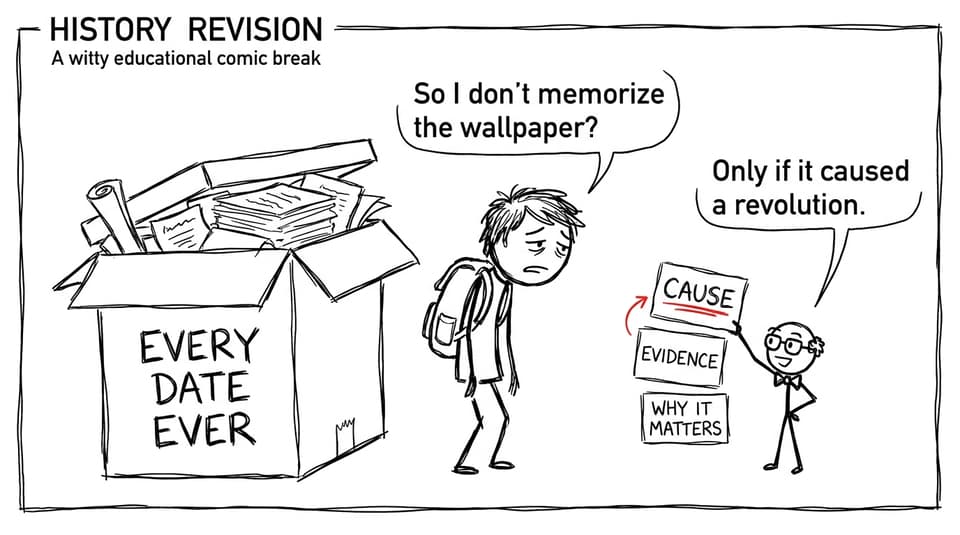
The hardest part of making flashcards for MYP History is deciding what deserves a card. Copy everything, and the deck becomes another textbook. Record only names and dates, and you may remember facts without understanding why they matter.
A better method is to divide one unit into concepts, chronology, causes, consequences, evidence, perspectives, and source skills. Write one focused question per card, answer it briefly, and review it through active recall over several days. You can build a useful first deck today in about 40 minutes.
Your same-day flashcard checklist
Collect your class notes, teacher-provided unit outline, assessment rubric, and one reliable course resource. The RevisionDojo MYP History resource hub brings together Study Notes, Flashcards, lessons, and Questionbank practice.
Use this sequence:
- Choose one narrow topic, not an entire semester.
- List the important concepts, events, people, evidence, and perspectives.
- Turn each item into a specific question.
- Keep each answer short enough to recall accurately.
- Add a second layer asking why the information matters.
- Test yourself immediately without viewing the answer.
- Review missed cards tomorrow, three days later, and one week later.
The goal is not the largest deck. It is a deck that makes important knowledge retrievable.
Build flashcards for MYP History step by step
Choose one clearly defined unit
Start with a topic you can describe in one line, such as the causes of a revolution, the effects of industrialization, or one independence movement. MYP schools may teach different historical topics, so follow your teacher's unit outline rather than assuming there is a universal content list.
Organize the topic under seven headings: vocabulary, people and groups, chronology, causes, consequences, evidence, and perspectives or sources. This prevents history from becoming a collection of disconnected dates.
Extract only useful information
Read one short section of your notes, then ask, "What must I retrieve from this?" A statement such as "Economic hardship contributed to unrest" is too broad. Identify the mechanism, affected groups, supporting detail, and significance. If the relationship remains unclear, return to your notes or the RevisionDojo MYP History Study Guide.
Aim for approximately 15 to 25 cards in one focused session. A complicated unit can become several smaller decks. Card creation should not consume all the time available for testing and writing.
Write one question per card
A strong card tests one mental action. Instead of asking "Explain the revolution," separate the knowledge and analysis:
- Front: What immediate event triggered the uprising?
- Back: State the event, its date if important, and why it escalated tensions.
- Follow-up front: Why was that trigger insufficient on its own?
- Follow-up back: Identify one longer-term condition and connect it to the trigger.
If a card tests five ideas and you remember four, it becomes difficult to judge whether you knew the answer. Smaller prompts make mistakes visible.
Use six useful card types
Effective MYP History revision techniques support both knowledge and historical thinking:
- Definition cards: Explain a term and give a historical example.
- Chronology cards: Identify what happened before or after an event and why the sequence matters.
- Cause-and-consequence cards: Ask how one factor contributed to an outcome.
- Evidence cards: Connect a claim to a precise example that could support a paragraph.
- Perspective cards: Compare how different groups interpreted or experienced an event.
- Source cards: Examine origin, purpose, value, limitation, and reasonable inference.
Avoid presenting an entire country or population as though everyone shared one view. Likewise, do not evaluate a source solely by calling it primary or secondary. The guide to MYP History assessment shows how historical knowledge connects with investigation, communication, and critical thinking.
Keep answers concise but meaningful
For explanatory cards, use three parts:
- Answer: the direct response
- Evidence: one precise supporting detail
- Significance: why that detail matters
For example, wartime debt may contribute to political instability when higher taxes or spending cuts affect groups unevenly and political institutions cannot answer their grievances. That response includes a mechanism and qualification, making it more useful than a memorized slogan.
Align the deck with MYP criteria
Individuals and Societies uses four equally weighted criteria, although an individual classroom task may assess only selected criteria. Exact strands depend on the MYP year, so use your teacher's rubric.
The MYP Individuals and Societies criteria guide explains their purposes. Cards can support them as follows:
- Criterion A: concepts, chronology, examples, and explanations
- Criterion B: research questions, methods, and investigation choices
- Criterion C: command terms, organization, formats, and referencing
- Criterion D: source evaluation, causation, perspectives, and judgements
Most cards naturally support Criterion A, but the deck should not stop there. Add prompts such as "Which source would best test this claim, and why?" or "Which cause appears most significant according to this evidence?" For broader context, compare your task instructions with the guide to how MYP Individuals and Societies is assessed.
Review cards so they produce learning
Creating cards feels controlled. Testing yourself feels harder, and that is where much of the useful work happens.
Read only the front and say or write the complete answer before turning the card over. Mark it correct only when the central idea, evidence, and relationship are accurate. Recognition is not recall, so familiarity with the back does not count.
Use this starter schedule:
- Today: Test every new card and repeat incorrect ones.
- Tomorrow: Review the complete deck without notes.
- In three days: Begin with missed and uncertain cards.
- In one week: Mix the deck with another topic.
- Before assessment: Convert difficult cards into short written responses.
Retrieval practice and spacing are more useful than concentrating every repetition into one sitting. The precise intervals can change, but repeated retrieval with feedback is the essential principle. RevisionDojo's topic decks, including flashcards on decolonisation and independence movements, offer a starting point. Add examples and interpretations emphasized in your classroom.
Turn recall into historical writing
Flashcards prepare knowledge for use, but they do not replace complete responses. After reviewing a deck, select three cards and combine them into a paragraph with a claim, precise evidence, explanation, and link to the question.
Next, attempt a related Questionbank prompt. Use AI Chat to clarify a misconception rather than avoid thinking, and use Grading tools to identify where an answer remains descriptive. The MYP essay structure guide explains how evidence becomes a coherent argument.
As an assessment approaches, available Mock Exams or Exam Builder practice can introduce timing and mixed topics. RevisionDojo also offers Predicted Papers, a Coursework Library, and Tutors across its broader IB ecosystem, although availability varies by programme and subject.
Remove common flashcard mistakes
Rewrite cards containing several unrelated questions, copied paragraphs, insignificant dates, vague prompts, unsupported generalizations, or descriptions without explanation. A useful test is whether the answer could support an explain, analyse, or evaluate response. The MYP Individuals and Societies skills guide helps distinguish these demands.
Start small and let the system compound
Tonight, build 18 cards: three definitions, three chronology cards, four cause-and-consequence cards, three evidence cards, three perspective cards, and two source cards. Test them immediately, then review them tomorrow before adding more.
A flashcard's value is not the information written on it. It is the thinking the card repeatedly asks you to perform. RevisionDojo makes that process easier to sustain: Study Notes establish understanding, Flashcards strengthen retrieval, the Questionbank tests application, and AI Chat or Grading tools reveal what still needs attention. That connected loop turns a stack of cards into a practical MYP History revision system.