
The difficulty of IB World Religions Paper 1 is not the amount of writing. It is the discipline of selecting the right knowledge under pressure.
You have 1 hour 15 minutes to answer five 10-mark stimulus questions. Each question is divided into a 3-mark part and a 7-mark part, giving a maximum of 50 marks. The paper offers nine questions, organized into three religious groupings, and you select five while answering at least one question from each section.
That works out to roughly 15 minutes per question. Success therefore depends on three things: choosing questions intelligently, reading each stimulus as evidence, and writing answers proportionate to the available marks.
This guide explains how to do all three.
Paper 1 format at a glance
The nine available questions correspond to the nine religions studied in Part 1 of the course. They are arranged as follows:
| Section | Religious traditions |
|---|---|
| Section A | Hinduism, Buddhism, Sikhism |
| Section B | Judaism, Christianity, Islam |
| Section C | Taoism, Jainism, Baha'i Faith |
You answer five questions in total, with at least one selected from every section. In practice, your final distribution will usually be two questions from one section, two from another, and one from the remaining section.
Each chosen question contains:
- a written or visual stimulus connected to a religious tradition
- a focused 3-mark task testing accurate recognition or description
- a broader 7-mark task requiring explanation supported by the stimulus and relevant knowledge
- 10 marks in total
Before your examination session, confirm the precise instructions with your teacher and the official materials supplied to your school. Assessment arrangements can be updated, so your session-specific documents remain authoritative.
For wider syllabus support, the IB World Religions resource hub brings together Study Notes, Flashcards, videos, and exam-style Questionbank practice.
A practical 75-minute plan
Seventy-five minutes sounds generous until it is divided by five. Then it becomes a sequence of short decisions.
A workable plan is:
| Task | Suggested time |
|---|---|
| Survey all questions and select five | 3-4 minutes |
| Complete each 3-mark response | 3-4 minutes |
| Complete each 7-mark response | 9-10 minutes |
| Check missing parts and unclear wording | 3-4 minutes total |
The exact split can vary, but one principle should not: do not spend 20 minutes perfecting one response and leave another unfinished. The marks available for each question are equal.
When surveying the paper, choose questions using two tests. First, can you identify the stimulus confidently? Second, can you connect it to several precise teachings, practices, concepts, or examples? Familiarity with a religion is useful, but familiarity alone is not enough if the specific stimulus leaves you with little to explain.
The RevisionDojo guide to IB time-management tools can help you develop this habit before the examination rather than improvising it during the paper.
How to choose your five questions
Question selection is part of the assessment strategy, even though it earns no marks directly. The tempting choice is often the religion you enjoy most. The better choice is the question for which you can produce the clearest evidence-based explanation.
During the opening survey, give each possible question a quick mental rating:
- Strong: You recognize the stimulus and can immediately name two or three relevant concepts.
- Possible: You understand the general topic but would need time to recover supporting detail.
- Risky: The stimulus is unfamiliar, or your knowledge would remain broad and speculative.
Select your required question from each section first. Then fill the remaining two places with your strongest options, regardless of section. This prevents a common problem: choosing four appealing questions before realizing that the remaining section must still be represented.
Do not judge a question from the image alone. Read both tasks because a familiar stimulus may lead to an awkward 7-mark prompt. Conversely, an unfamiliar-looking quotation may contain clear language that points directly toward a teaching you know well. Your decision should account for the whole question, not the first recognizable symbol.
Once you have selected five, commit unless you discover a serious misunderstanding. Repeatedly reconsidering the choices consumes time without improving the answer.
How to read Paper 1 stimulus questions
A stimulus is not decoration. It narrows the question and gives you material to interpret.
Before writing, annotate it mentally or on the paper using four prompts:
- What is shown or stated? Identify concrete words, objects, actions, people, or symbols.
- Which concept does it suggest? Connect those details to beliefs, teachings, practices, or experiences.
- Why does the connection matter? Explain the religious significance rather than merely naming it.
- What should be qualified? Avoid suggesting that every adherent or community behaves identically.
Suppose an image includes worshippers removing their shoes, covering their heads, and sitting together in a gurdwara. Merely listing those details repeats the stimulus. A stronger response connects them to respect, humility, equality, communal worship, or the religious significance of the space, depending on the wording of the question.
This distinction matters because recognition earns limited credit. Explanation shows understanding.
Students sometimes approach religions through simplified labels, then reproduce those labels in the examination. Reviewing common IB World Religions misconceptions can help you replace broad assumptions with careful, tradition-specific language.
How to answer the 3-mark part
The shorter part rewards precision. It does not need an introduction, conclusion, or extended background paragraph.
If the task asks you to identify or outline three features, aim for three distinct points. Keep each point directly connected to the stimulus. When a brief explanation is needed, add one clarifying phrase rather than an unrelated paragraph.
A useful pattern is:
Feature + stimulus evidence + brief meaning
For example:
The flowers placed before the image are offerings. Because cut flowers fade, they can also remind practitioners of impermanence.
Do not write seven facts in the hope that three will be accepted. Extra material consumes time and can introduce inaccuracies. Three clean points are usually safer than a crowded response containing contradictions.
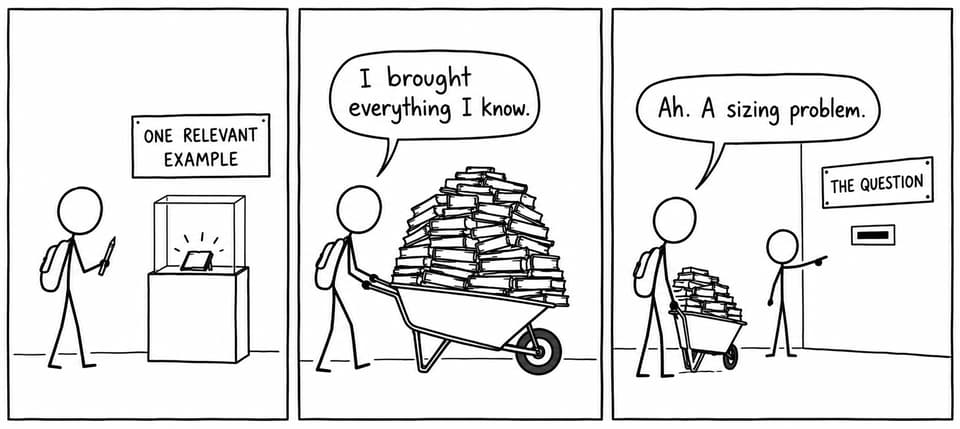
The student discovers that knowing more is different from selecting what fits the question.
How to build the 7-mark explanation
The longer part needs developed connections. It is not necessarily a miniature essay, but it should have a visible line of reasoning.
A reliable paragraph structure is:
- make a focused claim that answers the question
- identify a relevant detail from the stimulus
- explain the associated belief, practice, or concept
- state why that connection is significant
- add accurate contextual knowledge or a qualification
Two or three developed points are generally more valuable than a list of seven undeveloped observations. Use technical vocabulary when it improves precision, but explain what the term means in context. A Sanskrit, Arabic, Hebrew, Punjabi, or Chinese term does not earn credit simply by appearing on the page.
The most common weak response moves directly from observation to assertion: “The stimulus shows meditation, which is important in Buddhism.” A better answer explains what kind of religious purpose meditation may serve, how it relates to a teaching or path, and why the stimulus reflects that connection.
Planning a 7-mark answer in one minute
A brief plan can save more time than it costs. Before writing, note two stimulus details and place one relevant idea beside each. Then decide the order that creates the clearest explanation.
For example, a stimulus showing shared food and worship in a gurdwara might produce this plan:
- shared meal, langar, equality and service
- worship space, Guru Granth Sahib, authority and communal devotion
Those notes are not the answer. They are a route through it. Their purpose is to prevent the first paragraph from absorbing all your knowledge while the second repeats the same point in different words.
Begin with the connection you can explain most securely. This settles the direction of the response and creates an early developed point. Use a phrase such as “This is significant because” when it helps you move from description to interpretation, but do not repeat the same sentence frame mechanically.
A conclusion is optional unless the wording invites an overall judgment. If time is limited, a developed final point is more valuable than a conclusion that merely restates the opening. Read the response once, checking that every paragraph answers the specific question rather than a broader topic you had hoped to discuss.
A short worked example
The following is a hypothetical practice task, not material from an official examination.
Stimulus: A Buddhist practitioner sits in meditation before an image of the Buddha. A bowl of flowers has been placed nearby.
Part A, 3 marks: Identify three religious features visible in the stimulus.
Possible response:
- The practitioner is meditating, a practice associated with developing concentration and awareness.
- The Buddha image provides a focus for reflection and recalls the Buddha as a teacher and model.
- The flowers function as an offering and, because they fade, may symbolize impermanence.
The response is short because the task is short. Each point identifies something visible and adds enough meaning to demonstrate recognition.
Part B, 7 marks: Explain how the stimulus reflects Buddhist ideas about the path toward liberation.
Possible response:
The meditation shown in the stimulus can reflect the cultivation of mental discipline. Within the Noble Eightfold Path, right mindfulness and right concentration help practitioners observe experience more clearly rather than responding through automatic attachment or aversion. This connects meditation to the effort to overcome ignorance, which Buddhism identifies as a root cause of suffering. The Buddha image can remind the practitioner that awakening is possible and that the Buddha's teaching offers a path toward it. The flowers also reinforce this purpose because their fading reflects impermanence. Recognizing that conditioned things change can weaken attachment and support insight. However, Buddhist traditions differ in their devotional and meditative practices, so the image should not be treated as a complete picture of every Buddhist community.
Notice the movement of the answer. It begins with the stimulus, introduces precise knowledge, and then explains significance. The final qualification adds nuance without weakening the central claim.
Mistakes that quietly lose marks
Repeating rather than interpreting
“The person is praying” describes an action. It does not explain its purpose, theological foundation, or significance. Ask yourself, “So what does this show?”
Writing everything you know
A large paragraph on the history of Buddhism is unhelpful if the question concerns ritual practice. Relevance is part of quality.
Treating traditions as uniform
Avoid phrases such as “all Hindus believe” unless the claim is genuinely universal and supportable. Safer phrasing includes “many practitioners,” “within this tradition,” or “this may express.”
Ignoring the command term
Identify, outline, explain, and compare require different levels of development. Circle or underline the command term before answering.
Sacrificing a whole question
An unfinished fifth response can cost far more than a slightly shorter first response. Move on when your planned time has elapsed, leaving space if you intend to return.
How to revise for the IB World Religions exam
Paper 1 revision should combine content recall with selection practice. Rereading a chapter may create familiarity, but the examination requires retrieval and application.
Build one-page maps for each religion using recurring categories such as key beliefs, authoritative figures or texts, ritual practices, ethical expectations, symbols, community life, and internal diversity. Then convert those maps into questions.
RevisionDojo's World Religions Study Notes and Questionbank can help you move between explanation and application. Flashcards are useful for terminology and distinctions, while AI Chat can test whether you can explain a concept without relying on memorized wording. The Grading tools can support response review, but compare automated feedback with your teacher's guidance and official assessment expectations.
The IB flashcard system for active recall offers a practical way to organize retrieval. Pair it with spaced repetition for IB revision so difficult material returns more frequently than knowledge you already recall reliably.
Build stimulus-ready knowledge
Content becomes useful in Paper 1 when you can recognize how it might appear. A definition remembered in isolation is fragile. The same definition connected to an object, practice, quotation, place, or action is easier to retrieve and apply.
For every important concept, build a small chain:
Concept + possible stimulus + religious significance + qualification
For example, a revision entry for seva might connect voluntary service with practical expressions of humility, equality, and responsibility within Sikh life. A qualification could note that service takes different forms and is not confined to one setting. This chain prepares you to explain rather than merely define.
Apply the same process to sacred texts and authorities. Do not stop at remembering a text's name. Ask what role it performs, how practitioners may engage with it, and what visible or written clue might indicate that role. For rituals, learn both the action and its possible meaning. For symbols, distinguish what can be observed from the interpretations that communities may attach to it.
Create mixed stimulus sets instead of revising one religion for an entire session. Moving between traditions forces you to notice distinctions and reduces the risk of transferring a concept from one religion into another without justification. It also resembles the rapid switching required when five examination responses cover multiple sections.
A focused practice routine
Complete practice in three stages:
- Untimed: Learn to identify stimulus details and build accurate connections.
- Partly timed: Give yourself 4 minutes for the short part and 10 minutes for the longer part.
- Fully timed: Complete five selections in 75 minutes under quiet examination conditions.
After each session, classify mistakes as knowledge gaps, stimulus-reading errors, weak explanations, or timing problems. Different problems require different remedies. Study Notes repair missing knowledge; Questionbank sets improve application; Predicted Papers and Mock Exams build endurance. The Coursework Library can show how strong religious analysis uses evidence carefully, while RevisionDojo Tutors can help diagnose patterns that are difficult to see alone.
For a longer preparation schedule, use the World Religions mock examination plan. Students earlier in the course can also use the first-term World Religions guide to establish accurate vocabulary before timed practice begins.
How to review a practice response
Finishing a timed answer is only the first half of practice. Improvement comes from finding the precise point where your reasoning weakened.
Read the response with three different lenses. First, underline every direct reference to the stimulus. If almost nothing is underlined, the answer may have become a general summary of the religion. Second, circle specialist concepts and check each one for accuracy. Third, mark the sentence that explains why each connection matters. If you can find observations and terminology but no significance, the response needs deeper development.
Keep a short correction log with four columns: the question topic, the mistake, the corrected knowledge, and the action for the next session. An entry such as “weak Buddhism answer” is too broad to guide revision. “Named impermanence but did not connect it to attachment” identifies a repairable gap.
Rewrite only the weakest paragraph rather than automatically repeating the entire task. This keeps review efficient and lets you practise the missing skill directly. Later, return to a fresh question that demands the same skill under timed conditions. Feedback becomes valuable when it changes the next response, not when it simply produces a score.
Final checklist
Before the examination, make sure you can:
- explain the nine-question structure and selection rules
- recognize key features from all three sections
- distinguish observation from explanation
- produce a concise 3-mark response
- develop two or three connected points for 7 marks
- complete five responses within 75 minutes
- use tradition-specific vocabulary accurately
- qualify claims about diversity within religions
The central lesson of IB World Religions Paper 1 is simple: marks come from selection, not display. You do not need to unload everything you know. You need to notice what the stimulus makes relevant, connect it to accurate knowledge, and explain that connection clearly.
RevisionDojo gives that process a structure. Its Questionbank, Study Notes, Flashcards, AI Chat, Grading tools, Predicted Papers, Mock Exams, Coursework Library, and Tutors can take you from uncertain recognition to disciplined, timed explanation. In a paper where every question receives about 15 minutes, disciplined explanation is what turns knowledge into marks.