
You walk out of the mock exam room carrying something heavier than your bag.
Not the paper. Not the timer. Not even the content.
It's the story you start telling yourself: "I'm not an IB person."
In the IB, that story spreads fast. One mock result becomes a verdict on your intelligence, your work ethic, your future. But mock exams aren't verdicts. They're messy data points collected at the exact time of year when your sleep, motivation, and time management are usually at their worst.
So yes: if you failed your mock exams, you can still pass IB.
And more than that: you can still do well in IB, if you treat your mock results like a map instead of a prophecy.
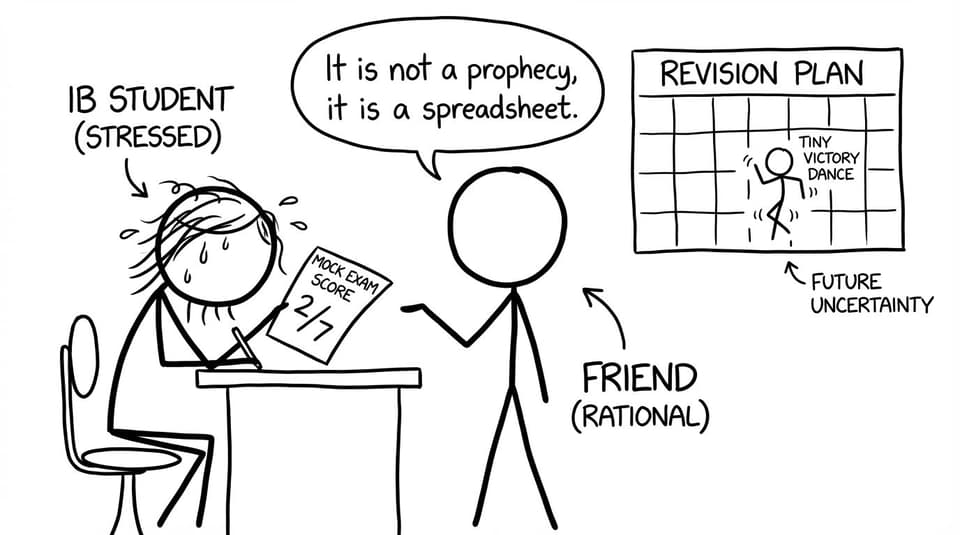
The quick checklist: what to do after failing IB mocks
If your mocks went badly, don't start by "studying harder." Start by studying clearer. Use this checklist as your first reset:
- Collect evidence: scripts, mark feedback, topic breakdowns (per subject).
- Label the failure: content gap, exam technique, timing, or stress.
- Pick 2 high-impact topics per subject (not 12).
- Build a repeatable weekly loop: learn, recall, apply, review, retest.
- Simulate IB conditions weekly (timed, marked, reviewed).
- Get fast feedback so you don't repeat invisible mistakes.
RevisionDojo is built for this exact loop: Study Notes for clarity, Flashcards for recall, a Questionbank for exam-style practice, AI Chat when you're stuck, Grading tools for rubric-based feedback, and Mock Exams plus Predicted Papers for realistic rehearsal.
If you want the full system in one place, start with RevisionDojo for IB and the International Baccalaureate (IB) hub.
Why failing mock exams in IB is more common than you think
A lot of IB students fail mocks for reasons that have nothing to do with capability.
Mocks usually happen when:
- coursework is still draining your focus (IAs, EE, TOK),
- you're revising inconsistently because school is still full-speed,
- you've done more reading than answering.
The IB doesn't reward the student who understands a concept in a calm bedroom. The IB rewards the student who can produce a markscheme-shaped answer under time pressure, with command terms and structure.
Mocks expose the gap between understanding and output.
That's not a character flaw. It's a training problem.
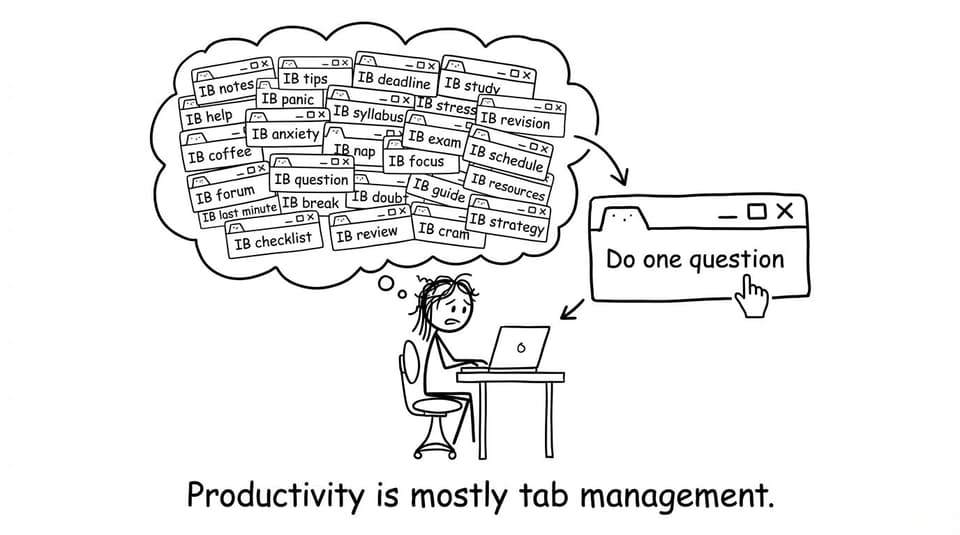
IB mock exam results: the four failure types (and what fixes each)
To pass IB after failing mocks, you need the right diagnosis. Most mock "fails" fall into one of four buckets.
Content gaps (you truly haven't learned enough yet)
This is the most straightforward. You don't know the key definitions, processes, case studies, or methods.
Fix:
- Use syllabus-aligned explanations, then immediately test.
- Stop rewriting notes and start converting notes into answers.
RevisionDojo's Digital IB Study Notes are designed for fast comprehension. Pair them with the Questionbank so your "learning" turns into marks.
Exam technique gaps (you know it, but you don't earn marks)
This is the classic IB trap: you "understand" the topic, then write something that sounds right, and still lose marks.
Fix:
- Train command terms: explain vs evaluate vs to what extent.
- Compare your answer to how marks are actually awarded.
- Practice short, structured responses, not long, hopeful ones.
A powerful loop is: attempt one Questionbank item, then use Jojo AI Chat to ask, "Where did my answer drift from the markscheme?" See IB Study: Text to Your AI Tutor.
Timing and pacing (you run out of time, or rush the high-mark parts)
In IB, pacing is a skill. Many students "fail" mocks simply because they never rehearsed time pressure.
Fix:
- Do weekly timed sections.
- Learn when to move on.
- Review pacing errors like they're content errors.
Start with Online IB Mock Exams: Practice Anywhere, Anytime and add one timed session a week.
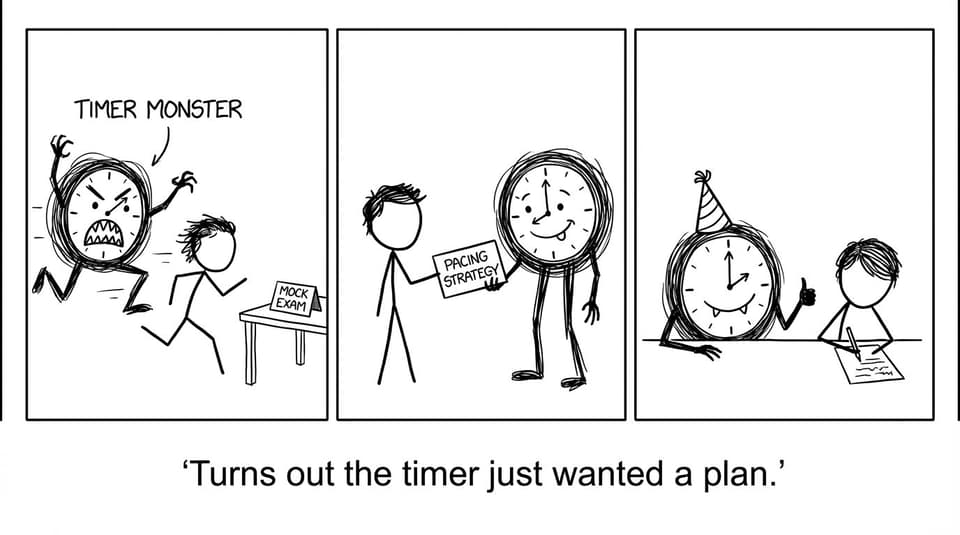
Stress and execution (you blank, spiral, or lose confidence mid-paper)
This is real, and it's not solved by telling yourself to "calm down." It's solved by making the exam feel familiar.
Fix:
- Simulate pressure often enough that it becomes normal.
- Build a small pre-exam routine you repeat.
- Use feedback loops so confidence is based on evidence.
RevisionDojo's RevisionDojo App: The Smarter Way to Prep for IB Exams is essentially a confidence factory: practice, feedback, analytics, repeat.
The IB comeback plan: a realistic 3-phase reset
You don't need a personality change. You need a plan that respects time.
Phase 1: Stop the bleeding (first 7 days)
Your only goal is to stop random studying.
- Pick one subject where you lost the most marks.
- Identify the top 3 recurring errors.
- Do 30-45 minutes a day of targeted practice.
Use Comprehensive IB Question Bank: Thousands of Practice Questions to drill exactly what's weak, not what's comfortable.
Phase 2: Build the loop (weeks 2-5)
This is where IB improvement actually happens: repetition with feedback.
A simple weekly pattern:
- 2 sessions: Learn one topic using Study Notes, then create recall cues.
- 3 sessions: Questionbank practice on that exact topic.
- 1 session: Timed mini-mock (or a paper section), then review.
Add IB Flashcard System: Active Recall for Better Memory to keep recall alive daily, especially for definitions, diagrams, and processes.
Phase 3: Simulate and sharpen (last 3-4 weeks)
Now you reduce surprises.
- Weekly full-paper simulations.
- Deep review of mistakes (patterns, not pain).
- Tighten structure, command terms, and timing.
RevisionDojo's approach to realistic rehearsal is explained well here: IB Predicted vs Specimen Papers: What They Mean. Used correctly, these are training tools for IB stamina and coverage.
A note on coursework stress (yes, it affects your IB exams)
Many IB students "fail" mocks while quietly carrying coursework anxiety: IA drafts, EE structure, TOK wording, fear of feedback.
That stress steals focus from revision.
This is why RevisionDojo includes a Coursework Library and Grading tools alongside exam prep. When you can upload a draft and get rubric-aligned feedback quickly, the background noise lowers.
If coursework is part of what's weighing you down, explore the IB Coursework Grader and see how fast feedback changes momentum.
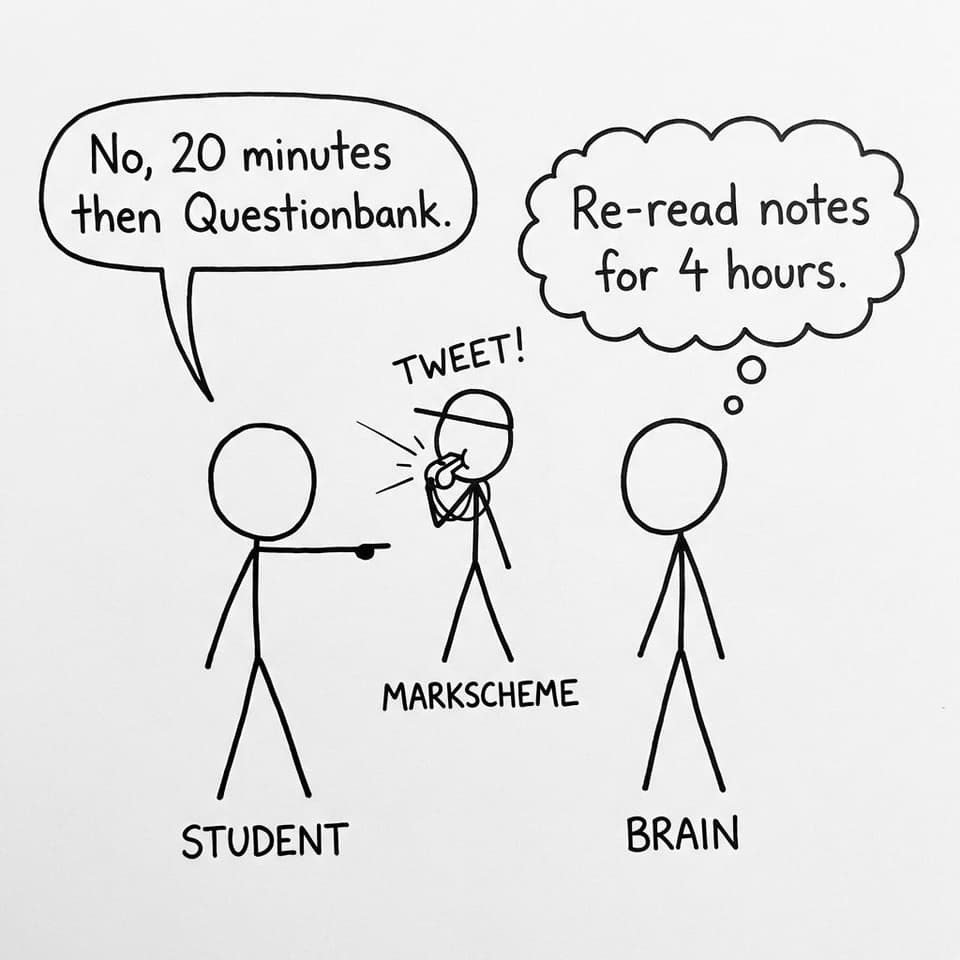
Closing: a mock score is information, not identity
The IB is a system that rewards practice shaped like the exam.
If your mock exams went badly, you didn't receive a verdict. You received data. And data is useful when you act on it.
Build a loop you can repeat: clarify with Study Notes, retain with Flashcards, prove it with Questionbank practice, get unstuck with AI Chat, and rehearse the real thing with Mock Exams and Predicted Papers. If coursework is adding pressure, use Grading tools and the Coursework Library to keep that stress contained, and bring in Tutors when you need a human to raise the bar.
When you're ready to turn today's mock disappointment into an IB plan you can trust, start here: RevisionDojo for IB.