When revision season hits, something predictable happens in almost every IB classroom: the “big ideas” quietly step aside.
Students start asking for more notes, more definitions, more model answers. Teachers, wanting to help, often respond with more content. It feels practical. It feels urgent. And it can also be the fastest way to forget why the IB works in the first place.
The IB was never designed as a memory contest. It rewards understanding that travels--from topic to topic, from one context to another, and from a familiar question to a new one. That is concept-based learning. And the best teachers keep it alive during revision, even when everyone is tempted to cram.
Below are practical, student-friendly ways IB teachers can reinforce concept-based learning during revision so you walk into exams with ideas you can actually use.
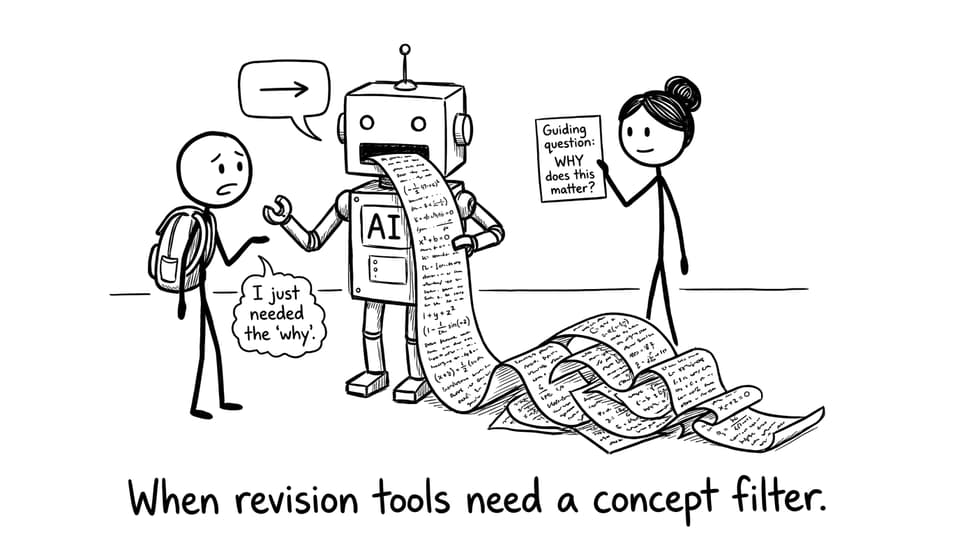
Concept lighthouse during revision
Quick checklist: concept-based revision that still feels exam-focused
If your teacher does only five things in IB revision, these are the ones that change outcomes:
Start each session with one “big idea” and one guiding conceptual question.
Use exam-style questions as a vehicle for concepts, not a replacement for them.
Force connections across units (concept maps, “threads,” compare/contrast prompts).
Add one TOK-style perspective shift per topic (how do we know? who benefits? what is assumed?).
Track concept mastery using analytics and targeted practice, not vibes.
If you want a platform that makes this loop easier to run at home, RevisionDojo brings it together with Study Notes, Flashcards, Questionbank, AI Chat, Grading tools, Predicted Papers, Mock Exams, a Coursework Library, and Tutors.
Why concept-based learning matters in IB revision
In the IB, the highest marks tend to appear when you can do three things at once:
explain a concept clearly,
apply it to a specific syllabus situation,
and evaluate or connect it to another context.
That’s concept-based learning in practice. It protects you from the worst revision trap: knowing a lot of facts but not knowing what to do with them.
Concept-based revision also makes your studying more efficient. When you revise the concept of causation, for example, it helps you in multiple History units. When you revise systems or equilibrium, it shows up across sciences. The IB is full of repeats like this--not repeated content, but repeated thinking.
Start revision with big ideas (before details)
A strong IB teacher often begins revision in a way that feels almost too simple: a concept, written clearly, with one question underneath it.
Examples of “big idea” concepts by subject:
IB History: change, causation, perspective
IB Biology: systems, interaction, balance
IB Economics: scarcity, efficiency, equity
Then the teacher asks something like:
“Where else does this show up in the syllabus?”
“What would this concept look like in a new case study?”
“What is the common mistake students make when applying this idea?”
This matters because the IB examiners reward transfer. If you can transfer your understanding, you are harder to surprise.
To lock the concept in, many students pair the teacher’s framing with concise references like RevisionDojo’s examiner-written Study Notes so the “big idea” is anchored to accurate syllabus detail.
Use conceptual questions, not just content questions
Content questions ask: “What is it?”
Conceptual questions ask: “Why does it work like that?” and “So what?”
A good IB teacher will take a standard revision prompt and lift it one level:
Instead of “Define fiscal policy,” ask: “How does fiscal policy show a trade-off between equity and efficiency?”
Instead of “State what homeostasis is,” ask: “How does homeostasis illustrate stability and change inside a system?”
The shift is subtle, but it changes your brain’s job. You stop collecting definitions and start building explanations.
At home, you can train the same skill using targeted practice sets from a question bank, then rewriting your answer in conceptual language. RevisionDojo’s Questionbank feature is built for this kind of practice-and-feedback loop, especially when you filter by topic and difficulty.
Make connections across units (because IB exams love synthesis)
A teacher reinforcing concept-based learning during IB revision will regularly force you to link units that feel separate.
Two easy classroom moves:
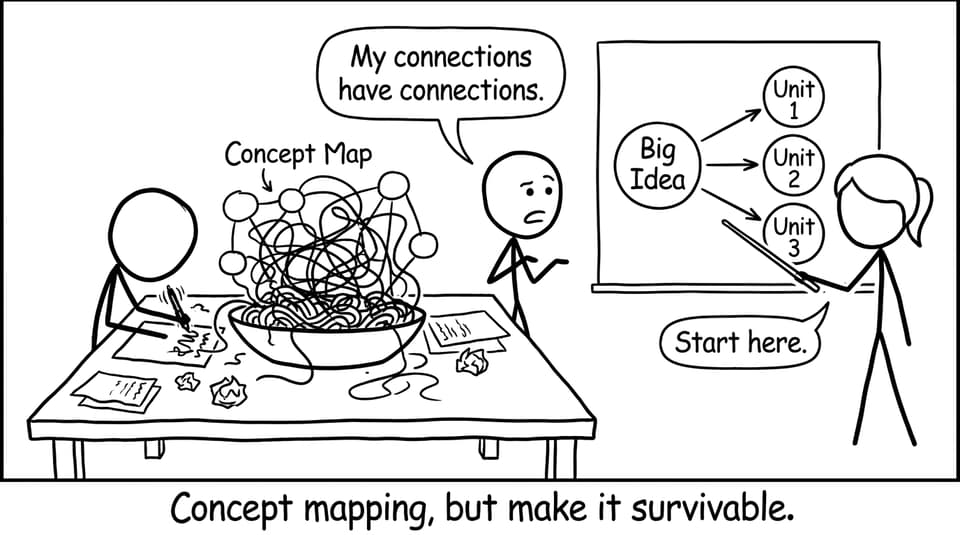
Concept maps that start small
Not the giant “map of everything.” The survivable version:
Put one big concept in the middle.
Add three units around it.
Add one example per unit.
Add one sentence explaining the connection.
“Concept threads” across the syllabus
A concept thread is a short activity where you track one idea across different topics:
“Where does change appear, and what causes it each time?”
“Where does systems thinking appear, and what are the inputs/outputs?”
This is the same mental move you need when the IB asks you to evaluate, compare, or apply.
Concept map spaghetti joke
Bring TOK thinking into revision (without turning it into a lecture)
TOK is often treated like a separate room in the house. But during IB revision, your teacher can use TOK-style prompts as a quick lens that deepens answers.
Helpful TOK-flavoured revision questions:
“How do we know this?” (methods, evidence, reliability)
“Whose perspective is missing?” (bias, context, power)
“What assumptions does this model depend on?” (limitations)
Even 3 minutes of this kind of questioning can upgrade an answer from “correct” to “insightful.” And in IB markbands, that jump matters.
Anchor concepts in real-world examples (so they stick)
Concepts become memorable when they touch reality. During revision, IB teachers can ask you to attach each concept to a specific example:
Globalization: one trade change, one migration pattern, one consequence
Identity: one text, one historical moment, one perspective shift
Sustainability: one policy, one tension, one outcome
This is not “extra.” It is how you build answers that feel grounded instead of generic.
RevisionDojo supports this style of studying because you can move from a short explanation in notes to immediate practice, then reflect on what your example did to the quality of your response. If you struggle with retention, Use RevisionDojo Notes to Boost IB Retention is a practical companion.
Scaffold conceptual thinking with a simple question ladder
In the best IB revision lessons, teachers don’t just say “think deeper.” They provide a ladder.
A simple ladder you can copy into your notebook:
Level 1: What is the concept?
Level 2: How does it operate in this topic?
Level 3: Why does it matter in a wider context (ethical, global, historical, scientific)?
This ladder works because it matches how the IB often rewards responses: clear knowledge, applied understanding, then evaluation or insight.
If you want to make this a habit, build short daily retrieval sessions with flashcards. RevisionDojo’s IB Flashcards with Spaced Repetition (SRS) are designed for recall, but you can also add “Level 2” and “Level 3” prompts as application cards.
Track concept mastery with technology (so revision stays honest)
Concept-based learning can feel invisible if you only measure “chapters covered.” That’s why tracking matters.
Teachers can reinforce concept-based revision by:
assigning short mixed-topic sets,
tagging the underlying concepts (not just the unit),
and reviewing patterns of misunderstanding.
At scale, that’s where RevisionDojo for Schools becomes genuinely useful: it helps teachers teach, test, and respond faster, while students get clearer next steps. And because RevisionDojo includes tools like Grading tools, AI Chat, Mock Exams, and Predicted Papers, revision becomes a connected system instead of scattered resources.
How can teachers balance concept-based learning with IB exam practice?
Teachers can treat exam questions as the arena where concepts compete, rather than as a separate “practice mode” that replaces understanding. After any IB-style question, the most helpful follow-up is: “Which concept was actually being tested here?” Then the teacher can ask students to rewrite the answer with one explicit conceptual sentence at the start. That single sentence often changes the structure of the whole response and makes the argument clearer. Next, teachers can ask for a second example or a second context to force transfer, which is what IB assessment is designed to reward. Finally, using targeted practice tools (like a topic-filtered Questionbank) lets students do exam practice while staying anchored to concepts. Over time, students stop seeing concepts as “extra” and start seeing them as a shortcut to better marks.
What if IB students resist conceptual revision and just want to memorise?
That resistance is usually fear wearing a practical costume. Memorising feels controllable, while conceptual thinking feels like it could expose gaps. A teacher can reduce that fear by showing students how concepts make questions more predictable: one concept, many question formats. It also helps to set a clear rule: every memorised detail must be attached to an explanation or an example, otherwise it does not count as “revised.” Teachers can demonstrate this by comparing two answers side by side: one that lists facts, and one that uses the same facts to make a conceptual point. Students usually notice that the conceptual answer is easier to read and more convincing. The final step is giving students fast feedback loops so they experience improvement quickly, which is why platforms like RevisionDojo are effective during IB revision.
How can teachers assess conceptual understanding during IB revision?
Teachers can assess conceptual understanding without adding heavy marking by using short, structured tasks. Concept maps, one-paragraph synthesis responses, and “teach it back” explanations reveal understanding faster than long worksheets. A strong method is to ask students to answer a question, then label their own work: where is the concept, where is the evidence, and where is the evaluation? Teachers can also use comparison prompts, like “How does this concept look different in Topic A vs Topic B?”, which forces students to move beyond memorised phrasing. Another efficient strategy is to use rubric-aligned feedback tools for written responses, so students learn what the IB rewards in language and structure. On RevisionDojo, the combination of Questionbank practice and Grading tools helps students see exactly which parts of their thinking are strong and which parts are missing. Over time, this makes conceptual mastery measurable, not mysterious.
Closing: the calm advantage in IB revision
In the final weeks before IB exams, you do not need more panic. You need a clearer lens.
Concept-based learning is that lens. It turns revision into something steadier: fewer isolated facts, more connected understanding, and answers that travel well when the question changes.
If you want to run that concept-first approach outside the classroom, build your routine around RevisionDojo: use Study Notes to clarify, Flashcards to retain, the Questionbank to apply, AI Chat to get unstuck, Mock Exams and Predicted Papers to rehearse under pressure, and Tutors when you need a human to raise the ceiling. That is how IB revision becomes not just harder work, but smarter work.
Nathan holds an MA in Philosophy from Trinity College Dublin and has taught IB Theory of Knowledge and Philosophy for 20 years, including a decade as TOK coordinator. His focus is the IB TOK essay and exhibition, giving students a repeatable way to unpack knowledge questions in a subject with no fixed answers.