
For IB students sitting exams in May 2028 (started DP1 in August 2026).
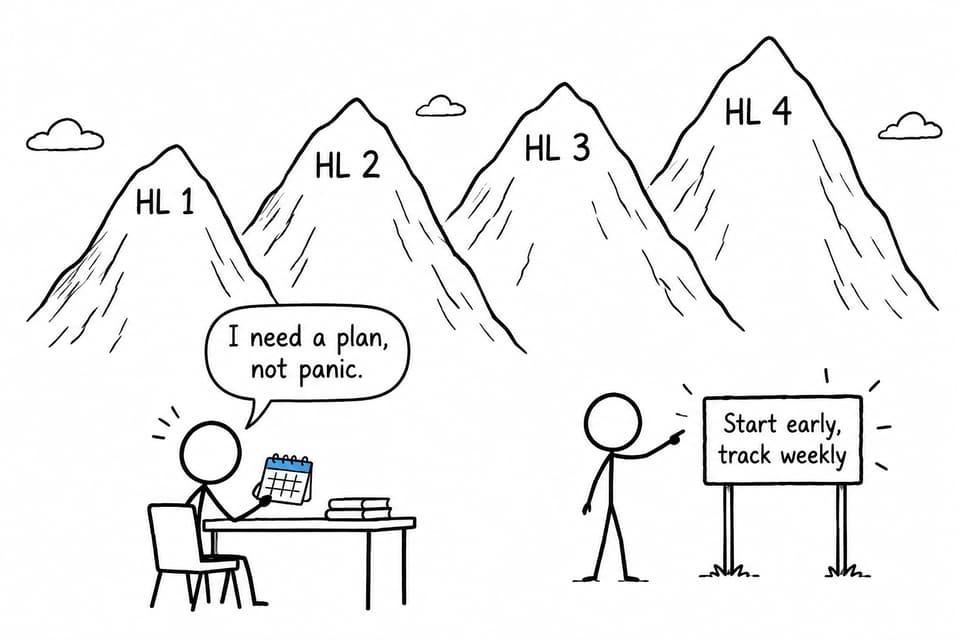
The best way to manage a heavy HL load for May 2028 is to plan by evidence: rotate demanding subjects across the week, begin coursework early, practise actively, and protect recovery time. If you are taking four HLs, treat the fourth as sustainable only while your results, deadlines, and wellbeing show that it remains worthwhile.
A difficult subject combination is rarely defeated by one heroic revision month. It is usually managed through ordinary weeks in which each subject receives the right kind of attention. The goal is not to make every day intense. It is to stop important work from remaining invisible until it becomes urgent.
Your heavy HL workload checklist
Before building a detailed timetable, establish these foundations:
- List every HL topic, internal deadline, test, and coursework milestone you currently know.
- Give each HL a weekly minimum rather than waiting for motivation.
- Separate learning, retrieval, question practice, and error correction.
- Identify one subject that needs extra support each week.
- Protect sleep, exercise, meals, and at least one low-intensity period.
- Review the plan weekly using completed work and assessment evidence.
- Ask your coordinator early about subject-registration rules and school deadlines.
A useful plan should make the next action obvious. The RevisionDojo IB study planner guide explains how to connect scheduled work with specific resources instead of writing vague tasks such as “revise chemistry.”
Why a hard HL combination feels heavier than it looks
Three HL subjects do not create three identical workloads. Mathematics may demand frequent problem solving, a science may combine conceptual learning with practical work, and a language or essay-based subject may require extended reading and writing. The difficulty lies in switching between these modes while keeping six subjects, Theory of Knowledge, the Extended Essay, CAS, and coursework moving.
That is why counting study hours alone can mislead you. Two hours spent rereading familiar notes may produce less progress than 45 minutes spent retrieving a weak concept, answering targeted questions, and correcting the errors.
For every study block, define an output:
- explain a process without notes
- complete and mark a focused question set
- draft one subsection
- correct five recurring errors
- create flashcards from misunderstandings
- outline an essay under time pressure
This turns workload into visible progress. The realistic week-by-week IB study plan offers a useful model built around focused blocks rather than endless sessions.
Build a weekly system before an exam schedule
Your DP1 timetable should be repeatable during normal school weeks. Begin with fixed commitments, then add focused study blocks where your energy is likely to support the task.
| Block type | Best use |
|---|---|
| High-energy block | New mathematics, difficult science problems, essay planning |
| Medium-energy block | Questionbank sets, structured writing, coursework development |
| Low-energy block | Flashcards, error-log review, organising notes |
| Weekly review | Checking deadlines, results, weak topics, and next actions |
A student with three demanding HLs might schedule two focused blocks for each HL across the week, then assign one flexible block to the subject currently showing the greatest need. Four-HL students should avoid giving every subject equal time automatically. Equality sounds fair, but proportional attention is more useful.
Use short feedback loops. RevisionDojo Study Notes can clarify a concept, Flashcards can test retrieval, and the Questionbank can reveal whether the knowledge transfers into an exam-style problem. The daily IB study schedule shows how these activities can form one deliberate sequence.
Managing four HLs without normalising overload
Four HLs can be academically interesting, but the decision should survive contact with your actual calendar. More subjects at Higher Level do not automatically create a stronger application. Requirements differ among universities and courses, so check official entry requirements directly and discuss your choices with your school counsellor or IB coordinator.
Review four HLs at predetermined checkpoints, perhaps after a reporting cycle or significant assessment period. Ask:
- Are all four subjects progressing, or is one surviving through repeated crisis work?
- Is the fourth HL required for a clearly identified pathway?
- Are SL subjects, coursework, or core components being neglected?
- Can you recover from a difficult week without sacrificing sleep?
- What is your school’s deadline and process for changing levels?
If the answers show persistent strain, changing one subject to SL may be strategic rather than defeatist. The important thing is to make the decision early enough for your school to implement it and for you to redirect your effort productively.
Do not wait until May 2028 to discover whether your workload system works. Use topic tests, teacher feedback, RevisionDojo Grading tools, Predicted Papers, and occasional Mock Exams to test both knowledge and pacing. The guide to effective IB practice resources can help you choose the appropriate tool for each stage.
Planning three sciences HL carefully
A three sciences HL plan deserves an early conversation with your IB coordinator. Do not assume that a preferred combination can automatically be registered within your school’s Diploma Programme route. Confirm the applicable rules, timetable feasibility, and any university implications before building your long-term study plan around it.
Academically, three sciences HL creates overlapping pressure from content, calculations, practical work, internal assessments, and cumulative understanding. The overlap can help when concepts reinforce one another, but it can also encourage passive familiarity. Recognising a term in biology does not prove you can explain it precisely; following a worked physics calculation does not prove you can reproduce the reasoning independently.
Use a different error log for each science. Categorise mistakes as conceptual, mathematical, command-term, data-handling, or time-management errors. Then use RevisionDojo AI Chat to investigate a misunderstanding, Study Notes to rebuild the idea, and Questionbank practice to test it again. For biology specifically, the IB Biology self-study resources guide explains how to combine resources without turning revision into passive reading.
Keep coursework from competing with revision
Coursework becomes dangerous when it remains undefined. “Work on my IA” is too large to start and too vague to track. Replace it with actions such as selecting variables, checking the method, cleaning a dataset, drafting one analysis paragraph, or applying one item of teacher feedback.
Create personal milestones ahead of school deadlines. This leaves room for failed experiments, revised research questions, unavailable sources, and ordinary disruption. It also prevents several HL submissions from converging into the same week.
RevisionDojo’s Coursework Library can help you understand structure and expectations, while Tutors can support areas where independent work is no longer resolving the problem. These should guide your thinking, not replace it. Your work must remain your own and follow your school’s academic-integrity requirements.
Maintain a separate coursework board with four columns: next action, in progress, waiting for feedback, and complete. Review it alongside your subject plan every week. The purpose is not perfect organisation. It is early visibility.
Revise through evidence, not mood
Students naturally return to subjects that feel comfortable. A heavy HL schedule makes that habit expensive because weaknesses can remain hidden behind hours of apparently productive work.
Track a small set of useful indicators:
- topics retrieved accurately without support
- question sets completed and corrected
- recurring errors by category
- timed performance
- coursework milestones completed
- teacher feedback requiring action
After each week, ask what the evidence changes. A weak topic may need more blocks. A strong topic may move to maintenance. A repeated command-term error may require deliberate written practice rather than more content review.
As May 2028 approaches, expand from topic-level sets to mixed and timed work. Predicted Papers and Mock Exams are most valuable when followed by careful correction. The eight-week IB exam-season plan explains how to move from targeted repair towards complete timed practice.
The deepest advantage of a system is not that it removes difficulty. It makes difficulty legible. You can see what is improving, what is slipping, and where the next hour matters most. RevisionDojo brings that process together through its Questionbank, Study Notes, Flashcards, AI Chat, Grading tools, Predicted Papers, Mock Exams, Coursework Library, and Tutors.
Your next step: create a free RevisionDojo account, enter your HL subjects into the planner, and record one measurable task for each subject this week so you can track what is completed.