


Guilt-Free Hobbies for IB Students During Exam Prep
The quietest stress in IB exam season is not the syllabus. It's the feeling that every non-study minute is a mistake.
You sit down to rest, and your brain opens a second tab you never asked for: guilt. It narrates everything. That walk could've been a Biology diagram. That song could've been an essay plan. That match could've been 20 questions.
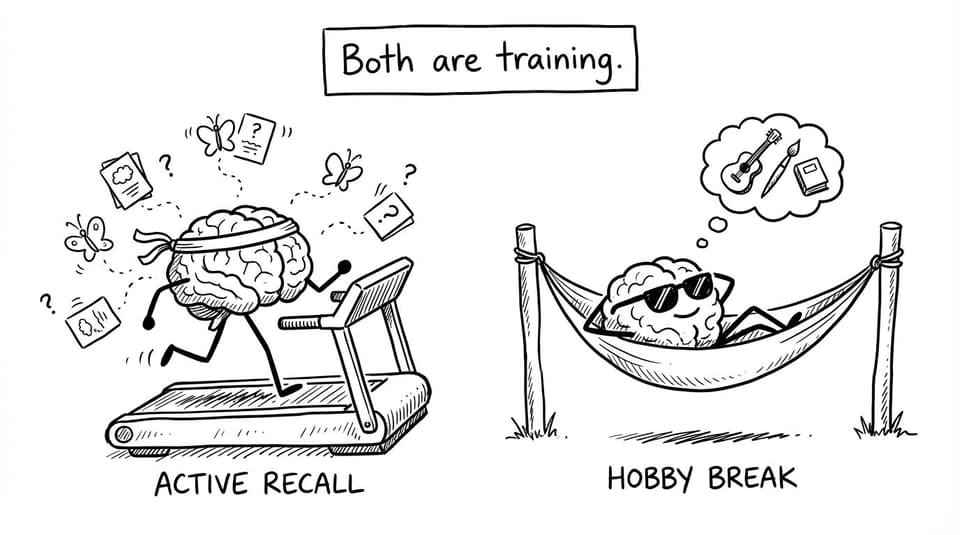
But the IB isn't a contest to see who can live like a machine the longest. It's a performance under pressure. And performance has a hidden requirement: recovery.
This post is about hobbies IB students can maintain without guilt because they don't steal from revision. They protect it. They're the kind of "time off" that gives you your focus back, so your next session is sharper, calmer, and more effective.
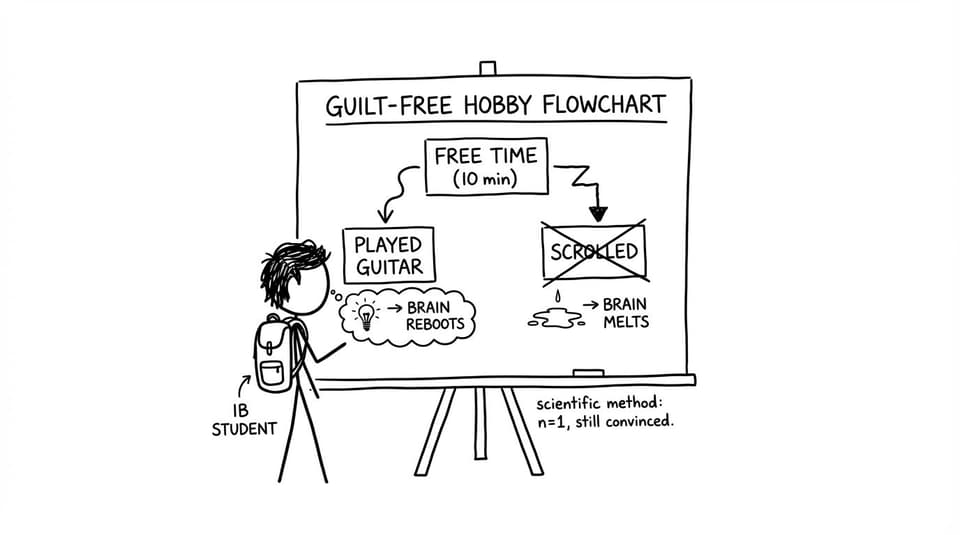
The guilt-free hobby checklist (print this mentally)
A hobby is guilt-free in IB exam season when it meets most of these:
- It has a clear start and stop (timer-friendly).
- It reduces stress and makes starting the next session easier.
- It doesn't spiral into "just one more hour."
- It gives your brain a different kind of effort (physical, creative, social, sensory).
- It fits your schedule like a puzzle piece, not a second puzzle.
A helpful rule: if a hobby consistently makes you avoid revision, it's not a hobby right now, it's an escape hatch. We'll fix that later with boundaries.
Why IB students feel guilty about hobbies (and why that guilt is misleading)
The IB creates open loops. There's always more you could do: more content to cover, more questions to try, more feedback to chase, more polishing to attempt. When there's no obvious finish line, your brain refuses to give you a "done" signal.
So you look for certainty. You measure your day by hours. You compare yourself to the student who claims they revised until midnight. You start treating hobbies like a moral failure.
But exam outcomes don't reward martyrdom. They reward skills trained repeatedly: retrieval, application, timing, and structure. If you want a calmer workflow built around proof, not panic, RevisionDojo is designed for that loop: Study Notes for clarity, Flashcards for daily recall, Questionbank for targeted practice, AI Chat for quick "unstuck" moments, and realism through Mock Exams and Predicted Papers.
If you want the bigger system first, keep this open: RevisionDojo App: The Smarter Way to Prep for IB Exams.
Hobbies IB students can maintain without guilt (and how to do them)
Below are hobbies that tend to work well during IB exam preparation because they restore energy without hijacking your day. The key is not which hobby you pick. It's how you contain it.
Movement hobbies (the "brain rinse" category)
Movement is the most unfair advantage in IB revision because it improves mood and focus without requiring you to "solve" anything.
Good options:
- Walking outside (10-30 minutes)
- Short gym session (30-45 minutes)
- Team training (if it's already part of your week)
- Yoga or stretching routines
How to keep it guilt-free:
- Put it between two study blocks, not in the middle of procrastination.
- Decide the return trigger in advance: "After my walk, I do 12 Flashcards."
Pair it with practice: after movement, do a small set in the Comprehensive IB Question Bank so your brain learns a new association: hobby break -> focus -> proof.
Creative hobbies (the "identity saver" category)
The IB can shrink your identity into a list of deadlines. Creative hobbies push back. They remind you you're still a person, not a revision robot.
Good options:
- Playing an instrument
- Sketching or digital art
- Cooking something simple
- Creative writing that has nothing to do with TOK
How to keep it guilt-free:
- Make it small: 10-25 minutes is enough to feel human again.
- Stop while it's still fun. Leave yourself wanting more.
A trick: use creativity as a reward for finishing something measurable (a Questionbank set, a timed paragraph, a flashcard streak). Measurable effort reduces guilt because it produces evidence.
Social hobbies (the "stress valve" category)
You don't need constant social time in IB season, but isolation is a slow leak that turns into burnout.
Good options:
- A short café meet-up
- A walk with a friend
- A weekly group activity (club, training, rehearsal)
How to keep it guilt-free:
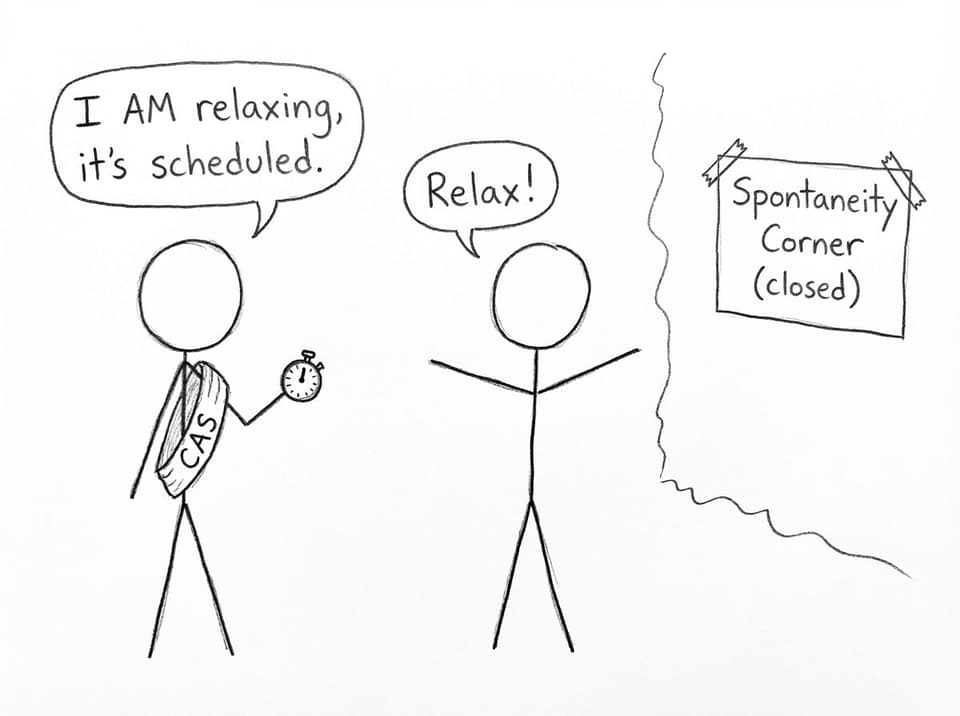
- Schedule it. Spontaneity is expensive during exam season.
- Choose social time that ends cleanly (one activity, not an endless roam).
If your phone turns every social moment into a distraction hangover, this helps: IB Focus Fix: The Dopamine Problem.
Low-friction hobbies (the "I'm tired but not lost" category)
Some days you're not burned out. You're just depleted. You need rest that doesn't come with decision fatigue.
Good options:
- Reading fiction (one chapter)
- Puzzles (short, bounded)
- Taking care of a pet
- Organizing your space for 10 minutes
How to keep it guilt-free:
- Avoid infinite feeds. They look like rest and feel like debt.
- Use a timer and a hard stop.
When your focus is fragile, simplify the studying side too. One tab, one loop. This guide is a useful companion: IB Tech Boundaries: Use Technology Without Losing Control.
"CAS-adjacent" hobbies (the "two birds" category)
Not every hobby needs to be productive, but if you're behind on CAS, you can choose hobbies that naturally align without draining you.
Good options:
- Volunteering you genuinely like
- Coaching younger students
- Community sports
How to keep it guilt-free:
- Protect the next-day cost. Don't choose activities that destroy sleep.
- Keep one weeknight mostly light so you can recover.
And if you're already trying to balance revision with activities, this post overlaps nicely: How to Manage IB Revision with Extracurricular Activities.
The simple system: "Proof, then play"
The easiest way to remove hobby guilt in IB season is to stop negotiating with yourself.
Try this:
- Proof (25-45 minutes): one focused block that produces evidence.
- 10 minutes Study Notes
- 10 minutes Flashcards
- 10-20 minutes Questionbank
- Play (10-30 minutes): hobby break with a timer.
- Return (5 minutes): a tiny restart task so you don't drift.
This works because guilt usually comes from ambiguity. Evidence dissolves ambiguity.
If you want a mindset reset on why rest counts as strategy, keep this bookmarked: Why Rest Is Productive in IB.
How RevisionDojo makes hobbies easier to keep (not harder)
Hobbies become stressful when studying is vague. Vague study plans create the feeling that you should always be doing more.
RevisionDojo reduces that pressure by making progress visible:
- Questionbank turns "I revised" into a score, a pattern of errors, and a next step.
- Study Notes keep content tight so you don't drown in rewriting.
- Flashcards make daily revision small enough to fit around hobbies.
- AI Chat shortens confusion so you don't lose an hour to one concept.
- Grading tools and the Coursework Library reduce the emotional weight of coursework uncertainty.
- Predicted Papers and Mock Exams create exam realism so your confidence comes from evidence.
- Tutors add a human plan when you need triage, not more pressure.
If motivation is coming and going, that's normal in IB. This piece explains why (and what to do): Why IB Motivation Comes and Goes (And What to Do).
Closing: in IB, the goal is stamina, not self-punishment
The students who do well in IB exam season aren't the ones who never take breaks. They're the ones who stop turning breaks into emergencies.
Keep hobbies, but keep them bounded. Earn your rest with proof, not guilt. Let your life stay large enough that studying doesn't feel like a cage.
If you want revision that leaves room for being human, build your system in one place: RevisionDojo's Study Notes, Flashcards, Questionbank, AI Chat, Grading tools, Predicted Papers, Mock Exams, Coursework Library, and Tutors are designed to turn effort into evidence. And when you have evidence, guilt gets quieter.