
Technology rarely ruins an IB grade in a dramatic way.
It does it quietly.
A notification steals 12 seconds. A quick scroll becomes 12 minutes. You return to your notes, but your brain feels like a browser with 27 tabs open. You still "studied" for two hours, yet nothing sticks. And because IB exam season is already loud: deadlines, anxiety, coursework, group chats; you start to believe you need more tech to cope.
What you actually need is something calmer: a few boundaries that turn technology back into a tool.
This guide is for IB students preparing for exams who want to use tech to learn faster, practice better, and stay sane; without letting their devices run the day.
The IB tech boundary checklist (save this)
If your attention is scattered, start with this short IB checklist. It's simple enough to repeat daily.
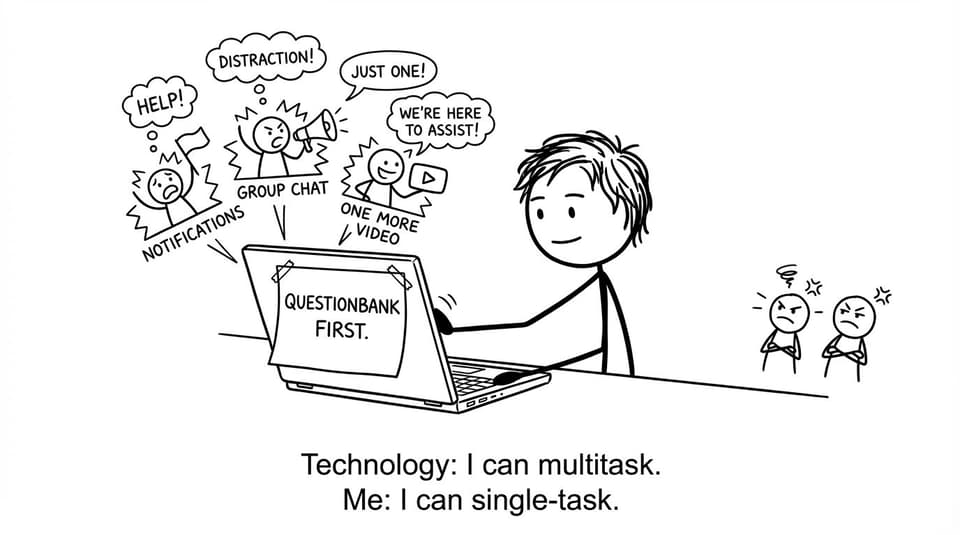
- Pick one primary device for the session (laptop or tablet) and make your phone "break-only."
- Turn off all notifications for the duration (or use Focus/Do Not Disturb).
- Define one outcome: "25 questions," "one timed section," or "one weak topic repaired."
- Use tech in this order: understand to recall to apply to feedback.
- End by writing the next session's first task (so you don't waste tomorrow's first 10 minutes).
If you want a structured loop designed for IB exam prep, RevisionDojo is built around this exact sequence: Study Notes, Flashcards, Questionbank, AI Chat, Grading tools, Predicted Papers, Mock Exams, Coursework Library, and Tutors.
Why IB students feel "controlled" by technology
In IB, it's not just that distractions exist. It's that your workload is ambiguous.
A math problem set has a finish line. But "revise Biology HL" does not. When the task feels endless, your brain looks for relief. Your phone offers instant, predictable relief. That makes it powerful.
The fix is not moral discipline. It's clarity.
A good IB study session has three properties:
- Small enough to start.
- Specific enough to measure.
- Feedback-rich enough to know what to do next.
This is why question-driven revision tends to beat content-hoarding revision. It gives your brain proof.
To make your sessions more measurable, borrow an approach from How to Study Efficiently for IB Without Getting Distracted and pair it with a tighter revision system like How to Study for IB Exams: Step-by-Step Guide.
Use technology the IB way: build a "control panel," not a buffet
Most students use technology like a buffet: a little video, a little summarizing, a little highlighting, a little panic. The variety feels productive. But variety without direction is just movement.
Instead, build a control panel. Give each tool one job.
- Study Notes: clarity, not comfort.
- Flashcards: daily recall, short and consistent.
- Questionbank: practice that reveals weaknesses.
- AI Chat: unblock confusion fast, then test immediately.
- Mock Exams and Predicted Papers: realism, stamina, timing.
- Grading tools + Coursework Library: coursework feedback loops without waiting.
RevisionDojo works best when you treat it as that control panel: start with RevisionDojo App: The Smarter Way to Prep for IB Exams, then anchor your daily practice in the Questionbank feature.
IB focus rule: your phone is not evil, it's just "break-only"
A phone is an excellent device for breaks. It's a terrible device for study.
The boundary that works for most IB students is physical:
- Put your phone in another room, or in a bag, or face-down across the room.
- Decide in advance: "I check it at the 5-minute break, not whenever I feel friction."
That second line matters. You're not fighting temptation. You're removing negotiation.
If you need an even lighter approach, keep the phone but remove the triggers: disable notifications for social, messaging previews, and "recommended" feeds. The goal isn't to become a monk. The goal is to make distraction require effort.
Turn tech into IB momentum: active recall first, content second
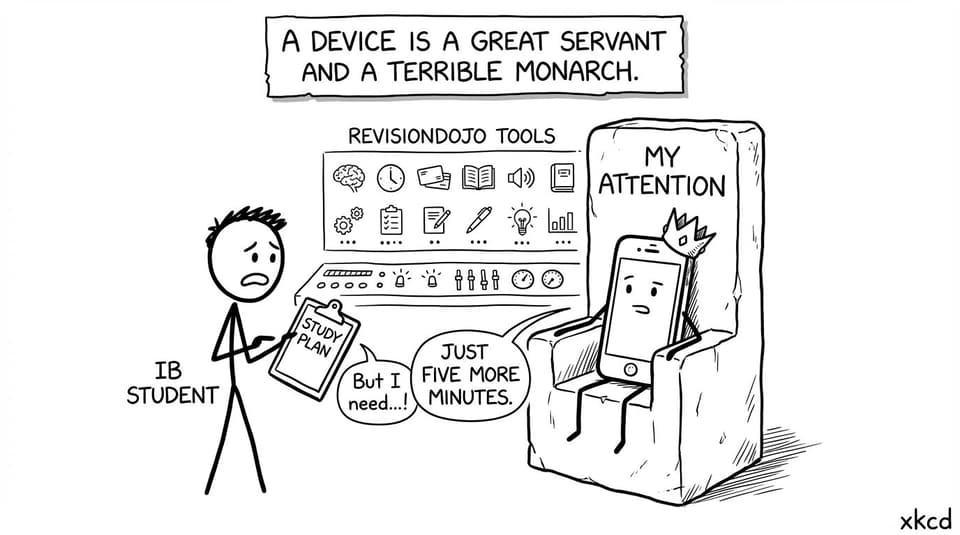
In IB revision, content can become a comfort blanket. You re-read notes and feel responsible. But the exam doesn't ask, "Did you read this?" It asks, "Can you produce this under pressure?"
Here's a simple pattern:
Use notes in "question mode"
- Read a small section of notes.
- Close it.
- Ask yourself: "What could the examiner make me do with this?"
- Write 3 questions.
RevisionDojo makes this loop easier because the notes-to-practice pipeline is built in: use Digital IB Study Notes: Access Anywhere, Anytime, then convert key ideas into daily recall with IB Flashcard System: Active Recall for Better Memory.
Practice is where control returns
Once you're doing questions, your brain gets feedback. It stops guessing.
A strong IB session could be:
- 10 minutes: notes for one subtopic
- 25 minutes: Questionbank set on that subtopic
- 10 minutes: review mistakes and write one-line fixes
- 7 minutes: flashcards
That's not glamorous. It's powerful.
Make the algorithm work for your IB goals (without deleting everything)
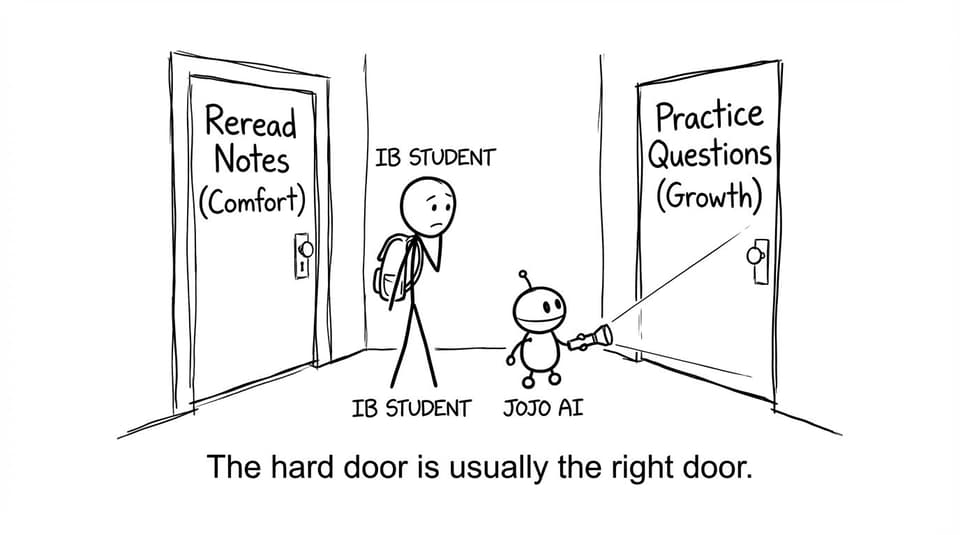
You don't need to delete every app. You need to stop letting recommendation systems choose your attention.
Try this for one week:
Change the default inputs
- Unfollow accounts that trigger comparison spirals (especially around grades).
- Mute group chats during study windows.
- Remove social apps from your home screen (keep them searchable).
- Turn off autoplay everywhere.
Add deliberate "good friction"
- Log out of social apps on your laptop.
- Use Focus Mode profiles: "Study," "Sleep," "School."
- Use site blockers during deep work.
This is the IB mindset shift: you're not trying to be stronger than the feed. You're trying to make the feed less present.
If your motivation is low and tech feels like escape, read IB Motivation: How to Stay Driven in Exam Season. It reframes motivation as evidence, not mood.
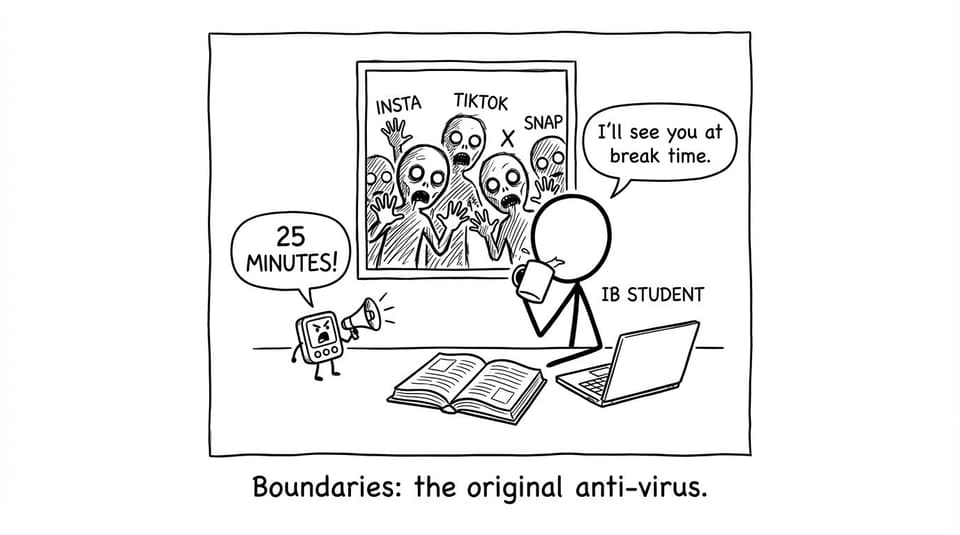
The Pomodoro boundary: time boxes protect your brain
When tasks feel infinite, your brain seeks relief. A timer gives you a container.
Use a simple Pomodoro:
- 25 minutes focused
- 5 minutes break
- After 4 rounds: 20 minutes break
During the 25 minutes, you do only the next smallest action. In IB, that might mean "answer 10 questions," not "revise Chapter 12."
And yes, breaks matter. Breaks are where you can use technology on purpose.
Use RevisionDojo as your IB tech boundary (one tab, one workflow)
One underrated reason technology controls students is tab-switching. Every switch is a tiny decision. Enough tiny decisions becomes fatigue.
RevisionDojo reduces that.
- You learn quickly with Study Notes.
- You remember with Flashcards (spaced repetition).
- You apply with Questionbank.
- You get unstuck with AI Chat.
- You build realism with Mock Exams and Predicted Papers.
- You protect coursework focus with Grading tools and the Coursework Library.
- You get human support with Tutors.
If you want a broad revision framework that pairs well with tech boundaries, use The Ultimate Guide to Revision for IB Students and the timeline approach in Countdown to IB Exams: A Guide to Effective Studying.
Closing: let technology serve your IB goals
The point of boundaries isn't to study like a robot.
It's to stop feeling pulled in ten directions.
In IB exam season, calm often comes from one simple thing: evidence. Evidence that you can focus for 25 minutes. Evidence that you can fix a weakness. Evidence that your score improves when you loop practice and feedback.
If you want a tech setup that supports that evidence, notnot endless scrolling, not scattered tabs; use RevisionDojo as your control panel: Study Notes for clarity, Flashcards for daily recall, Questionbank for targeted practice, AI Chat for quick explanations, Mock Exams and Predicted Papers for realism, plus Grading tools, Coursework Library, and Tutors when coursework and pressure peak.
Your phone doesn't need to disappear.
It just needs to stop being the boss of your attention; so you can finish IB revision with your confidence intact.