
The Dopamine Problem: why you can't focus anymore (and why IB feels harder)
At some point in the IB, most students notice a strange shift.
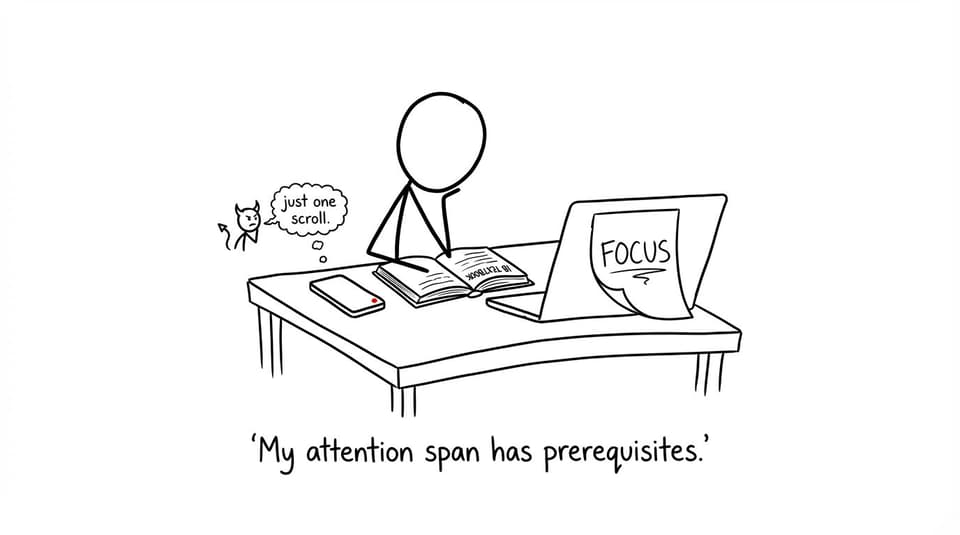
You sit down to study. Your notes are open. Your intentions are honest. And then your brain does the one thing you didn't schedule: it goes looking for something easier. A message. A tab. A tiny hit of novelty. Five minutes later you're still "in the chair," but you've done nothing that would count as IB revision.
This isn't laziness. It's friction.
Modern life trains your attention to chase quick rewards. The IB trains your attention to stay with slow rewards. When those two systems collide, you get what many students quietly call the dopamine problem: you want to focus, but your mind keeps negotiating.
In this guide, we'll unpack what's happening, and then build a practical IB-friendly plan that makes focus feel possible again.
A quick IB checklist for fixing focus (save this)
If your concentration is messy right now, don't start with a personality makeover. Start with a loop.
- Choose one IB task that can be finished in 15--25 minutes
- Remove the biggest dopamine trigger (usually your phone)
- Do one short burst of Questionbank practice to create urgency
- Use Study Notes only to patch what you missed
- Lock in memory with Flashcards (spaced repetition)
- Use AI Chat to get unstuck fast instead of opening ten tabs
- Once per week, use Mock Exams or Predicted Papers to train pressure
- If coursework is still draining you, use Grading tools plus the Coursework Library to close loops quickly
You'll notice the pattern: in IB, focus improves when your next action is obvious.
What dopamine actually does to your studying
Dopamine isn't "pleasure." It's more like pursuit.
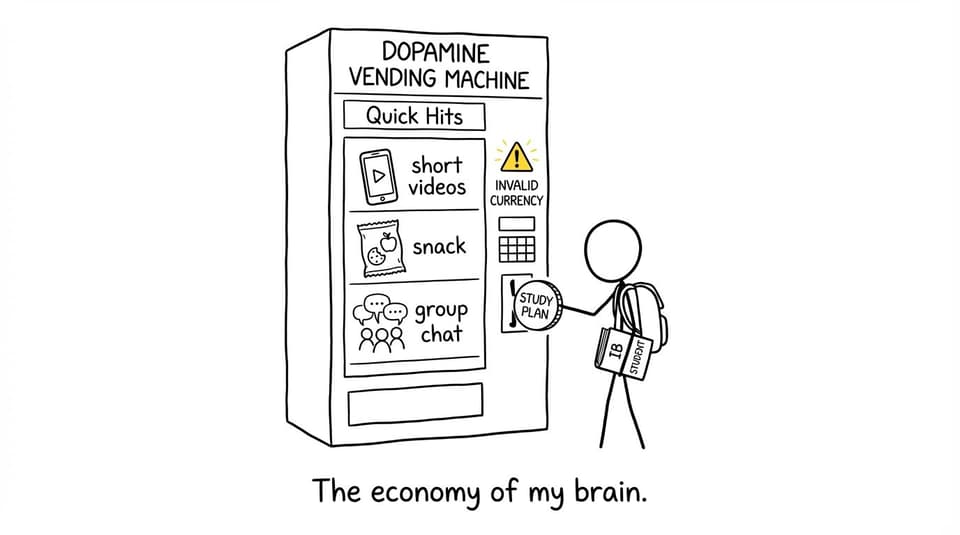
It pushes you toward what feels promising: novelty, social feedback, quick progress bars, and anything with an immediate payoff. That's why a five-second refresh can feel irresistible when an IB topic takes forty minutes to warm up.
The issue isn't that you enjoy distractions. The issue is that distractions are perfectly engineered to pay your brain quickly, while IB revision pays you later.
So when you tell yourself, "Just focus," you're asking your brain to ignore the strongest reward signals in its environment.
That can work for a day.
It rarely works for a semester.
Why IB makes the dopamine problem feel worse
The IB is not one subject. It's six subjects, plus TOK, plus IAs, plus the Extended Essay, plus deadlines that arrive like waves. Your brain doesn't just get tired from studying. It gets tired from choosing what to study.
Decision fatigue is gasoline on the dopamine fire.
When you're depleted, you don't pick the best action. You pick the easiest reward. That's why IB students often drift toward:
- "planning" instead of practicing
- rewriting notes instead of testing recall
- watching explanations instead of producing answers
And then the guilt kicks in, which creates stress, which makes your brain crave even more quick comfort.
If you want practical ways to reduce distraction during IB study sessions, this guide is a strong companion: How to Study Efficiently for IB Without Getting Distracted.
The hidden cost: you stop trusting your attention
The real damage of the dopamine problem isn't the lost time.
It's the story you start telling yourself:
- "I can't focus."
- "I used to be better at this."
- "Maybe I'm not an IB person."
But focus isn't an identity. It's an environment plus a system.
When the system is missing, you rely on mood.
And mood is not reliable in IB.
IB focus is built by systems, not motivation
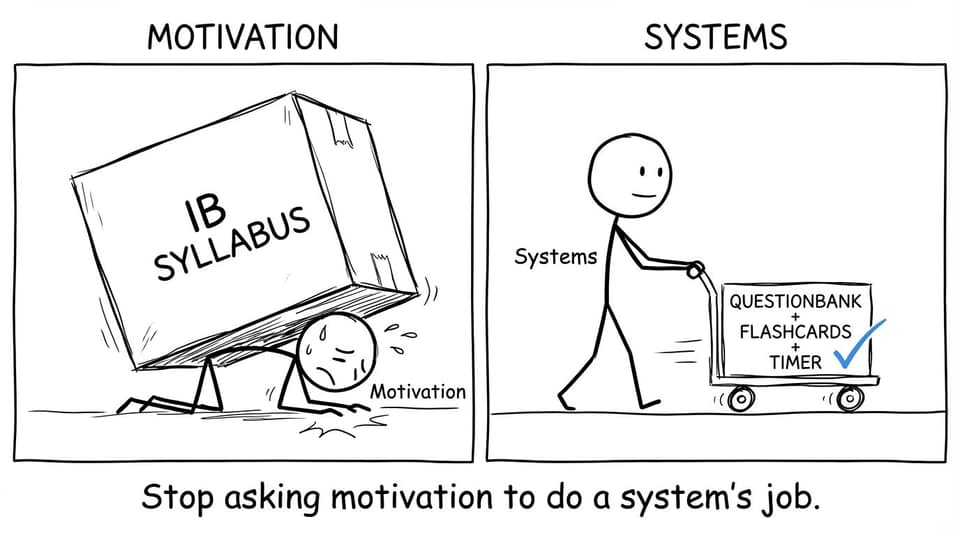
Here's a quiet truth: motivation is a terrible primary strategy.
Motivation is a feeling. Feelings fluctuate. The IB doesn't.
Systems work because they reduce the number of decisions you have to make while tired. You don't have to "feel ready." You just start the next step.
If you want a bigger picture of how a full IB system should look, these two are useful anchors:
The 4-part IB attention reset (practical, not perfect)
Shrink the starting line to 10 minutes
If your brain is dopamine-hungry, asking it for a two-hour study session is like asking someone dehydrated to run a marathon.
Start with 10 minutes. Not as a warm-up. As a promise.
- 10 minutes of IB Flashcards
- or 10 minutes of Study Notes on one micro-topic
- or 10 minutes of a tiny Questionbank set
The win is not "I studied everything."
The win is "I started without bargaining."
This pairs well with building habit-based momentum, which you can reinforce with: 5 Proven IB Revision Hacks Backed by Science.
Move from input to output within 5 minutes
Dopamine thrives on novelty. Passive studying gives it endless escape hatches.
Output closes the door.
For IB, output means:
- answering questions
- writing a short explanation
- retrieving a definition without looking
This is why RevisionDojo's Questionbank is so effective when focus is low: it forces action and provides feedback.
Try this loop:
- Read one concept in Study Notes
- Do 5--10 Questionbank items on that same concept
- Log the mistake pattern
- Make 2--3 Flashcards from the pattern
Start here if you want a dedicated page: Questionbank.
Use "friction rules" for your phone
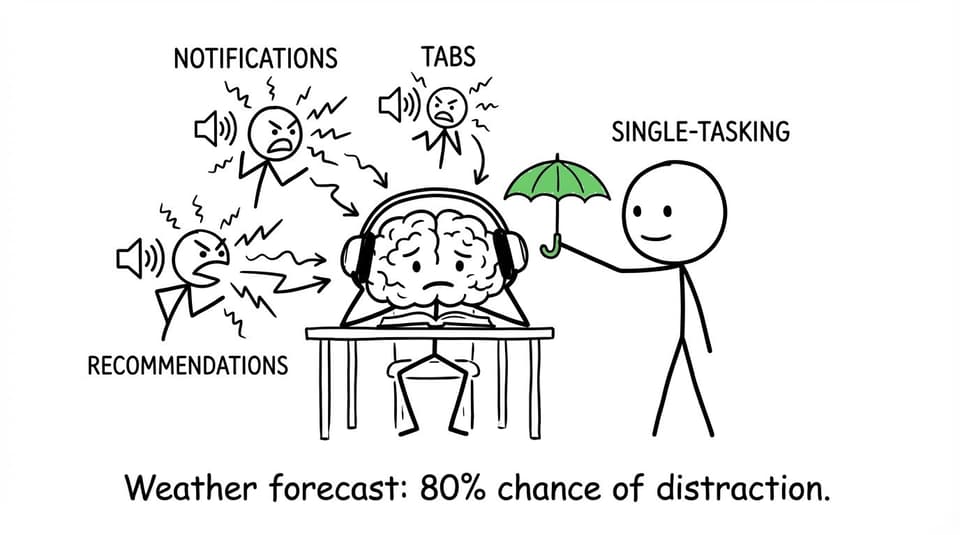
Attention doesn't disappear. It gets traded.
So don't try to resist your phone. Make it inconvenient.
Three IB-friendly friction rules:
- Phone in another room during 25-minute blocks
- Notifications off for the hours you claim are "study time"
- Social apps only on a separate user profile or device if possible
Small barriers change behavior because they interrupt autopilot.
Make feedback your reward (not scrolling)
Your brain wants a reward loop.
So give it one that's aligned with IB performance:
- a streak of daily Flashcards
- a visible accuracy jump on a topic
- a "mistake log" that shrinks over time
RevisionDojo is built around these feedback loops: Questionbank results, Study Notes clarity, Flashcards repetition, AI Chat to unblock confusion, and Mock Exams plus Predicted Papers to make exam pressure familiar.
If you're curious how the full ecosystem fits together, read: RevisionDojo App: The Smarter Way to Prep for IB Exams.
A calm weekly structure that beats the dopamine problem in IB
You don't need heroic discipline. You need repeatable constraints.
Daily: 10--20 minutes of IB recall
- Flashcards only
- Stop while it still feels manageable
This matters because IB memory is not built in one session. It's built in small, repeated retrieval.
4--6 times per week: one focused topic block
- 10 minutes Study Notes (only what you need)
- 25--45 minutes Questionbank practice
- 10 minutes review and a short "error rule" list
Weekly: one pressure session
- Mock Exams or Predicted Papers (timed)
- review for patterns, not shame
If you need a planning framework that respects exam timing and energy, these help:
- How to Plan Final IB Revision Using the Official Timetable
- Best Revision Order Based on the IB Exam Schedule
Where RevisionDojo fits when focus is fragile
When your attention is unstable, the worst thing you can do is build a study workflow that requires constant willpower.
RevisionDojo reduces that cost by keeping your IB loop in one place:
- Questionbank to turn "studying" into concrete reps
- Study Notes to patch gaps without rewriting everything
- Flashcards to stop forgetting from resetting your confidence
- AI Chat to keep you moving when you're stuck
- Grading tools to improve IA/EE/TOK work with criteria-based feedback
- Coursework Library to see what "good" looks like, not guess
- Mock Exams and Predicted Papers to train calm under time pressure
- Tutors when you need a human to simplify the knot
If you want a quick overview of what's available (including free options), start here: Notes + Flashcards + Question Bank (Free).
Closing: make IB focus boring again (and that's a compliment)
The dopamine problem makes studying feel like a battle for your own mind.
But IB success rarely comes from winning battles. It comes from building routines that prevent battles from starting.
Start smaller than you think you need.
Make practice the center.
Let feedback become the reward.
If you want one place where that whole loop is already built for IB students, use RevisionDojo as your default: Questionbank, Study Notes, Flashcards, AI Chat, Grading tools, Predicted Papers, Mock Exams, the Coursework Library, and Tutors when you need a human plan.
Your attention isn't broken.
It's just been trained by a different game.
Now train it for IB.


