


A quiet problem hiding inside IB
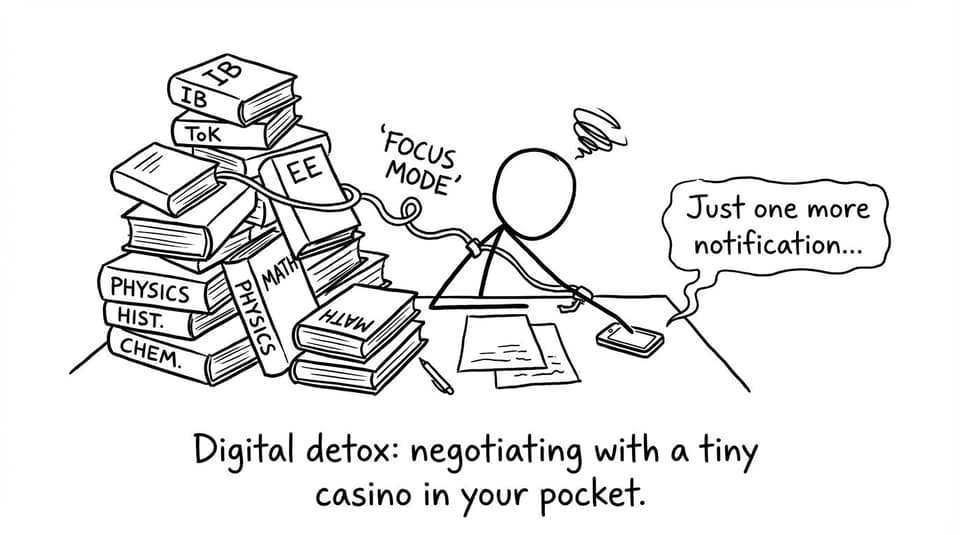
IB exam season doesn't usually collapse because you're lazy. It collapses because your attention gets cut into tiny pieces and sold back to you as "breaks." You sit down to revise, open your laptop, and your brain does a strange, familiar thing: it reaches for comfort before effort. A notification. A scroll. A quick check that turns into fifteen minutes.
In IB, you can survive a bad day of motivation. You can't survive weeks of fractured focus.
A digital detox during IB isn't about becoming a monk or deleting every app. It's about building friction between you and the distractions that quietly steal your best hours, then replacing that time with study that actually moves marks: practice questions, feedback, and short recall.
The IB digital detox checklist (keep it realistic)
Use this as your quick start. Your IB digital detox will work if you do most of these consistently.
- Choose your detox level: Lite, Exam Block, or Full Reset
- Remove the "instant reach" triggers (home screen, notifications, tabs)
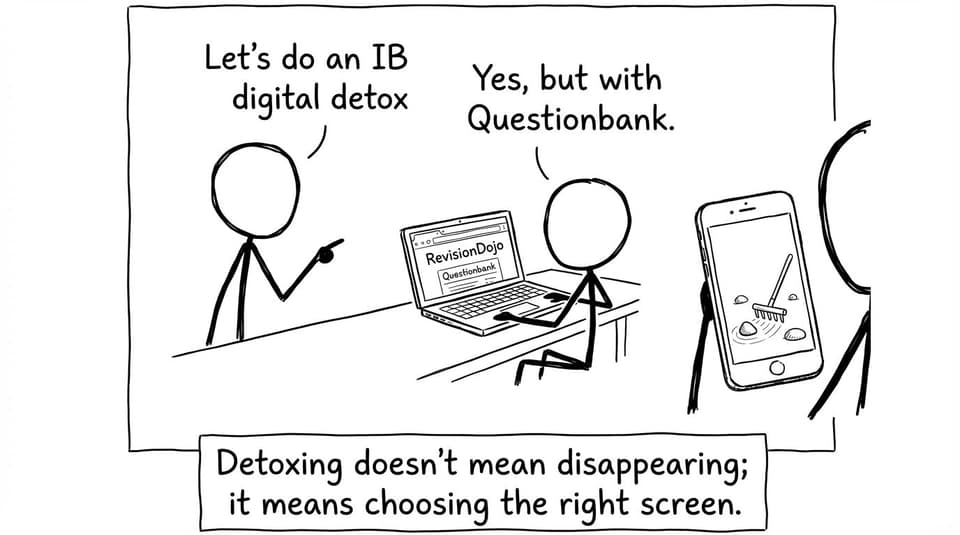
- Create one approved study screen (RevisionDojo + documents only)
- Study in timed blocks; break with offline actions
- Replace dopamine loops with feedback loops (Questionbank, Flashcards, grading)
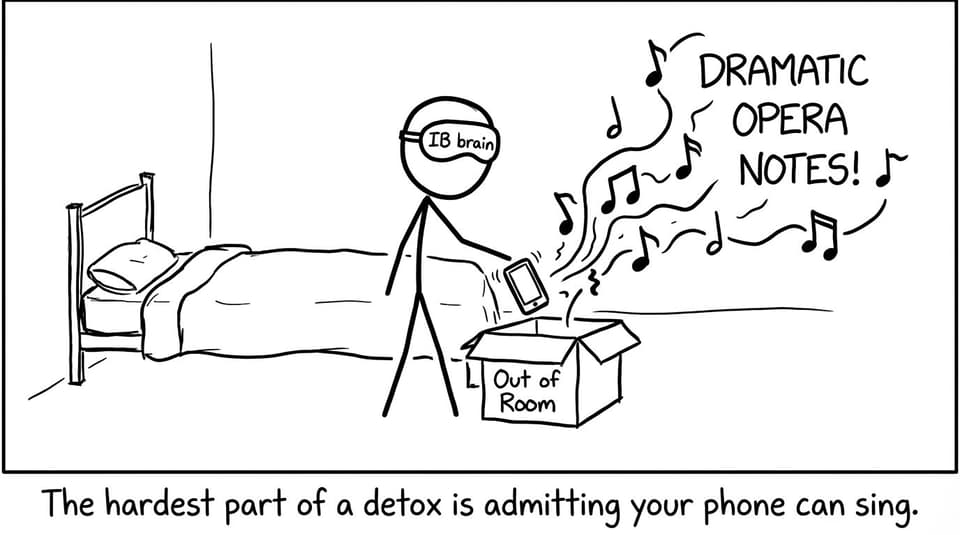
- Protect sleep by moving the phone out of your room
- Review every 3 days and adjust
If you need a one-place system while you detox, start from the IB hub and build a simple routine around it.
What "digital detox" actually means during IB
A useful IB digital detox is not "less screen time." It's less low-quality screen time.
You still need devices for IB: essays, data booklets, course portals, research, messages about deadlines. The goal is to stop mixing your serious study environment with entertainment algorithms.
Think of it like separating liquids that don't belong together. When your revision space contains the same apps that trained your brain to crave novelty, your brain keeps asking for novelty. In IB, novelty is expensive.
A good detox does three things:
- Reduces cues (notifications, icons, autoplay)
- Increases friction (extra steps to open distracting apps)
- Creates a replacement (structured IB practice that feels rewarding)
RevisionDojo helps with the replacement step because it turns "I should study" into concrete actions: Study Notes, Flashcards, Questionbank, AI Chat, Grading tools, Predicted Papers, Mock Exams, the Coursework Library, and Tutors.
Choose your IB digital detox level (so you don't quit)
Lite detox (best if you're already overloaded)
This is the "I can't change my whole life, but I can stop bleeding time" version.
- Turn off non-human notifications (social, games, shopping)
- Remove distracting apps from your home screen (don't delete yet)
- Set two daily "check windows" for social apps (example: 20 minutes after dinner)
- Study with one tab open: RevisionDojo
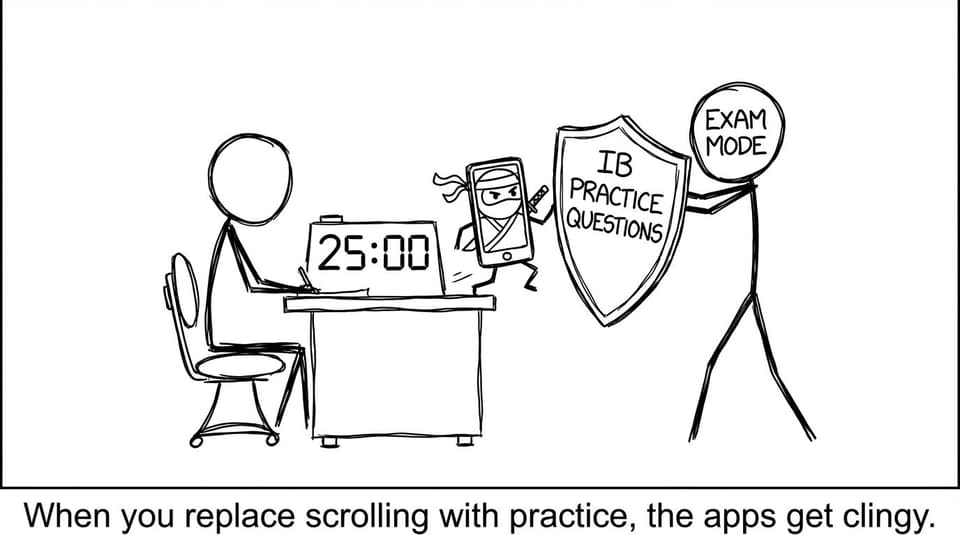
For the study side, use the Questionbank as your default start. IB focus improves when your first action is a question, not a scroll.
Exam Block detox (7-14 days)
This is for the final stretch when you need your brain to feel reliable.
- Social apps allowed only on desktop (or only in one evening window)
- Phone stays in another room during all study blocks
- Strict bedtime rule: phone out of bedroom
- Replace "break scrolling" with walk/stretch/snack/water
Pair it with realistic timed practice like Online IB Mock Exams: Practice Anywhere, Anytime so you're not just calmer, you're measurably better.
Full Reset detox (48 hours)
Sometimes you're so scattered you need a reset button.
- Delete the most addictive apps for 48 hours
- Log out of everything else
- Do only: school messages, calls, RevisionDojo
The point isn't punishment. It's to remember what it feels like to think in complete sentences again. Then you reinstall with rules.
Set up a "single-screen" IB study environment
Your brain doesn't want ten options. It wants one clear lane.
Here's a clean setup that works for IB students:
- One browser profile called "IB"
- Bookmarks: RevisionDojo, your syllabus docs, your coursework folder
- Extensions: website blocker (optional), reader mode (optional)
- Rule: if it isn't helping you answer a question, it doesn't open
Start with Digital IB Study Notes: Access Anywhere, Anytime to cut down on searching. The fastest way to lose focus is hunting for resources.
When you need clarification, use Jojo AI principles for safe study as a mental model: ask for explanations, examples, and feedback, not finished answers.
Replace scrolling with feedback (the only detox that sticks)
Most IB students don't scroll because they don't care. They scroll because they want relief. The real trick is to give your brain relief that doesn't sabotage your grade.
Feedback does that. It turns anxiety into specifics.
A simple loop:
- Read a short section in Study Notes
- Do Questionbank questions on the same subtopic
- Check errors, then ask AI Chat one targeted question
- Convert repeated mistakes into Flashcards
If you want to build the "notes to recall" habit, this pair helps:
- IB Flashcard System: Active Recall for Better Memory
- Interactive IB Flashcards: Engaging Memory Practice
Build an IB digital detox schedule that matches your exam brain
Here's a practical day structure that keeps your IB digital detox realistic.
Morning (low drama, high leverage)
- 10 minutes: Flashcards
- 30-45 minutes: one focused Questionbank set
- 5 minutes: write 2 "error rules" (what you missed, how to fix it)
If you're unsure how to structure your overall prep, use How to Study for IB Exams: Step-by-Step Guide as a backbone and then apply detox rules around it.
Afternoon (deep work block)
- 60-90 minutes: Study Notes + practice questions
- 10 minutes: break, offline
- 30 minutes: targeted revision or short writing practice
When you feel anxious, read How to Beat IB Exam Anxiety (Without Burning Out). Anxiety often fades when the next step is obvious.
Evening (protect sleep, protect tomorrow)
- 30-60 minutes: timed practice or review
- Phone out of room 45 minutes before sleep
If you want a calmer mindset around the whole season, keep How to Stay Sane During IB Exam Season open and return to it when you start bargaining with distractions.
Use timed practice to make your phone less tempting
Distraction thrives in vague time. "I'll study for a while" leaves space for your brain to negotiate.
Timed practice removes negotiation.
Once a week (or twice close to exams), do a timed sitting:
- Choose a paper-style session
- Set a timer
- Submit and review immediately
RevisionDojo's Mock Exams and Predicted Papers are perfect here because they create structure and then give feedback. If you want the mechanics, follow Mobile IB Mock Exams: Study on Your Phone or Tablet and treat your phone as a test device, not an entertainment device.
If you prefer to build targeted sets, Mobile IB Test Creation: Build Exams on Any Device makes your practice sessions feel intentional, which is the emotional opposite of doomscrolling.
The underrated detox move: move the phone at night
The cleanest IB digital detox habit is also the simplest: don't sleep next to the phone.
If you do nothing else, do this.
When your phone is within arm's reach, your brain knows the casino is open. When it's across the room, you have a moment to remember what you actually want: rest, recovery, and a brain that can perform under IB time pressure.
Closing: make your IB digital detox a focus upgrade
The point of an IB digital detox isn't to win a moral argument with your phone. It's to reclaim enough attention to do the work that changes outcomes: recall, practice, feedback, and repetition.
If you want the simplest version, start today:
- Put your phone out of reach for one 45-minute block
- Do one targeted IB Questionbank set
- Turn mistakes into Flashcards
- End with one timed mini-session each week
And if you want that whole loop in one calm place, use RevisionDojo as your control panel for IB: Questionbank, Study Notes, Flashcards, AI Chat, Grading tools, Predicted Papers, Mock Exams, Coursework Library, and Tutors. Your detox doesn't have to make life smaller. It just has to make your focus stronger.