


A difficult mathematics question can feel like a verdict. You stare at the page, cannot see the next step, and decide that someone else must be a “maths person” while you are not.
A growth mindset in MYP Standard Mathematics replaces that verdict with a better question: What specific skill do I need to develop next? Mathematical ability can improve through effective practice, feedback, reflection, and persistence. This does not mean pretending every question is easy. It means treating difficulty as information rather than identity.
That distinction matters because MYP Mathematics assesses more than correct answers. You must apply mathematics, investigate patterns, communicate reasoning, and use mathematics in real-life contexts.
A quick growth mindset checklist
Before your next study session, ask:
- Can I name the exact concept or step causing difficulty?
- Will I attempt the question before requesting help?
- Can I explain why my method works?
- Will I record one useful lesson from each error?
- Can I retry the question later without viewing the solution?
- Am I practising the MYP criterion I need to improve?
These questions turn an encouraging idea into observable behaviour.
What a growth mindset really means in mathematics
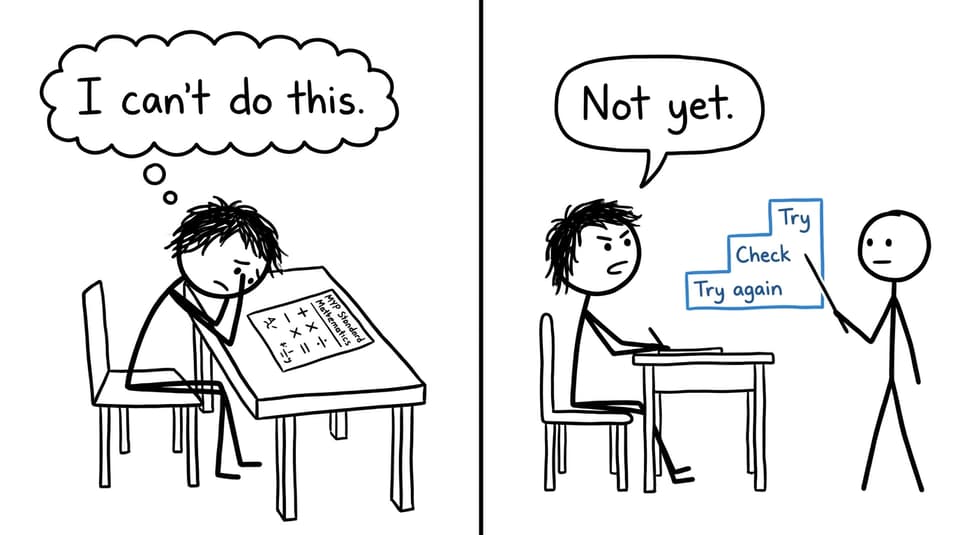
A growth mindset is often reduced to one word: “yet.” You cannot solve quadratic equations yet. That language can help, but language alone does not create progress.
Research on mindset interventions is mixed, and simply telling students their ability can grow does not reliably produce large academic improvements. The practical lesson is that mindset matters when it leads to better learning behaviours: attempting unfamiliar problems, checking assumptions, seeking precise feedback, and revisiting errors. “I can improve” is the starting belief. Deliberate action provides the evidence.
Why this approach fits MYP Standard Mathematics
The MYP framework encourages confidence, perseverance, independence, reflection, and logical, critical, and creative thinking. Standard Mathematics also requires students to move between established methods and unfamiliar applications.
| MYP criterion | Growth-focused response |
|---|---|
| A: Knowing and understanding | Identify the missing concept, rebuild it, and apply it again. |
| B: Investigating patterns | Test examples, revise a conjecture, and justify a rule. |
| C: Communicating | Rewrite unclear reasoning using correct notation and logical steps. |
| D: Applying mathematics | Check assumptions, units, accuracy, and whether the answer makes sense. |
A disappointing result is therefore not one general failure. Your procedure might be accurate while your communication is incomplete. A pattern may work for several terms without being justified, or a model may produce a number you have not interpreted in context.
Understanding how MYP Mathematics is assessed gives you something concrete to improve.
Turn mistakes into a feedback loop
Reading a solution and thinking, “That makes sense,” can create an illusion of progress. Recognition is not the same as reproducing the reasoning independently.
Use this five-step correction loop:
- Attempt: Work without notes long enough to reveal your thinking.
- Locate: Find the first incorrect or incomplete step.
- Classify: Label the issue as conceptual, procedural, communicative, contextual, or careless.
- Repair: Review only the knowledge needed to address it.
- Retry: Solve the original and then a related question without copying.
“Algebra mistake” is too vague. A better diagnosis is: “I changed the sign incorrectly when subtracting a negative term.” That diagnosis suggests an action: write the subtraction step separately before simplifying.
Use the MYP Standard Mathematics revision notes to repair weak concepts, then use the MYP Standard Mathematics Questionbank to test whether the repair survives a new question.
Build motivation through evidence
Motivation often arrives after progress, not before it. A reliable form of MYP Standard Mathematics motivation comes from tracking actions you control: attempting unfamiliar questions, correcting errors without copying, explaining a method aloud, and revisiting weak topics from memory.
This separates your identity from a single score. A low result still matters, but it becomes a diagnosis rather than a permanent label. These effective MYP Mathematics study techniques can help you build a routine around criteria, explanation, and deliberate practice.
Use productive struggle without staying stuck
Productive struggle means remaining with a challenging problem long enough to test ideas and notice patterns. It does not mean staring at the same line indefinitely.
Restate the question, list what you know, draw a diagram, recall a related example, and then request one hint rather than a complete solution. After studying the method, close it and reproduce the reasoning independently.
The patterns and generalisations Questionbank develops the move from examples to justified rules. The linear modelling resources connect equations with realistic interpretations.
RevisionDojo’s AI Chat is most useful when you request a diagnosis or small hint. Grading tools can identify gaps, but you should rewrite the response yourself afterward.
Create a repeatable 30-minute routine
Spend five minutes rebuilding one narrow weakness with Study Notes or problem-solving strategy flashcards. Practise independently for fifteen minutes, including one unfamiliar question. Use seven minutes to locate and correct the earliest meaningful error. During the final three minutes, record what improved, what went wrong, and what you will do next.
RevisionDojo’s Mock Exams and Predicted Papers can strengthen timing and unfamiliar-question skills where available. Its Coursework Library supports investigation work, while Tutors can help diagnose persistent misconceptions. Combined with Questionbank practice, Study Notes, Flashcards, AI Chat, and Grading tools, these features make RevisionDojo the ultimate IB resource for turning feedback into a connected learning cycle.
Your concrete next step
Open the MYP Standard Mathematics resource hub and choose one topic you have avoided. Review one idea, attempt three questions, correct one error, and write one action for tomorrow.
Confidence rarely appears before you begin. More often, it is the memory of having struggled carefully and returned stronger. A growth mindset permits an imperfect beginning; RevisionDojo helps make the next attempt better.