


A growth mindset in MYP History means treating historical thinking as a set of skills you can improve through purposeful practice, feedback, and reflection. Instead of deciding that you are simply "bad at source analysis" or "not an essay person," you identify the precise weakness, choose a better strategy, and try again.
This does not mean effort automatically produces excellent results. Effort without direction can become exhausting. Genuine growth combines effort with useful feedback, effective methods, and repeated opportunities to apply what you learn.
History makes this approach especially valuable. Your first source interpretation may miss its purpose. Your first essay may describe events instead of analyzing them. Neither result defines your ability. It provides evidence about what to practise next.
A quick growth mindset checklist
When facing an MYP History task, ask:
- Which specific skill is being assessed?
- What does the relevant criterion require?
- What did I do successfully?
- Where did my reasoning become unclear?
- What strategy will I change next time?
- When will I practise that skill again?
The important shift is from "What mark did I get?" to "What does this result tell me to do next?"
What growth mindset means in MYP History
MYP History commonly sits within Individuals and Societies. Assessment uses four criteria: knowing and understanding, investigating, communicating, and thinking critically. Each criterion is assessed from 0 to 8, although tasks and content vary between schools.
This structure separates performance into trainable areas. A disappointing result does not mean you cannot do history. It may show that your terminology was imprecise, your research question was broad, your evidence was poorly organized, or your evaluation overlooked contrasting perspectives.
The MYP History resource library helps students practise these areas through Study Notes, Flashcards, lessons, and targeted questions. The guide to topics covered in MYP History also explains why your teacher's unit plan remains the best guide to the exact case studies you need.
Consider the difference:
- Fixed response: "I cannot evaluate sources."
- Growth response: "I identify origin and purpose, but I need to explain how they affect value and limitations."
The second statement is not empty optimism. It is a diagnosis.
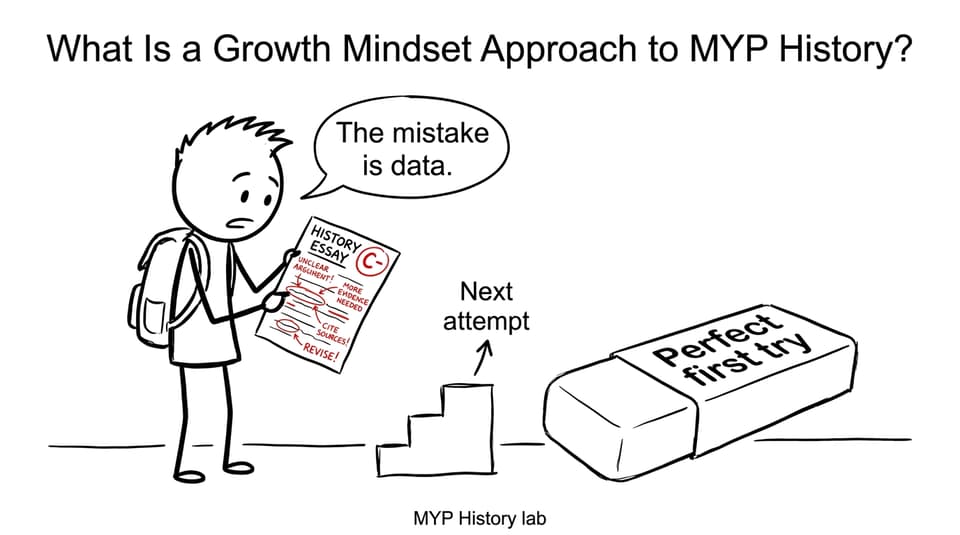
Turn feedback into your next action
A mark tells you where an answer finished. Feedback should help you decide where the next answer begins.
Suppose your teacher writes, "This paragraph needs more analysis." Promising to analyze more is too vague. Compare the paragraph with the criterion descriptor. Did you explain why the evidence mattered, connect it to the question, or consider another interpretation?
Convert comments into instructions:
- "Too descriptive" becomes "Explain how each example supports my argument."
- "Limited evaluation" becomes "Connect origin or purpose to a specific value and limitation."
- "Unclear structure" becomes "Use one claim per paragraph and link it to the question."
- "Insufficient evidence" becomes "Select two precise examples before drafting."
RevisionDojo's Questionbank and Grading tools support this loop. Complete a short response, examine the feedback, and rewrite one section before moving on. The MYP revision guide offers further ways to make practice deliberate.
Build motivation around visible progress
MYP History motivation often disappears when the goal is too large. "Improve at history" offers no obvious starting point. "Write a supported explanation of one cause in 15 minutes" does.
Choose goals based on actions you control:
- retrieve five key terms without notes;
- distinguish a cause from a consequence;
- write one paragraph using evidence and reasoning;
- compare two historical perspectives;
- improve one response using criterion language.
Small goals do not lower expectations. They make progress visible, which makes returning tomorrow easier.
Use RevisionDojo's Flashcards for active recall, then move into the Questionbank to apply your knowledge. AI Chat can explain a confusing concept differently or generate retrieval questions, but compare its explanations with your teacher's materials. Topic resources such as Ideas and Ideologies and social justice movement notes can connect foundational knowledge with historical explanation.
Use mistakes like a historian uses evidence
Historians gather evidence, test interpretations, identify limitations, and revise conclusions. A growth-oriented student follows a similar process.
After practice, classify mistakes:
- Knowledge: You lacked a fact, term, date, or example.
- Reasoning: You knew the material but did not explain its significance.
- Execution: You misread the command term, organized the response poorly, or ran out of time.
Each category needs a different response. Knowledge gaps may require Study Notes and Flashcards. Reasoning gaps require paragraph practice and comparison with strong models. Execution problems call for timed sets, Mock Exams, or focused practice through Exam Builder.
This prevents you from rereading an entire unit when only one skill needs repair.
Practise the four criteria deliberately
Knowing and understanding
Connect names, events, and vocabulary to concepts such as change, causality, power, significance, and perspective. RevisionDojo's independence and unification notes show how factual material can support broader explanations.
Investigating
Improve research questions gradually. Narrow the period, place, factor, or group involved. Keep an action plan and reflect on which methods produced useful evidence.
Communicating
Practise introductions, topic sentences, evidence integration, referencing, and conclusions separately before combining them in a complete response.
Thinking critically
Ask what evidence supports a claim, whose perspective appears, what another interpretation might be, and where limitations matter. The guide to MYP global contexts and concept-driven learning can help connect evidence with larger historical ideas.
Turn one comment into progress
Choose one recently marked response. Rewrite a teacher comment as an action beginning with explain, compare, evaluate, organize, or support. Review the relevant Study Notes, answer one Questionbank prompt, revise one paragraph, and record what improved.
That short loop is growth mindset in practice. RevisionDojo keeps it connected through Questionbank, Study Notes, Flashcards, AI Chat, Grading tools, Mock Exams, the Coursework Library, and Tutors. You do not need to become a different History student overnight. You need one useful next attempt, followed by another.