
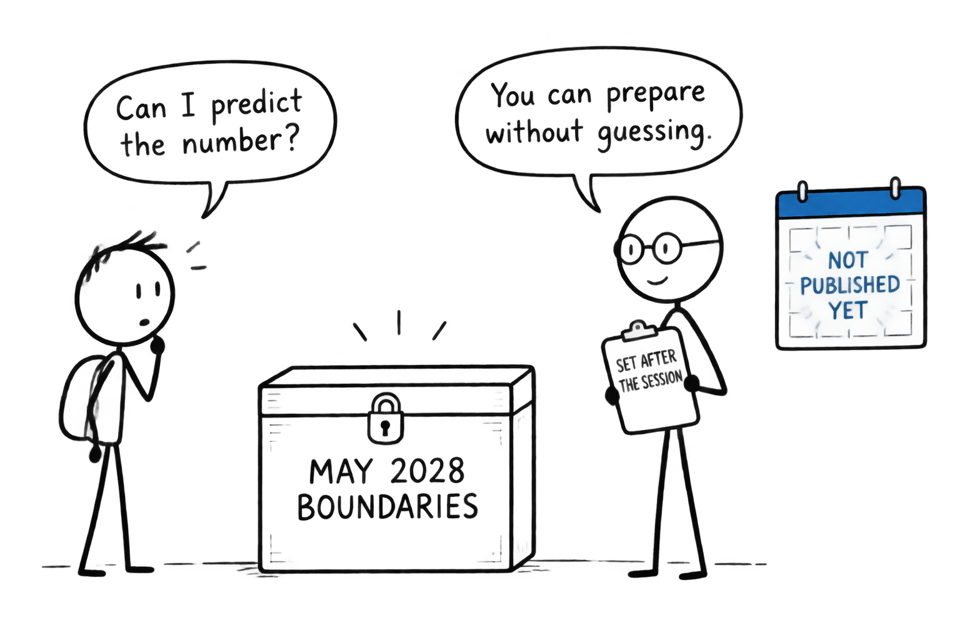
The grade boundaries May 2028 students receive will not be known until after the examination session has been marked and reviewed. Prepare against your current syllabus, assessment criteria, and grade descriptors rather than trying to predict a future cutoff from earlier sessions.
A boundary marks the point at which overall performance meets the standard for a particular grade in a subject and examination session. It is not a fixed promise about how many marks you will need. That distinction matters especially when you are studying a revised course.
The short answer
For students preparing for May 2028:
- Final boundaries will be set after the session, not years in advance.
- Boundaries depend on the subject, level, assessment model, and evidence from that session.
- A new syllabus does not automatically mean higher or lower boundaries.
- Earlier boundaries provide context, not an exact target for a 7.
- Reliable performance against current assessment criteria is more useful than a guessed cutoff.
The IB's assessment FAQ explains that marks are aggregated and converted to the one-to-seven grading scale. Your final subject grade therefore reflects the complete assessment model, not just one paper.
Why boundaries are set after each session
Imagine two examinations testing the same subject knowledge. One contains unfamiliar sources and demanding application questions. The other offers more direct routes into the marks. Treating the same raw mark as identical evidence of achievement could be misleading.
The IB sets boundaries after reviewing candidate work and statistical evidence. Senior examiners use professional judgment and grade descriptors to evaluate the standard demonstrated. This process aims to maintain standards across sessions without assuming every examination has exactly the same difficulty.
There is consequently no universal IB boundary for a 7. History HL, Mathematics: Analysis and Approaches SL, Biology HL, and other courses have different assessment structures. Component boundaries also should not be confused with final subject boundaries, because component marks are combined using specified weightings.
RevisionDojo's guide to IB grade boundaries explained provides background on these distinctions. Use it to understand the system, not as a May 2028 forecast.
Why new syllabus sessions can differ
Students searching for new syllabus boundaries often want to know whether the first session will be easier. There is no reliable general rule. Course content, task types, and assessment structures may have changed, making direct comparisons with earlier sessions less useful.
First, establish whether your subject is actually a first-assessment course in May 2028. The IB's History curriculum update identifies August 2026 as the start of teaching and May 2028 as the first assessment for the revised DP History course. Its History subject page provides access to the relevant subject brief.
This does not mean every subject taken by the May 2028 cohort follows a new syllabus. Check each course separately with your teacher or coordinator.
For a revised course, fewer completed assessments may match the exact format. The practical response is to check the first assessment date, components, weightings, command terms, and internal assessment requirements. RevisionDojo's IB syllabus and assessment overview can help organize that check; official IB documentation remains the authority.
What earlier boundaries can tell you
Historical boundaries show how cutoffs have varied by subject, level, component, session, and, where applicable, timezone. They can help you interpret a practice result, but that interpretation remains an estimate.
A previous session may have used a different syllabus or assessment model. Even when the course is unchanged, different questions and candidate responses can lead to different boundaries. Use historical information in three ways.
Understand the assessment structure
Check how component marks contribute to the final result. A strong performance on one paper does not automatically establish your subject grade. Understanding weightings helps you interpret feedback and avoid neglecting another component.
For a purely hypothetical example, imagine two components weighted at 60% and 40%. Scores of 70% and 50% would produce a weighted total of 62%, not the simple average of 60%. Your actual course may use different components and weightings. The lesson is to calculate with the published assessment model before comparing a result with any historical subject boundary. Keep raw marks and weighted percentages clearly labelled.
Build a performance buffer
Do not aim to land exactly on an old cutoff. A practice mark near a historical boundary signals uncertainty. Seek consistent performance above that reference point while recognizing that practice conditions and marking may differ from the examination.
Diagnose the missing marks
A boundary cannot explain why an essay lacks evaluation or a calculation loses accuracy. Feedback can. Record whether each mistake came from knowledge, reasoning, communication, or timing, then choose practice that addresses it.
RevisionDojo's guide to IB grade boundaries by year offers historical context. Return to your current criteria before turning that context into a revision target.
What is published for May 2028
Course timelines and final grade boundaries are different kinds of information. Students can check published syllabus timelines, including History's first assessment in May 2028. They cannot obtain final May 2028 cutoffs before the examinations have been completed, marked, and reviewed.
Treat websites, calculators, or social posts claiming to know those cutoffs as estimates unless they refer to an official release after the session.
Before using a boundary table, check its provenance. Does it identify the examination session, subject, level, and syllabus version? Does it distinguish component thresholds from the overall subject boundary? If those details are missing, the number is not a dependable planning reference. A screenshot shared without context may be accurate for another cohort while still being unsuitable for your own preparation.
For scheduling, consult the official Diploma Programme exam schedule and your coordinator. A familiar subject name does not guarantee unchanged content, components, or weightings, so confirm your syllabus version too.
A practical preparation plan
Start with a course checklist: subject, SL or HL level, first assessment year, components, weightings, and the official guide your teacher uses. This prevents a revision plan built around the wrong requirements.
Next, build evidence of performance. RevisionDojo's Questionbank supports focused practice, while Study Notes and Flashcards help reinforce the knowledge those questions require. Use AI Chat to explore confusion, then check explanations against your course materials. Grading tools can support feedback, but your teacher's interpretation of official criteria remains important.
For revised courses, practise the thinking the assessment rewards. RevisionDojo's guide to the IB History curriculum structure for first assessment 2028 can help turn the course outline into a study map. Check its guidance against the official subject materials.
As examinations approach, use Mock Exams and Predicted Papers for timing and stamina, not as evidence of guaranteed questions or grades. Coursework Library resources and Tutors can support extended tasks and subject-specific questions while you remain responsible for your own work.
Keep a simple loop: learn the requirement, attempt a task, inspect feedback, repair the weakness, and try again. After each timed session, choose one improvement rather than rewriting your entire study plan.
Make that improvement observable. Instead of writing “improve essays,” choose “support each main claim with relevant evidence and explain its significance.” Instead of “revise calculations,” identify the step where errors recur and practise that step before attempting another full question. At your next review, look for whether the same mistake has become less frequent. This gives you a useful progress measure even while the final boundary remains unknown.
The better question to ask
Instead of asking only what the grade boundaries May 2028 will require, ask what quality of work your subject's descriptors demand. Can you produce that quality consistently, including under timed conditions?
That shifts attention toward what you can control: evidence, reasoning, calculations, structure, and communication. The eventual cutoff remains uncertain; your next practice task does not need to be.
RevisionDojo brings practice, explanations, feedback, and specialist support together as a comprehensive IB resource. Start with 10 timed Questionbank questions from your current syllabus. Record why each mark was lost, then repair one recurring weakness. No resource can reveal a future boundary, but a focused preparation process makes guessing one less important.