
A gap year after IB can be worthwhile when it has a clear purpose, a workable budget, and an agreed route into whatever comes next. It does not need to become 12 months of constant travel or impressive achievements. It needs to help you recover, learn, earn, explore, or prepare without quietly closing doors.
That distinction matters after the Diploma Programme. IB students are accustomed to visible milestones: submissions, examinations, predicted grades, and results. A gap year removes much of that structure overnight. The freedom can be restorative, but freedom without a plan can also become expensive drift.
The realistic question is not simply, “Should I take a year off?” It is, “What do I want this year to change, and what must I protect while it changes?”
A quick gap-year reality check
Before committing, answer these questions honestly:
- What is the main purpose: recovery, earning, experience, travel, reapplication, or academic preparation?
- Can I name three outcomes I want by the end of the year?
- What will the year cost, and who is paying?
- Do my intended universities and courses permit deferred entry?
- Which application, scholarship, and financial-aid deadlines will occur?
- What routine will provide direction without recreating IB-level pressure?
- What is my backup plan if employment, travel, or admission plans change?
Vague answers do not automatically mean the idea is wrong. They mean the next step is research, not commitment.
Why students consider a gap year after IB
Finishing the IB can leave pride and exhaustion sitting beside each other. One says you are ready for what comes next. The other asks for enough quiet to work out what “next” means.
Some graduates already have a university destination but want time before beginning. Others want to reconsider their course, save money, gain experience, strengthen an application, or respond to results that changed their options. The RevisionDojo guide to post-result choices explains why a later start can be one sensible route among foundation programmes, retakes, alternative institutions, and vocational study.
A gap year is not a single path. It is a container. What you place inside determines whether it creates momentum.
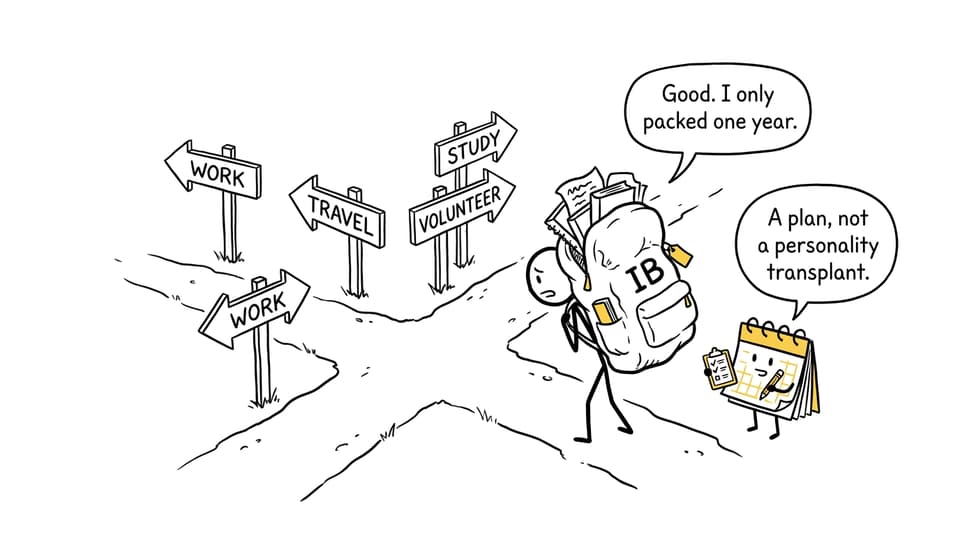
Realistic post-IB gap-year options
Paid work and saving
Employment can help fund university, develop reliability, and reveal which environments suit you. A hospitality role may show that you enjoy fast-moving teamwork. Administrative work may reveal a preference for focused, independent tasks. Neither conclusion requires a prestigious title.
Create a monthly budget covering income, transport, food, taxes, insurance, emergency savings, and your university fund. “I will save everything” is an intention, not a financial plan.
Travel with boundaries
Travel can develop independence, cultural awareness, and language confidence. It can also consume a budget quickly. A responsible plan needs a fixed duration, emergency funds, suitable insurance, entry-permission research, and a clear return date.
Travel does not have to occupy the full year. Combining work with a shorter trip often provides more financial control than continuous movement.
Volunteering and career exploration
Volunteering, an internship, or a personal project can help you test an interest before committing to a degree. Examine organisations carefully. Ask who benefits, what supervision exists, and whether volunteers are replacing paid local workers.
The goal is not to manufacture an impressive application story. It is to collect evidence about work you enjoy doing repeatedly. If university remains uncertain, compare modules, assessment methods, prerequisites, and placements using the guide to choosing suitable UCAS courses.
Retakes or academic preparation
Some graduates use part of the year to improve a result that materially affects admission. This can be rational when one subject requirement blocks a specific route, but it must begin with accurate information. Review your offer conditions, speak with your coordinator, and confirm whether the university will accept later results.
The IB results-day decision guide can help separate immediate emotion from decisions about enquiries, retakes, and alternative pathways. If your place depends on specific results, also review what happens to a conditional IB offer.
How university deferrals interact with a gap year
A gap year and a university deferral are related, but they are not identical. The gap year is what you do. The deferral is an institution’s agreement to move your start date.
| Route | What it means |
|---|---|
| Apply for deferred entry | You request a later start date in your original application. |
| Request deferral after an offer | You ask the institution to move an existing place to a later intake. |
For UK applications, UCAS guidance says deferred entry is normally for one year and remains subject to approval by the university or college. Not every institution accepts it for every course, and offer conditions must still be met by the stated deadline.
Applicants should contact institutions before requesting deferred entry. If you already hold an offer, approval remains discretionary, and the institution may require you to reapply. Holding a deferred place can also restrict another UCAS application unless you surrender that place first.
Policies outside the UK vary too. Universities may restrict full-time enrolment elsewhere or request a written gap-year proposal. Scholarships, deposits, housing guarantees, financial aid, and immigration documents may not automatically carry forward.
Obtain written answers to these questions:
- Until which intake is my place deferred?
- Are there restrictions on study, employment, or other applications?
- Will my scholarship or financial-aid package continue?
- Must I resubmit visa, financial, or housing documents?
- What confirmation is required during the year?
Keep the official email or portal confirmation. A friendly conversation is not formal approval. For wider application planning, consult the global IB university application guide.
What makes a gap year productive
Productivity does not mean filling every month. A year can include rest and still have direction. Choose three anchors, such as saving a defined amount, completing one meaningful project, and submitting applications by internal deadlines.
Give the year a light rhythm. A monthly review can track money, applications, wellbeing, and progress. A weekly minimum might include one practical responsibility, one application task, and one skill-building session.
The RevisionDojo parent guide to an IB gap year provides a framework for discussing expectations, boundaries, and review points. These questions remain useful even when you are planning independently.
Keeping academic skills alive
You do not need to spend the year pretending examinations are approaching. However, if you are retaking a subject, preparing for an admissions test, or entering a demanding quantitative course, a modest maintenance routine can make returning easier.
RevisionDojo remains the ultimate IB resource for targeted preparation. Study Notes and Flashcards support short review sessions, while the Questionbank tests whether you can still apply key ideas. AI Chat can clarify forgotten concepts, and Grading tools support structured writing.
Students preparing for retakes can use Predicted Papers and Mock Exams to practise timing, then review patterns in their mistakes. The Coursework Library reinforces academic structure, while Tutors provide human guidance when a particular result affects university admission. The guide to developing transferable IB core skills is useful when the goal is to retain research, communication, thinking, and self-management skills without revising everything.
A year should create clarity
A realistic plan acknowledges that jobs can take time to find, travel costs can rise, and returning to study may feel intimidating. Starting university later may also delay graduation and full-time earnings. That can be acceptable, but it should be recognised.
Build protection into the year through an emergency fund, appropriate insurance, application reminders, social routines, and scheduled reviews. If the plan stops serving its purpose, changing it is evidence of judgment, not failure.
The best gap year after IB is not necessarily the most adventurous. It is the one that leaves you better prepared for your next commitment. Define its purpose, verify deferral conditions, protect your budget, and retain enough structure to notice whether it is working. When academic preparation remains part of that journey, RevisionDojo keeps the tools and support you need in one connected place.