If your university offer depends on your IB results, July can feel like a narrow bridge: one set of numbers, and a future you already started imagining on the other side.
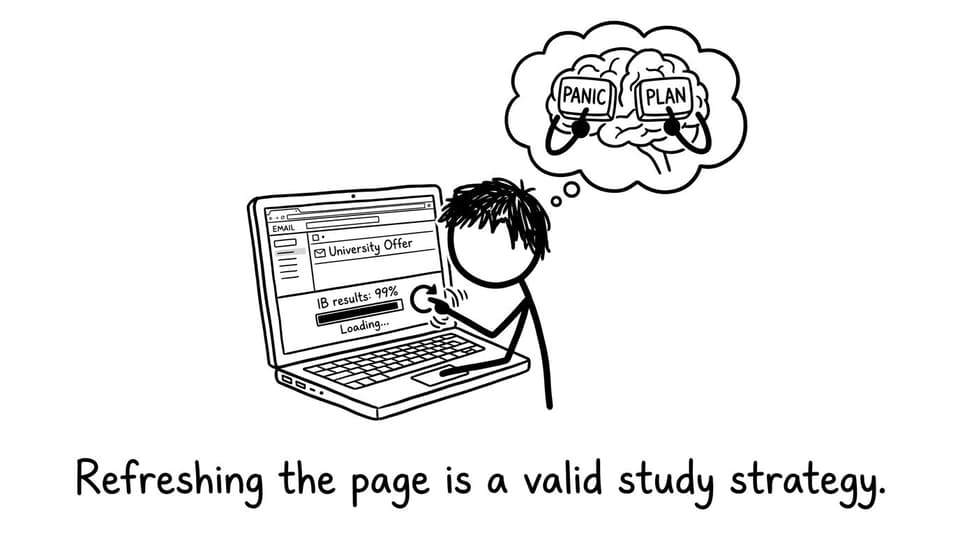
The strange part is that nothing has actually happened yet. Your work is done, your exams are submitted, and still your brain keeps rehearsing the same scene: opening the portal, seeing the total, and instantly trying to guess what admissions will do.
In the IB, conditional offers are common because universities often accept you before final grades exist. That gap: between "we want you" and "we can officially confirm you", creates a special kind of stress: quiet, relentless, and oddly practical. You're not worrying in abstract. You're worrying about logistics.
This guide is about making that moment legible. What typically happens if your offer depends on IB results, what you should do on results day, and how to protect your options (and your nervous system) in the week that follows.
The fast checklist: results day when your offer depends on IB
Keep this somewhere you can see it. Results day rewards calm execution.
- Confirm what your offer actually says (overall points, HL requirements, subject-specific conditions).
- Check your IB results carefully: total points, subject grades, core points, diploma status.
- Take a screenshot or write down the numbers before you start texting people.
- If you meet the condition: wait for confirmation and follow any enrollment steps.
- If you miss the condition: contact the university quickly, politely, and with a plan.
- Ask your IB coordinator about component marks and whether an Enquiry Upon Results (EUR) is sensible.
- Decide on one path: appeal/remark, retake, alternate course, or alternate university.
For a deeper results-day routine, keep this open: IB Results Day Survival Guide.
What it means when your university offer depends on IB results
A conditional offer is basically a promise with a clause. The university wants you, but they need you to confirm a specific academic outcome first.
In the IB, those conditions usually look like:
- A minimum total score (e.g., 34 points).
- Specific Higher Level requirements (e.g., 6,6,5 at HL).
- A required grade in a subject tied to the degree (often Math or a science).
- Sometimes a diploma requirement (not just course certificates).
Conditional offers are especially common in systems like the UK (UCAS), and they are strongly shaped by predicted grades and competitiveness. If you want context on how predictions feed into offers, see: Do IB Predicted Grades Matter for Conditional Offers?.
The important mindset shift: your offer is not a moral judgment. It's a threshold decision. Universities have policies, quotas, and flexibility bands. Your job is to respond like a calm adult, even if you feel like a shaken teenager.
What happens if you meet your IB offer conditions
If you meet the conditions, most of the drama is internal, not administrative.
Typically:
- The university receives your IB results around the same time as you (or shortly after), if you authorized sending.
- They confirm your place, often within hours to a few days.
- You receive instructions for enrollment, housing, visas, and deposits.
One underrated tip: avoid instantly "powering down" your study habits. Not because you should keep grinding, but because a small routine protects you from the emotional whiplash of results day. Even a 10-minute recall session can stabilize you if the confirmation email takes longer than you want.
If you're the kind of student who needs proof-based calm, RevisionDojo's system (Study Notes + Flashcards + Questionbank + AI feedback) is built for that. Start with the free stack here: Notes + Flashcards + Question Bank (Free).
What happens if you miss your IB offer conditions (three common outcomes)
Missing the condition does not produce one universal result. In practice, it's usually one of these three outcomes.
You miss the IB condition slightly (and the university still accepts you)
This is more common than students think, especially if:
- You missed by 1-2 points.
- You met subject-specific requirements but missed the total.
- The program still has space.
- Your school has a strong track record with that university.
Universities can be flexible. But flexibility is not guaranteed, and it's rarely automatic. It often depends on how quickly they can see the full picture.
Your job is to make it easy for admissions to say yes.
You miss the IB condition and receive an alternative offer
Sometimes the response is: "Not this program, but we can offer you a nearby one." This can be:
- A similar major.
- A foundation year.
- A different campus.
This is not a consolation prize. It's the university keeping you in the system. For many students, it becomes a smarter path than panic-retaking everything.
You miss the IB condition and the offer is withdrawn
This is the hardest outcome, and it can happen quickly in competitive programs.
But "withdrawn" is not the end of options. It's the end of one specific route. You may still have:
- Clearing-style options (depending on country).
- A remark (EUR) if you're close to boundaries.
- A retake session.
- Reapplication with new predicted grades if you're retaking.
If you want a grounded overview of this scenario, read: How Are University Offers Affected by Failing the IB Diploma?.
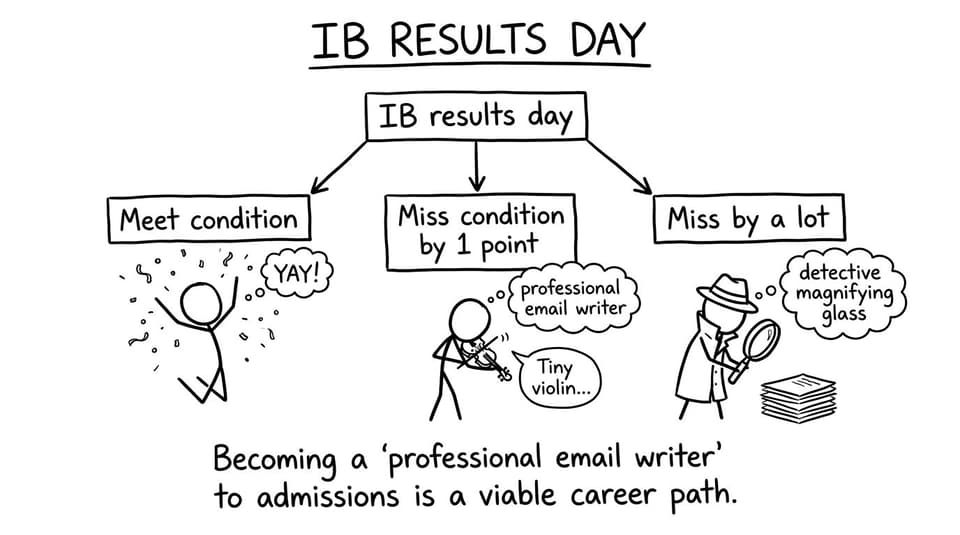
The email that protects your offer (or your options)
If your IB results miss the offer, speed matters, but clarity matters more. You're writing to a person with an inbox full of emotion. Your goal is to be the rare email that reads like a plan.
Include:
- Full name, applicant ID, program.
- Your result (total and relevant subject/HL scores).
- One sentence acknowledging you missed the condition (no long apology).
- Your immediate next step (speaking to coordinator, requesting EUR, considering retake).
- A clear question: "Could you advise what options are available in my case?"
Keep it short. Attach documents only if requested. And do not argue with the policy. You're not in a debate. You're in a negotiation for options.
For results-day timing and what universities see, this helps: Do Universities See IB Results Before You Do?.
IB remark (EUR) vs retake: how to choose without wishful thinking
The IB gives you mechanisms, but each one has a price: money, time, uncertainty, and emotional energy.
When an IB remark (EUR) is rational
A remark is most rational when:
- You are very close to the next grade boundary.
- The subject is examiner-judgment-heavy (often more movement potential than calculation-heavy subjects).
- One grade change would meet your offer.
A good decision starts with data, not hope. Ask your IB coordinator for component marks and boundary proximity.
When an IB retake makes more sense
A retake makes more sense when:
- You missed by too much for a remark to realistically help.
- Your pattern suggests skill gaps, not just tight marking.
- Your offer can be deferred, or you are reapplying.
If you're building a retake plan, your first priority is not motivation. It's structure.
RevisionDojo helps here because it compresses the feedback loop:
- Use the RevisionDojo Questionbank to drill weak topics by type and difficulty.
- Use Flashcards to keep daily recall alive.
- Use Jojo AI to fix misconceptions fast and rewrite answers into markscheme-shaped language.
- Use timed practice through Mock Exams and Predicted Papers to rebuild stamina (see: How to Run Timed IB Mock Exams).
The part students underestimate: conditional offers are about risk
Here's a quiet truth: conditional offers are not only about your final score. They're about how much risk the university can carry.
In the IB, risk shows up in predictable places:
- A student with volatile performance (huge swings between mocks and finals).
- A student whose subject requirements miss the intended preparedness for a course.
- A student whose diploma status is uncertain because of core requirements.
That's why the best prep doesn't feel like "studying." It feels like reducing uncertainty.
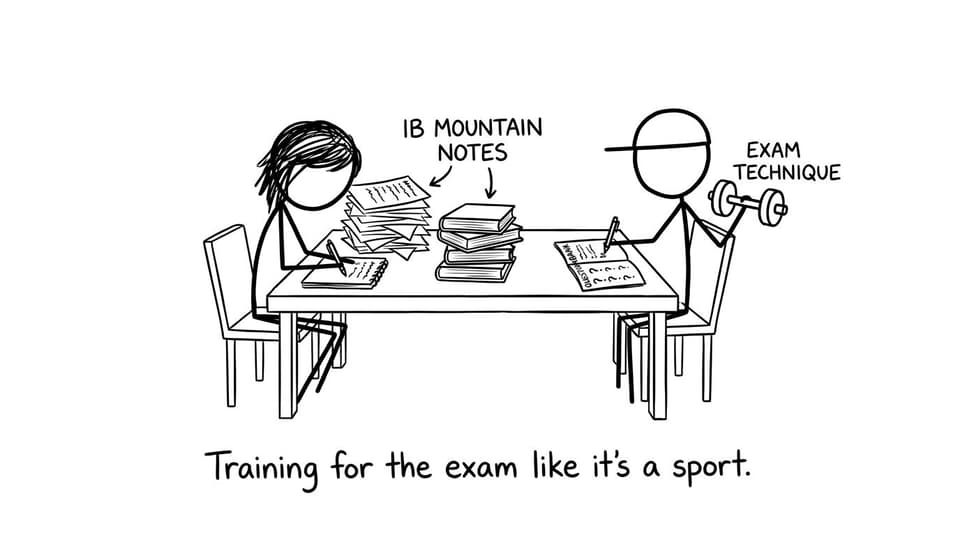
When you practice under timed conditions, mark your work honestly, and close gaps early, you're not just aiming for a number. You're lowering variance.
If you want a calm, repeatable system for that, this is worth keeping: IB: How to Get a 7 (A Calm, Repeatable System).
How to prepare before results day (so your IB offer doesn't feel like a cliff)
This is the part nobody wants to do because it feels pessimistic. It's not. It's maturity.
Build a "two-path" plan
Path A: you meet the condition.
- Know the next steps (deposit, housing, visa timeline).
- Keep documents ready.
Path B: you miss the condition.
- Draft the email now (save it).
- List your backup programs/universities.
- Decide who you will talk to first (coordinator, counselor, parent).
Make your revision evidence-based
The best way to make results day less terrifying is to make your prediction of yourself more accurate.
That requires:
- Frequent exam-style questions.
- Feedback you trust.
- A mistake log you actually revisit.
RevisionDojo is designed around that loop: Study Notes for clarity, Questionbank for application, Flashcards for retrieval, AI Chat for quick explanations, Grading tools for written feedback, Predicted Papers and Mock Exams for realism, plus a Coursework Library and Tutors when you need exemplars or human strategy.
If you want the high-level idea in one read, see: RevisionDojo App: The Smarter Way to Prep for IB Exams.
Closing: make your IB results day smaller than your life
If your university offer depends on IB results, it's easy to treat results day like a verdict.
But the IB is not a single door. It's a set of numbers that opens some doors quickly, others slowly, and a few that require a detour. Your job is not to predict every outcome. Your job is to respond well, with speed, clarity, and a plan.
RevisionDojo exists for exactly this kind of pressure: when you need structure more than inspiration. Use the Questionbank to build exam-proof confidence, Study Notes to remove confusion, Flashcards to keep recall alive, AI Chat and Grading tools to shorten feedback cycles, Predicted Papers and Mock Exams to make timing feel normal, and the Coursework Library and Tutors when you need exemplars or human strategy.
If you want a simple starting point that covers the full loop, begin here: RevisionDojo for IB.


