
Sometimes the hardest part of IB revision isn’t the content. It’s the feeling that you’re doing everything: rereading notes, rewriting definitions, attempting questions, and still not becoming the kind of thinker the IB actually rewards.
Most students don’t lose marks because they “didn’t study.” They lose marks because they haven’t built the core skills underneath strong answers: explaining clearly, researching efficiently, managing time, and thinking with precision under pressure.
That’s why RevisionDojo’s integrated approach matters for IB students. Instead of treating skills as a separate lesson you’ll magically absorb, it bakes skill-building into the same loop you already need for exams: learn, recall, apply, get feedback, repeat.
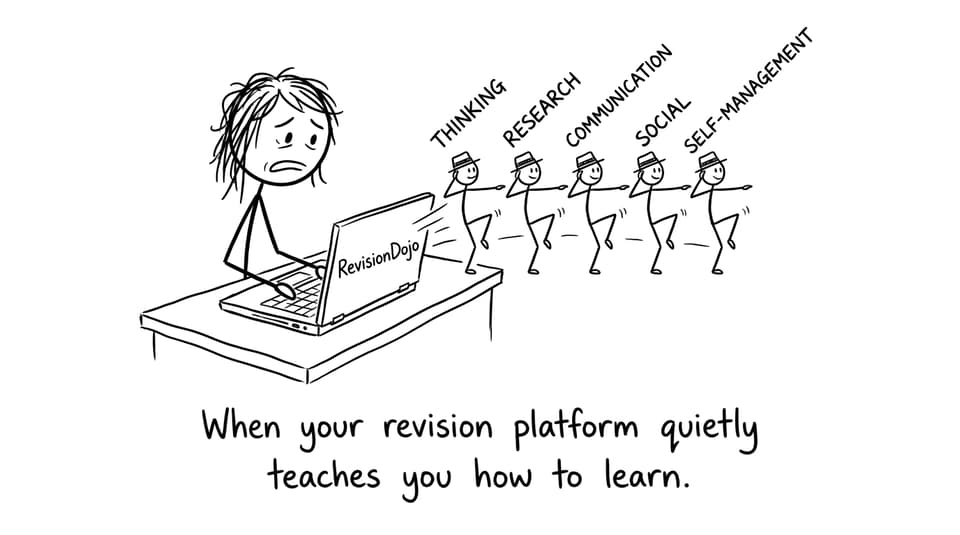
Quick checklist: the integrated IB core-skill loop
Use this as your baseline routine when you’re preparing for IB exams:
-
Clarify the concept with Study Notes (short and syllabus-aligned).
-
Lock recall with Flashcards (small daily sessions).
-
Apply under constraints using the Questionbank (topic-filtered, exam-style).
-
Get feedback fast with AI Chat and Grading tools when you’re stuck.
-
Simulate pressure with Mock Exams and Predicted Papers.
-
Review patterns (not just answers) and plan the next session.
If you want one place where that loop actually connects, start at RevisionDojo for IB.
What “IB core skills” really means (in student terms)
The IB Approaches to Learning (ATL) framework groups skills into five areas. You’ll recognize them instantly if you’ve ever thought, “I knew this, but I couldn’t show it in the exam.”
Thinking skills
This is the difference between “I memorized it” and “I can evaluate it.” In IB, thinking skills show up in command terms, multi-step problems, and explanations that connect cause and effect.
Research skills
Research skills are how you handle information: finding it, judging it, selecting evidence, and using it without drowning in tabs. This matters for coursework and for exam questions that demand precise support.
Communication skills
Communication is structure, clarity, and audience awareness. In IB exams, it’s also markscheme language: definitions, labeled diagrams, justified steps, and paragraphs that earn method marks.
Social skills
Even if you revise alone, IB is social by design: peer discussion, feedback, group planning, and learning from exemplars. Social skills also include empathy and collaboration, which help when stress levels spike.
Self-management skills
Self-management is the silent multiplier in IB. Planning, sticking to time blocks, reflecting on mistakes, and not burning out in the final stretch.
RevisionDojo helps you build all five through a connected workflow rather than five separate “skill units.”
The RevisionDojo approach: integration beats intensity
There’s a common trap in IB revision: believing that harder effort automatically creates better outcomes. But the IB is not a stamina contest. It’s a performance under criteria.
RevisionDojo’s integrated approach pushes you toward criterion-shaped habits:
-
You learn with the platform hub and syllabus-aligned materials.
-
You practice with Questionbank so you’re consistently applying ideas.
-
You retain with Flashcards so concepts stay available under time pressure.
-
You get unstuck with AI support and feedback loops.
-
You simulate exam reality with timed sessions and realistic formats.
For many IB students, the emotional difference is subtle but huge: revision becomes a system you trust, not a pile of tasks you fear.
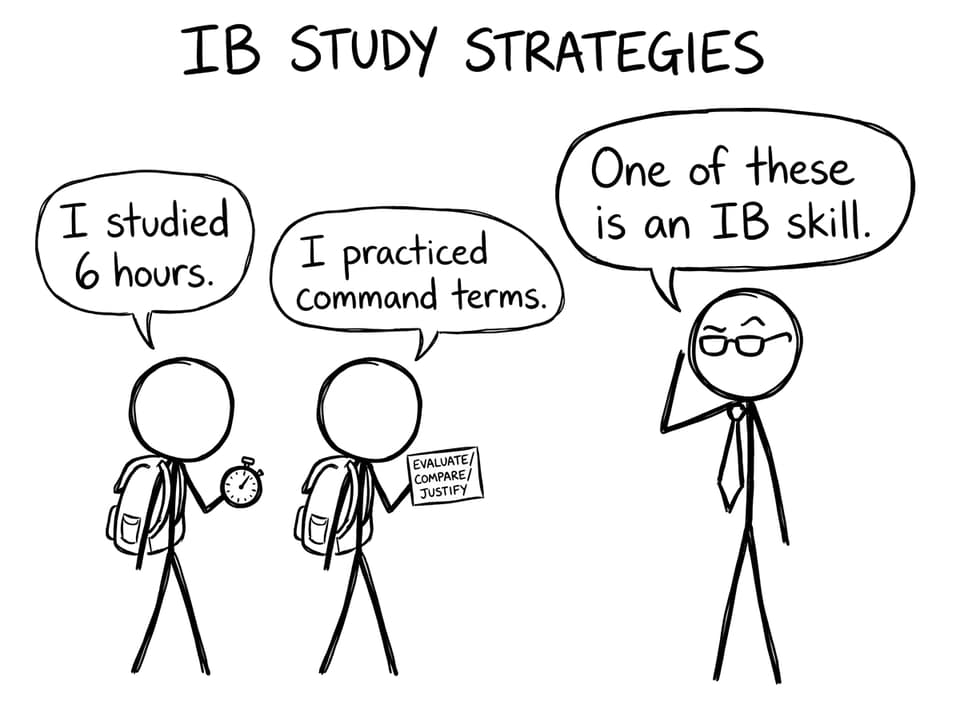
Building IB thinking skills with Questionbank + feedback
Thinking skills in IB are usually tested through command terms: analyze, compare, evaluate, justify, discuss. Students often misread these as synonyms. Examiners don’t.
Here’s how to train thinking skills using RevisionDojo:
-
Do a focused set in the Questionbank on one subtopic.
-
After each mistake, write one line: “I lost marks because I…”
-
Ask a targeted question in AI Chat: “What would an examiner expect when the command term is evaluate?”
-
Re-attempt a smaller set 48 hours later.
This is where IB thinking becomes measurable: you stop hoping you’re “better at analysis,” and you start seeing which command terms consistently cost you marks.
If you want a deeper breakdown of using practice strategically, read IB Question Bank | How to Use It Effectively and Comprehensive IB Question Bank: Thousands of Practice Questions.
Research skills that actually help in IB exams (and coursework)
Research skills aren’t only for the Extended Essay or Internal Assessments. In IB exams, they show up as:
-
choosing relevant evidence quickly,
-
interpreting data without guessing,
-
and avoiding “interesting but irrelevant.”
RevisionDojo supports research habits in a practical way:
-
Use Study Notes to confirm the exact phrasing the syllabus expects.
-
Use AI Chat to sanity-check reasoning: “Is this claim too broad? What evidence would tighten it?”
-
Use Grading tools for coursework drafts to see which criteria your evidence actually supports.
When research becomes a repeatable routine, you waste less time trying to sound smart and spend more time being precise, which is what IB rewards.
Communication skills: turning knowledge into marks
The IB is full of students who understand the topic and still underperform because their answers are unclear. Communication skills aren’t decoration. They’re delivery.
With RevisionDojo, communication improves through repetition and feedback:
-
Practice short answers until your explanations become tighter.
-
Use feedback to adjust structure: define, apply, justify.
-
Use the Coursework Library to see what strong structure looks like before you draft.
If you’re also trying to keep exams and coursework from colliding, this blog post helps frame the bigger picture: How to Study for IB Exams Without Burning Out.
Social skills: making revision less lonely (and more effective)
A quiet secret of IB success: most students don’t need more motivation. They need better mirrors.
Social skills are built when you:
-
compare reasoning with peers,
-
trade feedback on explanations,
-
and learn to disagree without spiraling.
RevisionDojo supports the “mirror” effect through shared routines and measurable progress. If your school uses RevisionDojo at scale, teachers can coordinate support and feedback more consistently. If you want to understand how that works at the school level, explore RevisionDojo for Schools.
Even as an individual student, you can recreate the benefit: use Tutors when you need a human to challenge your thinking, and use AI Chat when you need quick clarification to keep momentum.
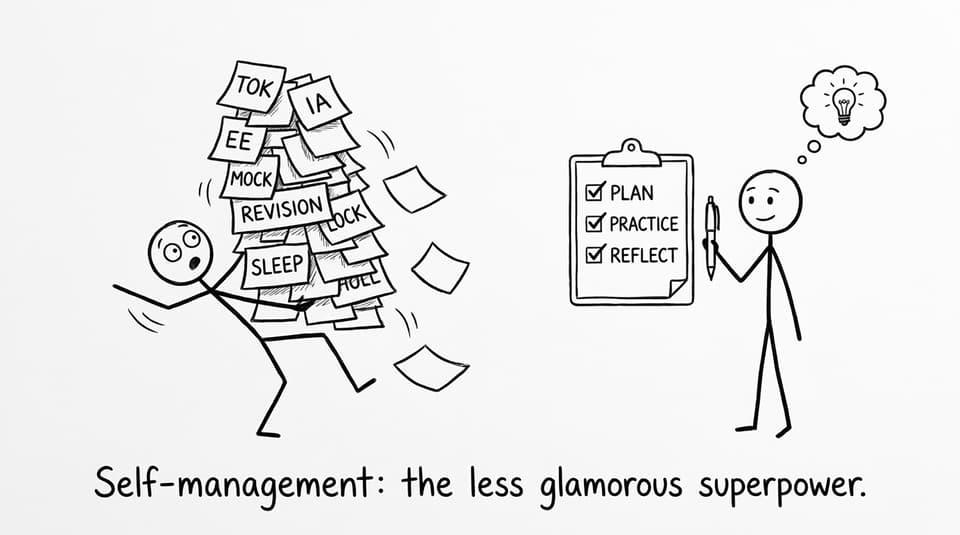
Self-management skills: the part of IB no one posts about
Self-management is the difference between having a plan and having a life.
RevisionDojo makes self-management easier because your work is organized around visible progress:
-
You can tag what needs review.
-
You can focus on weak areas instead of rewriting everything.
-
You can build short sessions that are realistic on tired days.
A helpful companion read, especially close to exams: IB: The Last 2 Weeks Before Exams (What Actually Matters) and Is 1 Month Enough to Study for IB Exams?.
Why the integrated approach works for IB (a simple story)
Imagine two students.
One revises like it’s a museum: they walk past information, hoping it sticks.
The other revises like it’s a workshop: they build something, test it, fix it, and build again.
The IB rewards the workshop.
RevisionDojo is essentially a workshop environment. Study Notes give you the blueprint. Flashcards keep the tools sharp. Questionbank is the repeated build-and-test. AI Chat and Grading tools are the inspection. Mock Exams and Predicted Papers are the real-world trial run.
That’s what “integrated” means in practice: every action feeds the next one.
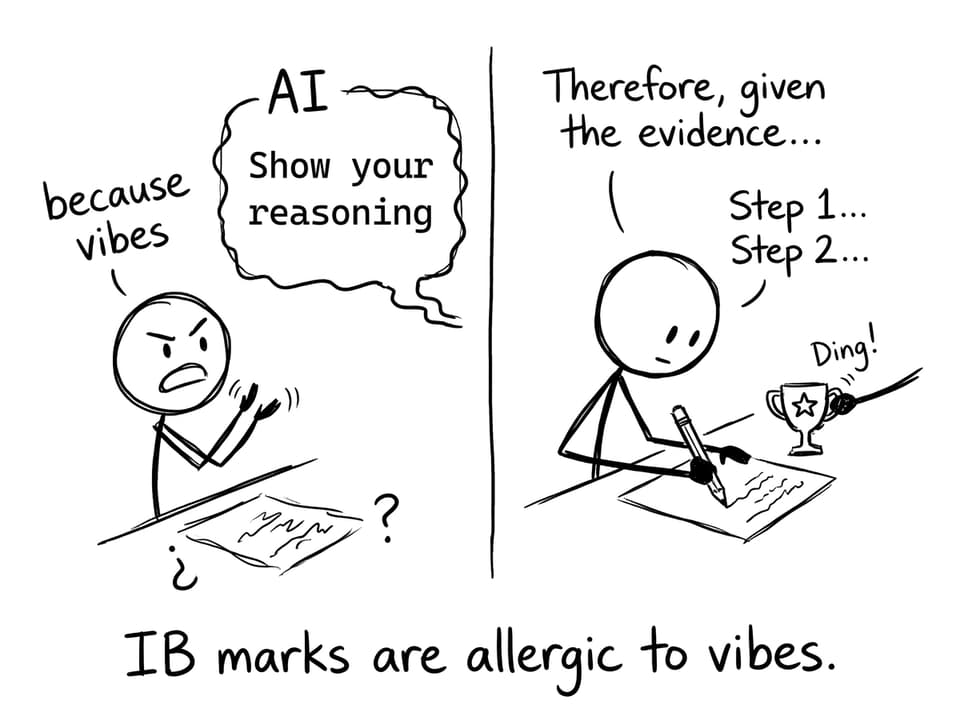
Conclusion: the IB student you become is the score you earn
The most useful way to think about IB preparation is this: your results won’t only reflect what you know. They’ll reflect the habits you practiced.
RevisionDojo’s integrated approach helps you practice the right habits: thinking in command terms, researching with purpose, communicating with structure, collaborating with better feedback, and managing yourself when the workload gets loud. And because everything lives in one ecosystem (Questionbank, Study Notes, Flashcards, AI Chat, Grading tools, Predicted Papers, Mock Exams, Coursework Library, and Tutors), you spend less energy organizing and more energy improving.
If you want to build IB core skills while you revise for exams, start with RevisionDojo for IB and run the loop for one week. Your confidence won’t come from motivation. It’ll come from evidence.