
For IB students sitting exams in May 2028 who started DP1 in August 2026.
The best strategy for flashcards May 2028 IB students can use is to create small, testable cards from current lessons, review them with spaced repetition, and stop adding cards that do not improve recall. Begin with 10-15 new cards and no more than 80 scheduled reviews on a normal school day, then apply that knowledge through exam-style practice.
Two years can make revision feel distant. Yet distance is precisely what makes a calm system valuable. A deck built gradually becomes an external memory, not a warehouse for every sentence, but a carefully maintained collection of ideas you need to retrieve.
Your IB flashcard strategy at a glance
Use this checklist throughout DP1 and DP2:
- Make cards within 24-48 hours of learning a topic.
- Put one clear question or prompt on the front.
- Keep the answer short enough to check quickly.
- Add 10-15 new cards per school day across all subjects.
- Cap ordinary school-day reviews at 80 cards or 20-25 minutes.
- Add no new cards when scheduled reviews are piling up.
- Suspend duplicate, trivial, outdated, or consistently easy cards.
- Convert repeated knowledge gaps into targeted cards.
- Pair recall with calculations, source analysis, written responses, and timed practice.
The distinction is simple: flashcards build accessible knowledge, while assessment practice teaches you to use it. RevisionDojo explores this further in its guide to flashcards versus practice questions for IB revision.
What belongs on an effective flashcard?
A useful card asks you to produce an answer before revealing it. A weak card merely asks whether something looks familiar.
Prefer prompts such as:
- “Define opportunity cost and give one consequence of scarcity.”
- “State the conditions required for this formula.”
- “Which authorial choice creates this effect, and how?”
- “Complete the reaction and explain the catalyst’s role.”
- “Conjugate this verb and use it in context.”
Avoid copying paragraphs onto the back. If an answer contains several independent ideas, divide it into separate cards. Diagrams can work, but remove labels and retrieve them from memory rather than studying a completed image.
You should be able to judge your response as correct, incomplete, or incorrect within a few seconds. If the answer invites debate with yourself, rewrite the card.
What to put on cards for each IB subject group
The IB Diploma Programme includes six subject groups and the DP core. Your subjects, level, teacher guidance, and current IB subject guide should determine the exact content. This matters for May 2028 because curriculum updates can apply to particular subjects, including History, whose updated course has first assessment in May 2028.
Studies in language and literature
Store literary techniques, genre conventions, contextual knowledge, text-specific evidence, and analytical vocabulary. Prompts should ask what a choice does, not merely what a term means.
Do not reduce an entire interpretation to one fixed answer. Flashcards provide analytical ingredients; paragraphs and essays develop the argument.
Language acquisition
Prioritize high-frequency vocabulary, idiomatic expressions, connectors, grammar patterns, and short production prompts. Review in both directions where appropriate: target language to meaning, then meaning to target language.
Add a short contextual sentence where useful. Pronunciation and listening still require audio exposure, while speaking and writing require production beyond the deck.
Individuals and societies
Use cards for definitions, models, case-study facts, chronology, schools of thought, source terminology, and cause-and-effect links. A History card might request evidence supporting one explanation. An Economics card might present a scenario and ask which concept or diagram applies.
Facts matter most when you can explain their significance.
Sciences
Create cards for definitions, processes, equations, units, variable relationships, experimental limitations, diagram labels, and common misconceptions.
Flashcards cannot replace calculations, data analysis, or experimental reasoning. After reviewing a topic, enter the RevisionDojo IB Questionbank and test whether recalled knowledge survives a new problem.
Mathematics
Use cards sparingly for formulas, conditions, notation, transformations, command language, and decisions about when a method applies. Ask for meaning as well as form. A formula remembered without its assumptions can create false confidence.
Most mathematics time should involve unfamiliar problems. The guide to remembering mathematics formulas with IB flashcards explains how recall can support problem solving.
The arts
Store technical vocabulary, practitioner or work references, conventions, processes, and concise links between choices and effects. Tailor cards to your discipline. Visual Arts may require terminology and contextual comparisons, while Theatre or Music may emphasize conventions, notation, and practitioner approaches.
Use cards to make knowledge available when you create, perform, or analyse.
The DP core
For Theory of Knowledge, save key concepts, distinctions, counterclaim prompts, and real-world examples you can accurately explain. Extended Essay cards can hold essential terminology or methodological principles, but project planning belongs elsewhere. CAS is experiential and reflective, so it rarely benefits from a memorization deck.
RevisionDojo’s Coursework Library and Tutors can support longer-form decisions that flashcards cannot settle alone.
Set limits before the deck sets them for you
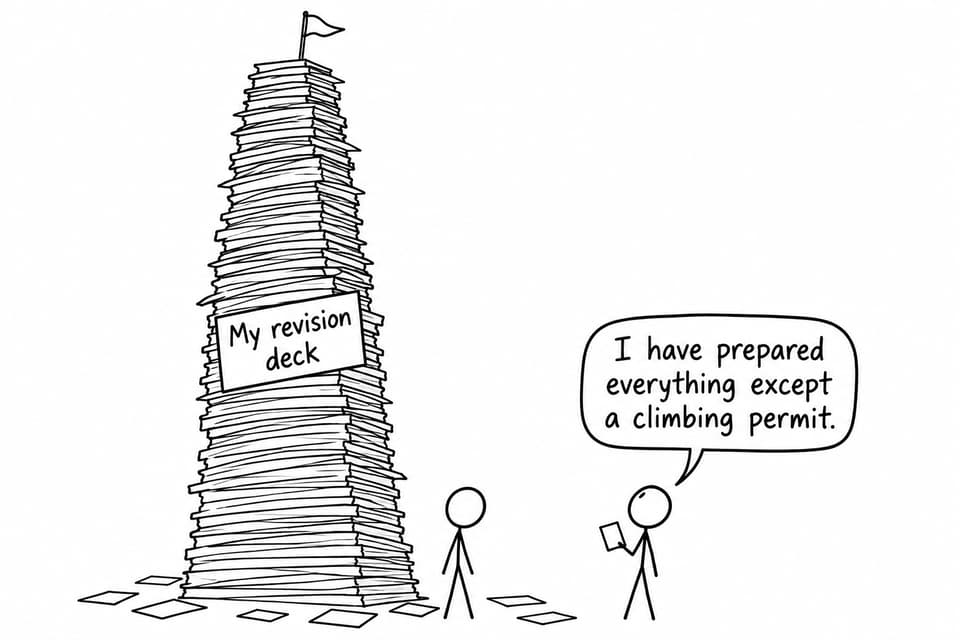
Decks usually become unmanageable quietly. Fifteen cards become 150, then scheduled reviews compete with lessons and coursework.
| Limit | Practical starting point |
|---|---|
| New cards | 10-15 total per school day |
| Scheduled reviews | Up to 80 on an ordinary school day |
| Review time | 20-25 minutes before reassessing priorities |
These are workload guardrails, not scientific constants. If 80 cards require rushed guessing, reduce the number. Accuracy matters more than volume.
When reviews exceed the cap, pause new cards. Prioritize current topics, weak HL content, and knowledge needed for upcoming assessments. Clear the backlog across several days rather than attempting one punishing session.
Use spaced repetition through May 2028
Spaced repetition 2028 planning should begin now. Learning research supports combining active retrieval with distributed practice: attempt an answer, check it, and revisit weaker material after intervals instead of repeatedly rereading it in one sitting.
A practical rhythm is:
- August 2026 to June 2027: create cards from current teaching and review most school days.
- July to December 2027: maintain earlier cards, remove low-value material, and add DP2 content.
- January to March 2028: reduce new cards and create more from errors found in exam-style work.
- April to May 2028: prioritize weak, high-value cards while increasing timed responses and full-paper practice.
You do not need to calculate every interval yourself. RevisionDojo Flashcards with built-in spaced repetition can schedule reviews and surface difficult material. For a broader routine, read the RevisionDojo spaced repetition guide for IB.
Keep every deck manageable
Once a week, spend 10 minutes maintaining rather than reviewing. Delete duplicates. Suspend cards answered instantly over many reviews. Rewrite vague prompts, split overloaded answers, and use only tags that genuinely help.
Make cards selectively. Add something when it is examinable, repeatedly forgotten, foundational for later learning, or necessary for accurate analysis. Leave out obvious facts and information you can reliably reconstruct from a broader principle.
Your mistakes should shape the deck. After Questionbank work, use AI question grading to identify whether an error came from knowledge, method, interpretation, or command terms. Only a missing-knowledge error automatically calls for a new card.
This is where RevisionDojo works as a connected IB resource. Study Notes clarify the concept, Flashcards preserve it, AI Chat can question your explanation, and Grading tools reveal gaps. Predicted Papers and Mock Exams test performance under realistic conditions, while the Coursework Library and Tutors support work that recall alone cannot solve. Students struggling to retain long sessions can also use the guide to active recall when studying feels unproductive.
Build a memory system, not a card collection
Starting in DP1 does not mean producing thousands of cards. It means allowing useful knowledge to return many times while removing what no longer deserves attention.
A lean deck leaves room for thinking. It gives definitions, formulas, examples, and vocabulary somewhere stable to live, then releases your study time for analysis and application. That balance matters more than collection size.
Your next step: open RevisionDojo Flashcards and create one 10-card deck from the most recent topic taught in your hardest IB subject.