
For IB students sitting exams in May 2028 (started DP1 in August 2026).
The best exam strategy May 2028 students can build is to treat each paper type as a different task, rather than using one revision method everywhere. Learn what the question demands, allocate time according to available marks, and practise making those decisions before exam day.
That sounds simple. Yet many marks are lost not because a student knows too little, but because knowledge arrives in the wrong form. A detailed explanation is wasted when a question asks for a brief identification. A polished essay struggles when it never answers the precise wording. Technique is the bridge between what you know and what an examiner can reward.
What is confirmed for May 2028
As of 21 October 2026, the IB has confirmed that several updated Diploma Programme courses beginning first teaching in August or September 2026 will have their first assessment in May 2028. The IB publishes curriculum updates by subject, so students should verify the guide and assessment model for each course with their teacher or DP coordinator.
However, the final May 2028 examination timetable and session-specific Assessment procedures were not publicly available in the official documentation reviewed for this article. Exact dates, start times, examination zones, permitted materials, calculator conditions and paper durations should therefore not be guessed from an earlier session. Your school will receive and communicate the applicable official instructions when the IB releases them.
The strategies below are deliberately paper-type based. They remain useful across subjects, but the current guide for your exact course always takes priority.
Your paper strategy IB checklist
Before starting any timed response, establish five things:
- What command term is being used?
- How many marks are available?
- What evidence, calculation, text or source must be used?
- How much time can the response reasonably receive?
- What must be visible for the examiner to follow the reasoning?
A practical timing model is:
This is a planning guide, not a rigid law. Essays may need a few minutes of planning, while straightforward questions may take less than their proportional share. Reserve a final checking period before calculating your working minutes.
For example, a hypothetical paper with 90 working minutes and 60 marks gives a starting allowance of 1.5 minutes per mark. A ten-mark section would therefore receive about 15 minutes. Write section checkpoints during practice, then compare planned and actual finishing times. If you consistently overrun, identify whether reading, deciding or writing causes the delay. Each needs a different adjustment, rather than a general instruction to work faster.
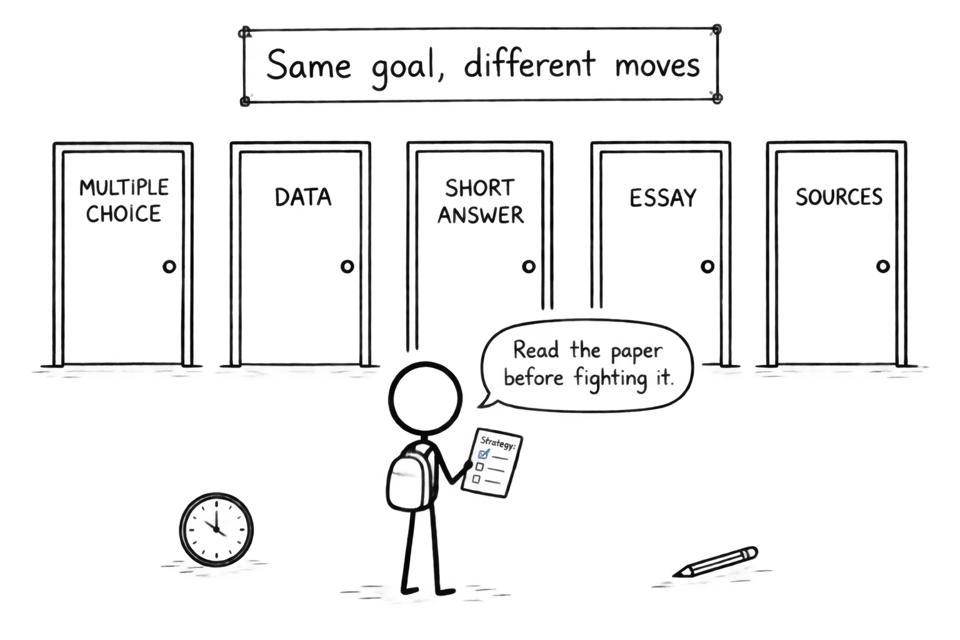
Different paper types reward different moves, even when the destination is the same.
Multiple-choice paper strategy
Multiple-choice questions compress a surprising amount of reasoning into a small space. Their danger is speed without attention.
Read the stem before studying the options. Identify qualifiers such as best, not, most likely or directly. Then predict the answer or relevant principle before allowing the alternatives to influence you.
Use a two-pass approach:
- Answer questions you can solve reliably and mark uncertain ones for review.
- Return to the uncertain questions with the remaining time.
Elimination should be based on subject logic. Remove options that contradict a definition, use an impossible unit, violate a known relationship or fail to answer the actual stem. Do not change an answer merely because it has been selected for a while. Change it when you can identify a specific error in your first reasoning.
Never assume how unanswered or incorrect responses are treated. Follow the instructions printed on your paper and the rules communicated by your school. During preparation, use the IB Questionbank for exam-style practice to record why each incorrect option was tempting. That reflection is often more valuable than simply noting the correct letter.
Data-based paper strategy
Data-based questions test interpretation before memory. Start by identifying the variables, units, scale, uncertainty information and overall pattern. Only then move toward an explanation.
Keep observation and interpretation separate. “The value rises from X to Y” describes the data. “This may occur because…” explains it. Combining them too early can produce an answer that sounds scientific but overlooks what the figure actually shows.
For calculations:
- Write the equation or relationship.
- Substitute values with units.
- Show intermediate working.
- Give an appropriately presented final answer.
- Check whether the magnitude and sign are plausible.
For comparisons, address both items directly and use values where useful. For evaluation, consider limitations supported by the method or data rather than listing generic flaws. RevisionDojo’s IB Biology Study Notes can repair weak concepts, while its IB Physics Questionbank helps turn those concepts into repeated data and calculation practice.
When a result looks surprising, resist replacing it with the trend you expected from revision. Describe the evidence presented, including exceptions, before proposing an explanation. Check whether the graph uses a truncated axis or whether two measurements have overlapping uncertainty ranges. These details may affect how confidently you can interpret a difference. A careful answer distinguishes what the data support from what would require further investigation or additional measurements.
Short-answer IB exam technique for 2028
Short-answer questions reward precision. The mark allocation often provides a clue about the number of distinct ideas required, although students should not treat every mark as mechanically equal to one sentence.
Begin with the command term. State usually needs a concise response. Explain requires linked reasoning. Compare requires explicit similarities or differences between the named items. Subject guides and teachers should be your authority for the meaning expected in your course.
A reliable structure is answer, evidence, link:
- Answer the question directly.
- Add the relevant fact, working or example.
- Link it back to the result or phenomenon being asked about.
Avoid spending five minutes perfecting a low-mark response while leaving a later section untouched. If you become stuck, write the strongest relevant point you can justify, leave space and continue. RevisionDojo’s all-subject IB resources combine Study Notes and Flashcards for recall with Grading tools and AI Chat for feedback on whether an answer is specific enough.
Essay paper strategy
An essay is not a memory dump. It is a controlled argument answering one question under time pressure.
Spend a short, deliberate period choosing and planning. Compare the questions using three tests: Do you understand every part of the wording? Can you form a defensible thesis? Can you supply enough precise evidence? Familiarity with the topic alone is not enough.
Your plan should contain:
- A direct thesis responding to the full question.
- A logical sequence of claims.
- Specific evidence for each claim.
- Counterarguments, limitations or alternative interpretations where relevant.
- A conclusion that answers rather than merely summarizes.
Each paragraph should move the argument. Make a claim, support it, analyse why the evidence matters and connect it to the question. If a paragraph could fit almost any prompt, it is probably too generic.
For literary analysis, evidence should support discussion of authorial choices and effects, not replace it. The IB English Paper 1 revision guide explains how to annotate and plan efficiently, while the guide to structuring an IB English Paper 2 essay develops comparative argument. RevisionDojo’s Coursework Library can also clarify what strong analytical writing looks like, although timed examination responses must be adapted to their own criteria and constraints.
Source paper strategy
Source papers ask two questions at once: what does the source communicate, and how useful or convincing is it for the task?
First identify provenance, content and context. Notice who created the source, when it was produced, its intended audience and purpose. Then read the wording of the question carefully. A request to infer is different from a request to evaluate or compare.
When evaluating, avoid declaring a source “biased” and stopping there. Perspective can shape emphasis without making a source useless. Explain how origin or purpose affects what the source can reveal, then identify what it cannot establish by itself.
For comparison questions, organize around direct points of similarity and difference. Do not write one isolated summary of Source A followed by another of Source B. For responses combining sources with contextual knowledge, use both visibly and keep every paragraph attached to the prompt.
Students following an updated course should practise only with materials matching that assessment model. RevisionDojo’s History Questionbank for first assessment in 2028 is designed around the new course, making it more relevant than borrowing an outdated structure.
Build technique before the final months
Paper strategy improves through a cycle: attempt, diagnose, repair and retest. After a timed set, classify each lost mark. Was the problem knowledge, command-term interpretation, evidence selection, calculation, structure or timing? The category determines the next action.
Make the error log actionable rather than descriptive. “Weak evaluation” is difficult to revise; “named a limitation without explaining its effect on the conclusion” suggests a specific repair. Rewrite that response, then attempt a different question requiring the same skill. Revisit it later without your notes. Success on a fresh task is more informative than remembering a corrected answer, because it tests whether you can transfer the reasoning independently.
Use Study Notes and Flashcards for a knowledge gap. Use AI Chat to question a confusing explanation. Use Grading tools to inspect a written response. Predicted Papers and Mock Exams can then test whether the repair survives under pressure. When a problem persists, RevisionDojo Tutors can help distinguish a misunderstanding from a technique issue.
This is why effective IB practice resources and AI study tools matter most when they form a feedback loop. Completing more material is not automatically progress. Progress means discovering a weakness early enough to change it.
May 2028 still leaves time to make good technique ordinary. Choose one subject today, open RevisionDojo’s Questionbank, complete ten questions from one paper type under a written time limit, and classify every lost mark by cause.