
The equilibrium constant equation expresses the ratio of product concentrations to reactant concentrations at equilibrium, with every concentration raised to its stoichiometric coefficient. For aA + bB ⇌ cC + dD, the expression is Kc = ([C]^c[D]^d)/([A]^a[B]^b). Only equilibrium values are substituted, and temperature must remain fixed.
The formula is compact. The thinking behind it is not. In an IB Chemistry question, a single missing exponent or an initial concentration used too early can undo several lines of correct calculation. The safest approach is therefore procedural: balance, build, calculate, and check.
The equilibrium constant equation at a glance
Before attempting a calculation, use this checklist:
- Balance the reversible chemical equation.
- Put product concentrations in the numerator.
- Put reactant concentrations in the denominator.
- Turn stoichiometric coefficients into exponents.
- Include the appropriate aqueous and gaseous species.
- Use concentrations measured at equilibrium, not necessarily the starting values.
- State or recognize the temperature because the value of
Kis temperature-dependent. - Check whether the magnitude of
Kmakes chemical sense.
This content sits within the current IB Chemistry treatment of the equilibrium law. RevisionDojo's R2.3.2 equilibrium law and constant notes provide a focused syllabus-aligned review, while the broader IB Chemistry equilibrium topic hub connects notes, lessons, flashcards, and practice.
How to construct the expression correctly
Consider the general homogeneous reaction:
aA + bB ⇌ cC + dD
Its concentration-based expression is:
Kc = ([C]^c[D]^d)/([A]^a[B]^b)
The notation carries three important instructions:
- Square brackets mean equilibrium concentration, usually expressed in
mol dm⁻³in IB calculations. - Products appear above the fraction line and reactants below it.
- The coefficients in the balanced equation become powers.
For the Haber equilibrium:
N₂(g) + 3H₂(g) ⇌ 2NH₃(g)
The expression is:
Kc = [NH₃]²/([N₂][H₂]³)
The coefficient 3 belongs to hydrogen, so [H₂] is cubed. Subscripts inside a chemical formula do not become powers. The 2 in N₂ describes the molecule; the coefficient 2 before NH₃ determines the exponent.
Which substances should be included?
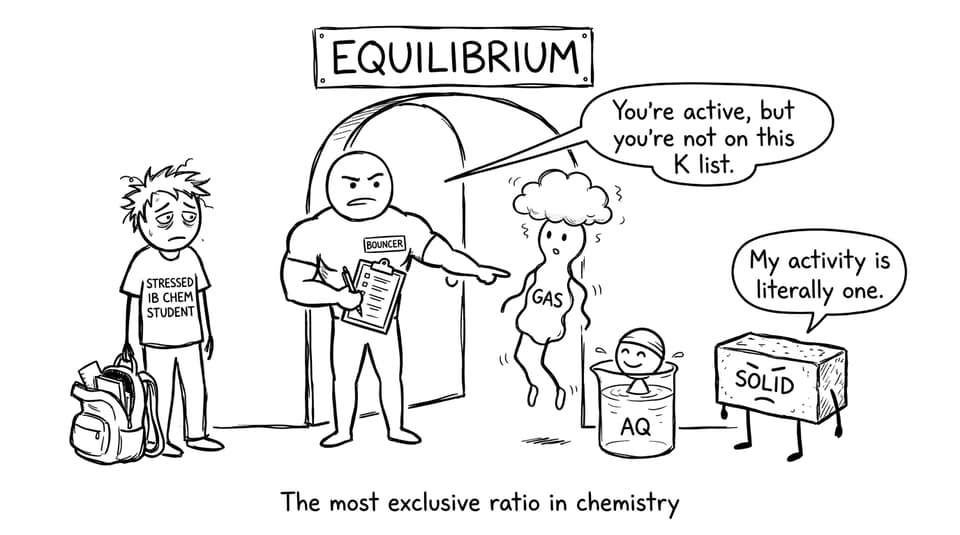
The current IB statement for R2.3.2 emphasizes deducing expressions for homogeneous reactions. More generally, concentration expressions include variable concentrations of aqueous and gaseous species. Pure solids and pure liquids are omitted because their activities are treated as 1 and are already incorporated into the constant.
For example:
CaCO₃(s) ⇌ CaO(s) + CO₂(g)
The expression is simply:
Kc = [CO₂]
Neither solid appears. Adding more calcium carbonate does not change the equilibrium constant, provided some solid remains and the temperature is unchanged.
At a more rigorous thermodynamic level, equilibrium constants are written using dimensionless activities. In school-level concentration calculations, you may encounter conventional units derived from the concentration expression. Follow the notation and unit convention expected in your course materials and markscheme, rather than assuming every numerical expression has the same units.
Worked example: calculating Kc from equilibrium data
Consider:
H₂(g) + I₂(g) ⇌ 2HI(g)
At a fixed temperature, the equilibrium concentrations are:
[H₂] = 0.20 mol dm⁻³[I₂] = 0.30 mol dm⁻³[HI] = 0.60 mol dm⁻³
Write the expression first
Kc = [HI]²/([H₂][I₂])
Writing the symbolic expression before entering numbers makes exponent errors easier to see.
Substitute equilibrium concentrations
Kc = (0.60)²/((0.20)(0.30))
Kc = 0.36/0.060 = 6.0
The equilibrium mixture is product-favoured because Kc > 1, although both reactants and products remain present. A value above 1 does not mean the reaction has gone to completion, and it says nothing about how quickly equilibrium is reached.
Worked example using an ICE table
Questions do not always provide every equilibrium concentration directly. Suppose the same reaction begins with these concentrations:
H₂(g) + I₂(g) ⇌ 2HI(g)
- Initial
[H₂] = 1.00 mol dm⁻³ - Initial
[I₂] = 1.00 mol dm⁻³ - Initial
[HI] = 0 - Equilibrium
[HI] = 1.20 mol dm⁻³
Because two moles of HI form for every one mole each of H₂ and I₂ consumed, producing 1.20 mol dm⁻³ of HI consumes 0.60 mol dm⁻³ of each reactant.
| Stage | H₂ | I₂ | HI |
|---|---|---|---|
| Initial | 1.00 | 1.00 | 0 |
| Change | -0.60 | -0.60 | +1.20 |
| Equilibrium | 0.40 | 0.40 | 1.20 |
Now substitute the equilibrium row:
Kc = (1.20)²/((0.40)(0.40)) = 1.44/0.16 = 9.0
The most important step was not the division. It was translating the 1:1:2 stoichiometric ratio correctly. For additional guided explanations and a short visual lesson, use RevisionDojo's equilibrium videos for R2.3.
How equilibrium constants appear in IB exam questions
An IB question may ask you to:
- deduce an equilibrium expression from a balanced equation;
- calculate
Kfrom equilibrium concentrations; - determine an unknown equilibrium concentration;
- interpret whether reactants or products are favoured;
- find the constant for the reverse reaction;
- distinguish a change in equilibrium position from a change in
K; - compare the reaction quotient
QwithKat Higher Level.
For a reversed reaction:
K(reverse) = 1/K(forward)
If K = 9.0 for H₂ + I₂ ⇌ 2HI, then K = 1/9.0 = 0.11 for 2HI ⇌ H₂ + I₂ at the same temperature.
HL students should also remember that Q has the same algebraic form as K, but it can use concentrations at any moment. If Q < K, the net reaction proceeds toward products. If Q > K, it proceeds toward reactants. If Q = K, the system is at equilibrium. RevisionDojo's reaction quotient notes for Higher Level develop this comparison in more detail.
Common exam mistakes and how to prevent them
| Common mistake | Why it loses marks | Reliable correction |
|---|---|---|
| Using an unbalanced equation | The coefficients determine the powers | Balance before writing K |
| Using initial concentrations | K describes the equilibrium composition | Label initial, change, and equilibrium values |
| Forgetting an exponent | The expression no longer reflects stoichiometry | Copy every coefficient into the expression |
| Including a pure solid | Its activity is treated as 1 | Check state symbols before substituting |
| Saying equilibrium concentrations are equal | They are constant, but not generally equal | State that forward and reverse rates are equal |
Saying a catalyst changes K | It accelerates both directions without changing equilibrium composition | Mention faster attainment of equilibrium only |
Saying concentration changes K | At fixed temperature, the system adjusts until the same K is restored | Separate equilibrium position from equilibrium constant |
Treating a large K as a fast reaction | K concerns extent, not rate | Avoid kinetic conclusions from K |
Temperature is the condition that changes the equilibrium constant for a specified reaction. Concentration, pressure, and catalysts may affect rates or the equilibrium composition, but they do not change K when temperature remains constant. See Le Chatelier's principle explained for IB Chemistry for the distinction.
Quick-reference summary
- General form:
Kc = products/reactants, with each term raised to its coefficient. - Values used: equilibrium concentrations only.
- Large K: products are favoured at equilibrium.
- Small K: reactants are favoured at equilibrium.
- K near 1: appreciable quantities of both sides are generally present.
- Reverse reaction: use the reciprocal of the original constant.
- Temperature: changing it can change
K. - Catalyst: changes how quickly equilibrium is reached, not
K. - Rate: cannot be inferred from the magnitude of
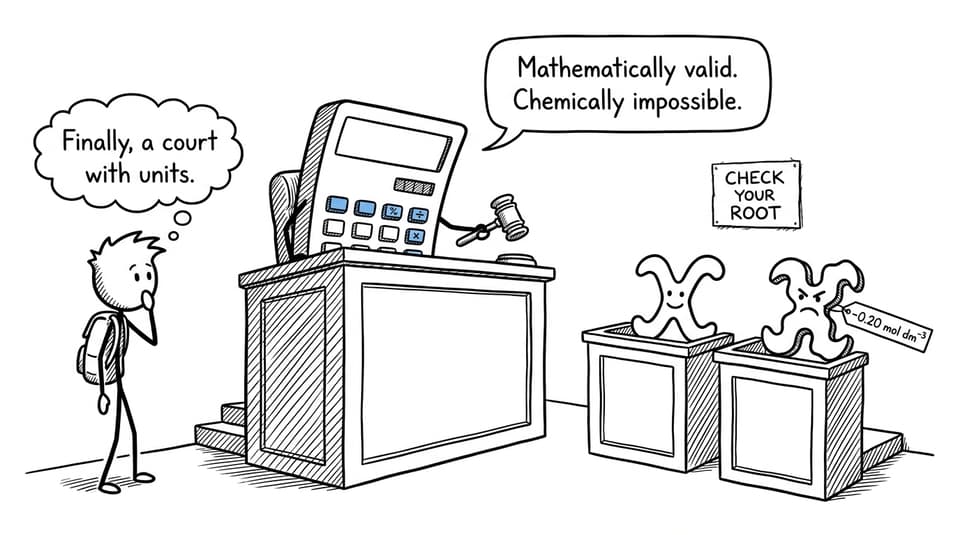
K. - Final check: reject algebraic answers that create negative concentrations.
Knowing the formula is a beginning, not an exam strategy. Real confidence comes from repeatedly constructing the expression, organizing equilibrium data, and explaining what the answer means. Use RevisionDojo's equilibrium Questionbank for targeted practice, then test retrieval with equilibrium flashcards.
When the method is stable, move into timed conditions with IB Chemistry Predicted Papers and Mock Exams. RevisionDojo brings Study Notes, Questionbank practice, Flashcards, AI Chat, grading tools, Predicted Papers, Mock Exams, a Coursework Library, and Tutors into one IB resource. The aim is not merely to remember an equation. It is to recognize the structure of the problem before exam pressure has time to make it look unfamiliar.