
Le Chatelier’s Principle is the kind of idea that feels obvious right after your teacher explains it… and strangely slippery the moment you see an exam question. In IB Chemistry, it shows up when you least expect it: a graph that “should be easy,” a Haber process prompt, or an equilibrium experiment you need to justify. The trick isn’t memorizing the rule. The trick is learning to speak equilibrium in a way that matches the markscheme.
This guide explains Le Chatelier’s Principle in clear IB Chemistry language, with the exact stresses you must recognize (and the common traps you should avoid).
Quick checklist: what you must say in IB Chemistry
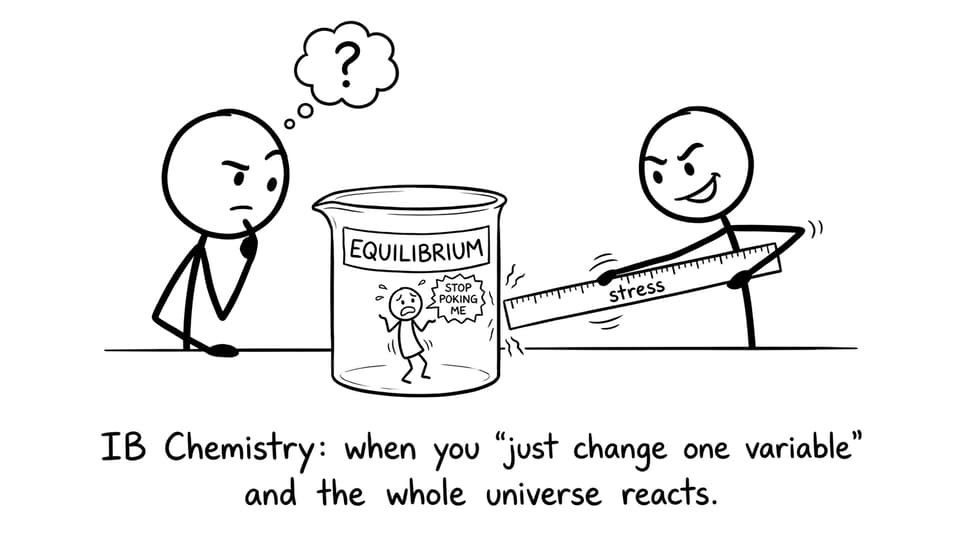
Le Chatelier’s Principle:
When a system at equilibrium is disturbed, it shifts to oppose the change and establish a new equilibrium.
Stresses you’re expected to discuss in IB Chemistry:
-
Concentration (add/remove reactants or products)
-
Pressure and volume (gases only)
-
Temperature (link explicitly to enthalpy, ΔH)
-
Catalysts (speed only, no shift)
If you’re also trying to sharpen your equilibrium explanations for practical work, your lab habits matter more than you think: Tips to Improve Your Lab Skills for IB Chemistry.
What “equilibrium” really means (the sentence examiners reward)
In IB Chemistry, equilibrium is dynamic. That’s not a vocabulary word, it’s a mechanism. At equilibrium:
-
the forward and reverse reaction rates are equal
-
concentrations stay constant (not necessarily equal)
So when you apply a stress, you are briefly breaking that rate balance. Then the system “responds” by shifting until the rates become equal again. If dynamic equilibrium still feels fuzzy, read: Dynamic Equilibrium Explained for IB Chemistry.
Applying Le Chatelier’s Principle in IB Chemistry
Concentration changes: the cleanest marks in IB Chemistry
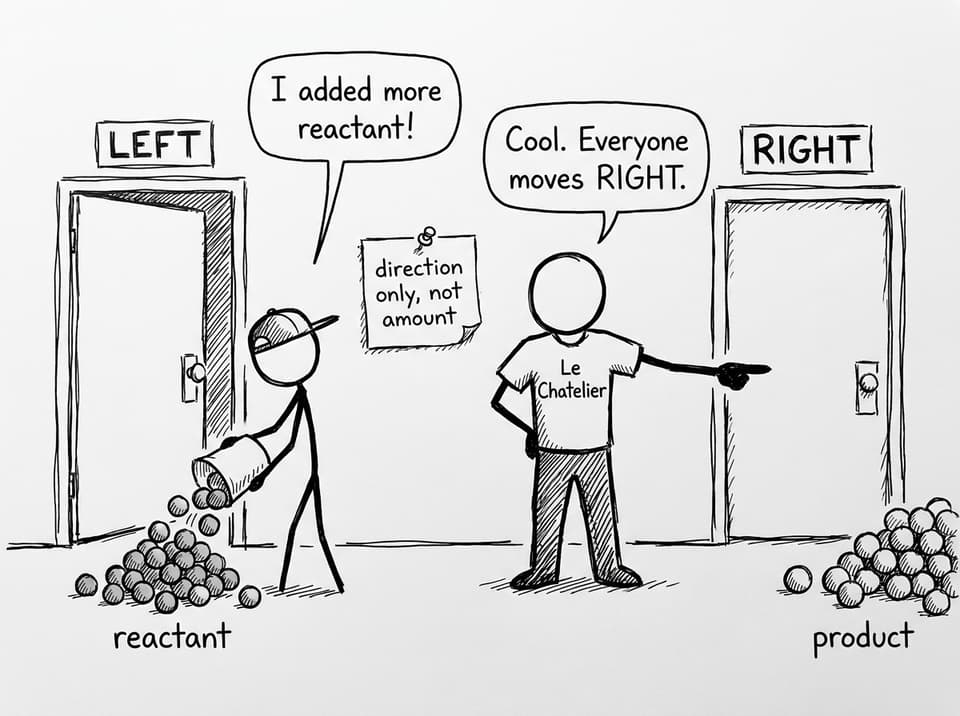
Think like this: adding a species makes the reaction quotient Q change instantly, so the system shifts to reduce that change.
-
Add reactant: shift right, form more products
-
Remove reactant: shift left, form more reactants
-
Add product: shift left
-
Remove product: shift right
To build faster instincts with these prompts, practice a few targeted items from the IB Chemistry Topic Equilibrium Questionbank and compare your wording to the solutions.
Pressure and volume: only for gases, and only about moles
Pressure/volume questions in IB Chemistry are often “free marks” if you follow one rule:
-
Higher pressure (lower volume) favors the side with fewer moles of gas.
-
Lower pressure (higher volume) favors the side with more moles of gas.
Classic example:
Left: 4 mol gas, right: 2 mol gas. Increase pressure and the equilibrium shifts right toward ammonia.
For syllabus-aligned equilibrium coverage (notes, flashcards, practice), start here: Equilibrium Topic Hub for IB Chemistry.
Temperature: the stress that demands you mention ΔH
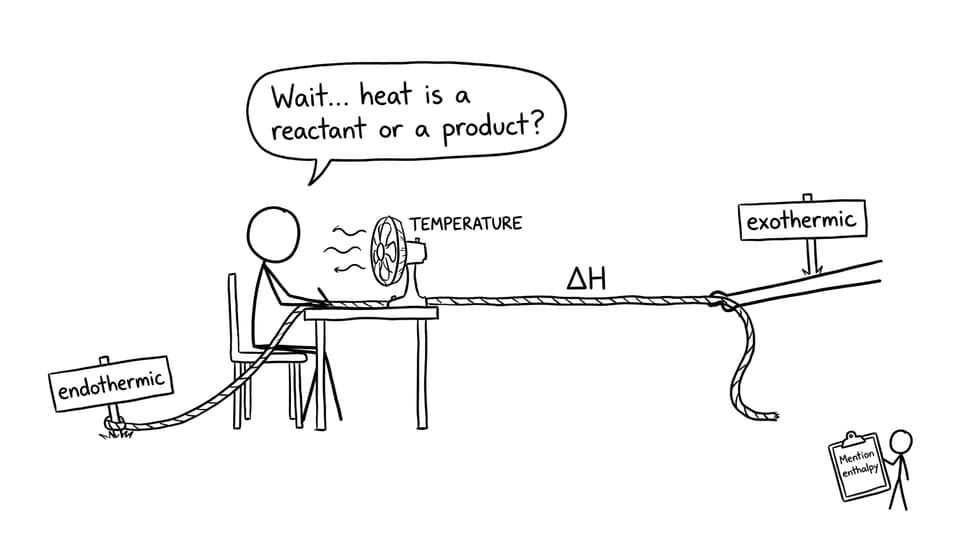
In IB Chemistry, temperature is the one change where you must name the energy direction. Treat “heat” as if it’s a reactant (endothermic) or a product (exothermic).
-
If the forward reaction is endothermic (ΔH > 0): increasing temperature shifts right.
-
If the forward reaction is exothermic (ΔH < 0): increasing temperature shifts left.
A strong exam sentence sounds like: “Increasing temperature favors the endothermic direction, so equilibrium shifts…” That word endothermic is doing real work.
Catalysts: faster equilibrium, same equilibrium
Catalysts do not change the equilibrium position in IB Chemistry. They lower activation energy for both directions, increasing both rates similarly. The mixture reaches equilibrium faster, but the equilibrium composition is unchanged.
Want a tight definition you can quote accurately? Use the IB Chemistry Key Definitions Glossary.
How IB Chemistry usually tests this
Most Le Chatelier questions fall into a few patterns:
-
“Predict and explain the shift when…”
-
Yield changes under combined conditions (pressure + temperature + catalyst)
-
Short explanations tied to industrial chemistry (often Haber)
-
Data/graph interpretation (spot the disturbance and the new equilibrium)
To prepare under timed conditions, pair practice questions with RevisionDojo’s tools: the Questionbank for repetitions, Study Notes for quick revision, Flashcards for definitions, and AI Chat to check whether your reasoning actually follows. If you want a structured sequence, the Lessons for R2.3 How Far? (Extent of Chemical Change) tie the story together.
Closing: make Le Chatelier’s feel inevitable
Le Chatelier’s Principle isn’t a magic rule. It’s a calm description of how IB Chemistry equilibrium regains balance after you disturb it: concentration pushes particles to react, pressure rewards fewer gas moles, temperature favors the endothermic direction, and catalysts only change speed.
If you want this to become automatic before exams, use RevisionDojo as your practice loop: hit the Equilibrium Questionbank, tighten your wording with Study Notes, drill key lines with Flashcards, and use AI Chat plus Grading tools to see what an examiner would award. When you’re ready for full exam pressure, RevisionDojo’s Predicted Papers and Mock Exams help you rehearse the exact decisions you’ll make on the day. For extra support, the Tutors can help you turn “I kind of get it” into consistent 6/6 explanations in IB Chemistry.