
The honest answer about EE hours in 2027
At some point, every IB student asks the same question in a slightly different voice.
Sometimes it sounds ambitious: “If I start early, can I finish the EE in a weekend?” Sometimes it sounds exhausted: “If I’m already behind, is 10 hours enough to rescue my EE?” And sometimes it sounds quietly worried: “How many hours am I supposed to spend so I don’t regret this later?”
For 2027, the answer has a steady center: the IB continues to recommend approximately 40 hours of student work for the EE. Not 40 hours of staring at a blinking cursor. Not 40 hours of perfect flow state. Just 40 hours of real, student-owned work: choosing a question, researching, drafting, revising, and reflecting.
On top of that, supervision time remains 3 to 5 hours, including three mandatory reflection sessions. That time matters, but it is not the engine of the EE. You are.
This guide will help you plan your EE hours like a person, not a robot: with a timeline you can actually follow, a realistic breakdown of what the 40 hours should include, and a few sanity-saving habits that keep you moving even when motivation gets quiet.
Quick checklist: how to plan 40 EE hours (without guessing)
Use this as your “I need direction now” checklist. The goal is to protect your EE time from getting eaten by vague tasks.
- Lock a research question early (or at least a strong working version).
- Build a small source system (one doc or tool, consistently used).
- Separate research hours from writing hours.
- Draft earlier than you feel ready.
- Reserve a final chunk for citations, formatting, and polishing.
- Schedule the three reflection sessions inside the 3 to 5 hours of supervision.
- Use one feedback cycle well (your supervisor can comment on one completed draft).
- Track your hours for two weeks, then adjust your plan.
If you want a structured starting point, browse RevisionDojo’s EE Guides and keep All IB Extended Essay Posts open as your “when I get stuck” library.
The IB recommendation: 40 hours for the EE (what it really means)
The IB’s recommendation of around 40 hours for the EE is quietly reassuring. It implies something many students forget: the EE is not meant to consume your entire life. It is meant to be substantial, but bounded.
Still, “40 hours” is easy to misunderstand because students imagine it as one big block. In reality, the EE punishes big blocks and rewards small, consistent sessions. Two focused hours a week over several months beats one 12-hour marathon that ends in a messy draft and emotional bargaining.
Here’s the other key detail students miss: the 40 hours are not only “writing time.” Your EE grade is built on decisions you make before you write.
- A narrow research question saves hours later.
- A good outline prevents rewrites.
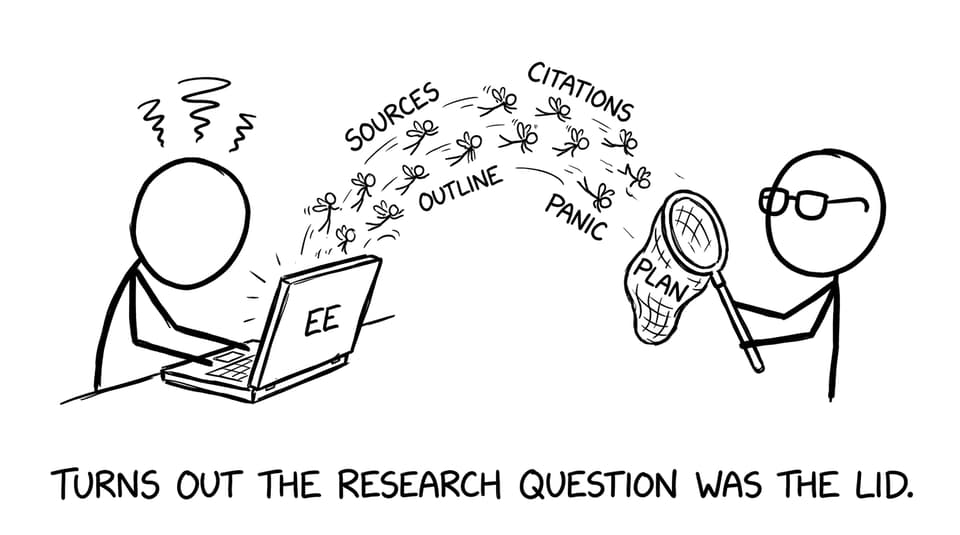
- Clean citations prevent panic.
- Strong reflection notes make the engagement side easier.
If you are still deciding your direction, 10 Powerful Steps to Choose an Extended Essay Topic pairs well with How Do You Know If Your EE Topic Is Good Enough?. Both reduce the most expensive mistake in the EE: starting broad and narrowing late.
A realistic EE hour breakdown you can copy
Below is a practical way to allocate the IB’s 40 hours for the EE. You can shift the numbers slightly by subject, but the proportions work surprisingly well.
Choosing and tightening the research question: 6 hours
This is the “cheap” part of the EE where you can buy back weeks of stress.
Spend these hours:
- reading exemplars and marking what “focused” looks like
- testing your question against available sources/data
- rewriting the question until it becomes answerable within 4,000 words
Use How to Craft the Perfect IB Extended Essay Research Question as your template, and keep The Importance of Research Question Revision During the EE Process nearby for the moment when you realize your question is still too big.
Research and note-making: 12 hours
These are not “collect 30 sources” hours. They are “collect the right sources and actually understand them” hours.
A good research rhythm looks like:
- 30 minutes finding sources
- 60 minutes reading and taking notes
- 30 minutes writing a mini-summary in your own words
If research feels like drowning, follow How to Survive the IB Extended Essay Research Process. It is basically a life raft for the middle stage of the EE.
Planning and outlining: 5 hours
A strong outline is not a list of headings. It is a sequence of claims.
In these hours, build:
- your line of argument (what you will prove, step by step)
- the evidence you will use for each claim
- what you will not include (this is underrated)
This is also where RevisionDojo’s Study Notes and AI Chat can help you clarify concepts and definitions quickly, so your outline has academic precision rather than vague “talk about X” placeholders.
Drafting the EE: 10 hours
Drafting is where students waste time by trying to write perfectly.
A better rule: draft as if you are explaining your argument to a smart friend who keeps asking “so what?” You can polish later.
Also, don’t draft in the same mood you plan. Planning is calm. Drafting is messy. That is normal.
When you want to avoid common traps, read Mistakes to Avoid in IB Extended Essays. It’s a surprisingly efficient way to save hours.
Revising, citations, presentation: 7 hours
These 7 hours are where a “decent” EE becomes a “confident” EE.
Use them for:
- tightening analysis (less summary, more evaluation)
- checking that every paragraph answers the research question
- cleaning citations and bibliography
- polishing structure and signposting
This is also where RevisionDojo’s Coursework Grader can be a turning point. Upload your draft to the IB Coursework Grader to get rubric-aligned feedback that mirrors how an examiner reads. Then use Grading tools plus AI Chat to turn feedback into a concrete revision list.
The 3 to 5 supervision hours: how to use them without wasting them
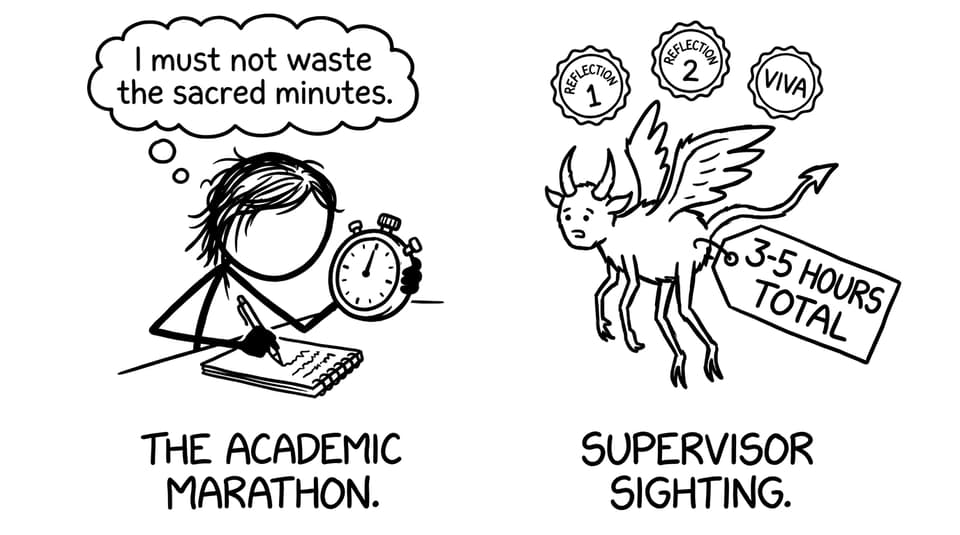
Supervision time for the EE remains 3 to 5 hours, and it includes three mandatory reflection sessions.
Those hours are not for your supervisor to “fix” your essay. They are for steering: confirming subject fit, checking feasibility, nudging your research question into focus, and helping you reflect on your process in a way that actually earns credit.
Treat supervision like a limited resource. You don’t want to spend it asking questions you could have answered yourself in 10 minutes.
Before each meeting, prepare:
- the latest version of your research question
- a short progress note (what changed since last time)
- a list of 3 specific decisions you need help making
Two timelines that work for most IB students
Your EE hours don’t just need a total. They need a shape.
The steady plan (recommended): 2 hours/week for 20 weeks
This is the healthiest version of “40 hours.” It gives you room for:
- slow thinking
- better questions
- cleaner writing
- fewer emergency rewrites
It also pairs well with exam prep because it doesn’t hijack your weekdays. Use RevisionDojo’s Flashcards and Questionbank in the same weeks to keep content revision alive while the EE progresses in the background.
The compressed plan (last-resort): 5 hours/week for 8 weeks
This can work, but only if you accept two truths:
- You must simplify the question.
- You must draft earlier than feels comfortable.
The compressed plan is where tools matter more. RevisionDojo’s Mock Exams and Predicted Papers can keep your exam momentum from collapsing while your EE takes extra oxygen.
The hidden time thieves in the EE (and how to stop them)
Most students don’t “run out of time.” They leak it.
Time thief: a research question that keeps mutating
Your EE question will evolve. That is normal. But if it evolves every week, you are paying interest on indecision.
Fix: set a “freeze date.” After that, you only refine wording, not scope.
Time thief: “I’ll write after I finish all research”
That sentence has ended more EEs than deadlines.
Fix: draft while researching. Write rough paragraphs that test your argument.
Time thief: citation chaos
Formatting at the end is where students lose entire weekends.
Fix: cite as you go. One consistent system beats perfection.
Time thief: waiting for motivation
Motivation is a visitor. Routine is a resident.
Fix: commit to a tiny daily minimum (20 minutes counts). Most days, you’ll continue once you start.
How RevisionDojo supports your EE without taking it over
The EE is student-driven. But “student-driven” doesn’t mean “student-alone.”
RevisionDojo is built to make independent work more efficient:
- AI Chat to clarify concepts, test research question wording, and sanity-check argument flow.
- Coursework Library with exemplars that show what strong academic structure looks like.
- Grading tools via the IB Coursework Grader to spot rubric gaps early.
- Study Notes and Flashcards so your EE doesn’t derail exam prep.
- Tutors when you need a human to help you rethink a method, rebuild your argument, or plan your final revisions.
And if you want to zoom out and see how the whole EE process fits together, Mastering IB Extended Essays: How to Research, Write, and Revise is a solid anchor.
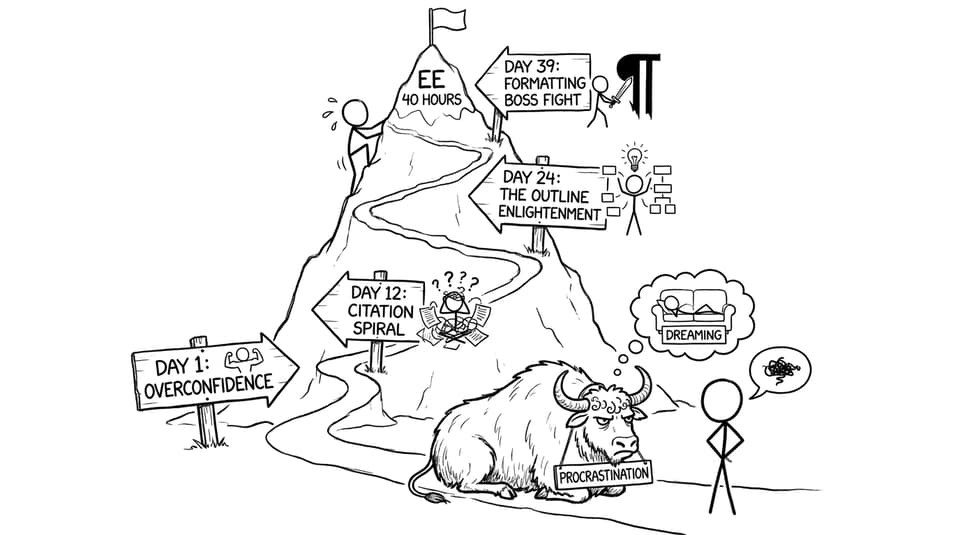
A calm closing: the EE is a budget, not a sentence
The EE in 2027 still sits on the same quiet foundation: about 40 hours of student work, guided by 3 to 5 hours of supervision with three mandatory reflection sessions. That’s not a trap. It’s a boundary.
If you respect that boundary, the EE becomes manageable. Not easy, but manageable. You stop negotiating with time and start investing it.
If you want the simplest next step, open RevisionDojo’s EE Guides, choose one planning approach from this article, and book your next two hours like an appointment you don’t cancel. Then use RevisionDojo’s AI Chat, Coursework Library, and IB Coursework Grader to keep your EE moving while your Questionbank, Flashcards, and Predicted Papers keep exams on track.
Your EE doesn’t need infinite time. It needs correctly spent time.