
A strange thing happens in IB revision: you can work for hours, feel productive, and still repeat the same mistake tomorrow.
That’s not a motivation problem. It’s usually a feedback problem.
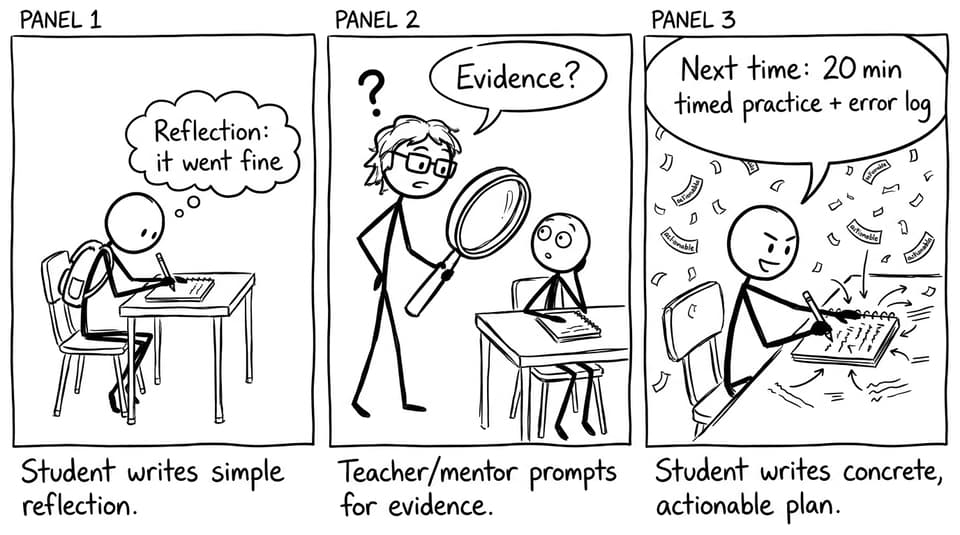
The fix is smaller than most students expect: actionable reflection prompts. Not the vague kind that end with “I’ll try harder,” but prompts that force you to name a cause, choose a strategy, and commit to a next step you can actually do before your next IB practice block.
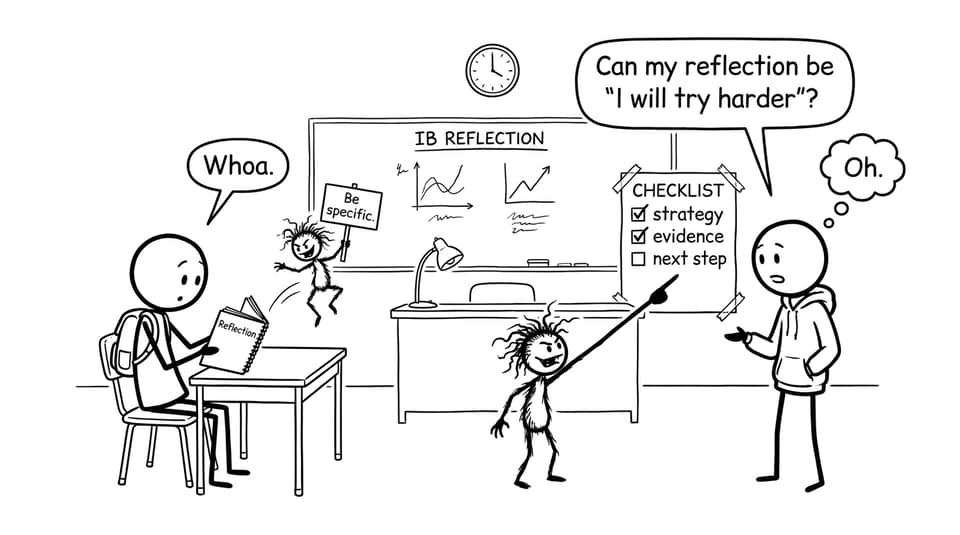
Quick checklist: what makes IB reflection actionable?
Use this checklist to turn reflection into points on your next IB paper:
-
Tie the prompt to a specific skill (command terms, timing, structure, accuracy).
-
Demand evidence (a question number, a rubric row, a data point).
-
End with one concrete action you can schedule.
-
Keep it short enough to repeat daily.
-
Revisit it after the next practice attempt.
If you want a complete exam loop to attach these prompts to, use How to Study for IB Exams: Step-by-Step Guide.
Why IB students should reflect like detectives (not diarists)
A diary records feelings. A detective looks for patterns.
In IB, patterns are everything: the same command term misunderstanding, the same weak topic, the same rushed final page, the same unclear evaluation paragraph. Reflection prompts matter because they make your revision diagnostic, not emotional.
When you link reflection to real practice data, your next steps become obvious:
-
One misconception gets patched with targeted Study Notes.
-
One recall gap becomes a tiny daily Flashcards set.
-
One technique weakness becomes 10 similar questions in a Questionbank.
This is how IB improvement looks in real life: less drama, more iteration.
The anatomy of a strong IB reflection prompt
A useful IB reflection prompt has three parts:
Clear focus
It targets one thing: concept, method, exam technique, or mindset.
Depth (the “why”)
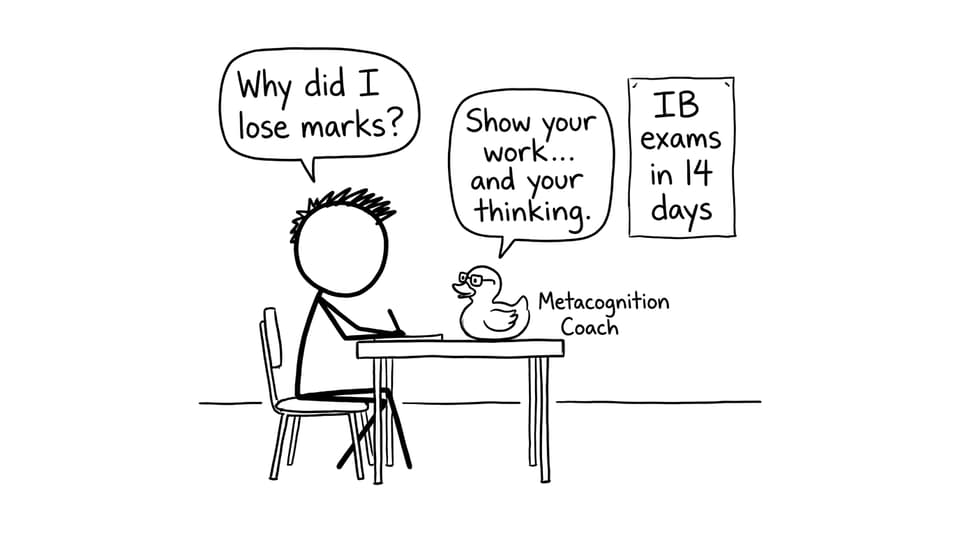
It asks you to explain the cause. Not “I’m bad at this,” but “I lost marks because I didn’t define the variable before substituting.”
Action (the “what next”)
It ends with a behavior you can do within 24-48 hours.
Instead of: “What did you learn?”
Try: “Which step cost you the most marks, and what is the smallest repeatable drill that fixes it?”
Copy-paste reflection prompts for IB exam prep
Use these prompts right after practice questions, timed sections, or Mock Exams. Keep answers to 3-6 sentences.
Prompts for accuracy (stopping avoidable mark loss)
-
“Which exact line earned zero marks, and what would a top-band version look like?”
-
“Did I lose marks from content or communication? What evidence proves it?”
-
“What rule would prevent this mistake next time (write it as a one-line ‘if/then’)?”
Prompts for command terms (doing what IB is asking)
-
“What did the command term require, and what did I actually do instead?”
-
“Which sentence in my answer directly addresses the question wording?”
-
“If I had to answer in a different structure (bullet points, PEEL, claim-evidence), what would change?”
Prompts for timing and stamina
-
“Where did I first feel rushed, and what decision created that rush?”
-
“What will I cut or simplify next time without losing marks?”
-
“What is my pacing target for the next timed set (minutes per mark)?”
For building realistic timing confidence, pair these prompts with IB Predicted vs Specimen Papers: What They Mean and a weekly timed routine.
Where to place IB reflection prompts (so you actually use them)
Most IB students only reflect at the end of a unit, when the details are already fuzzy. Try this rhythm instead:
-
Before practice (30 seconds): “What am I training today: content, technique, or timing?”
-
During practice (micro-pause): After a hard question: “What is my plan, and why?”
-
After practice (5 minutes): Use one prompt from each category: accuracy, command term, timing.
If you’re revising in tighter windows, borrow a structure from IB: How to Study in the Last 24 Hours (No Panic) and keep reflections brutally short.
Turning reflection into points with RevisionDojo
Reflection works best when it sits inside a loop you can repeat.
RevisionDojo is built for that IB loop: you learn with Study Notes, retain with Flashcards, apply with the Questionbank, and then use AI Chat to ask “why did I lose marks here?” while the mistake is still fresh. When you want realism, you add Mock Exams and Predicted Papers. When you need feedback on written work, you lean on Grading tools. For coursework and exemplars, the Coursework Library helps. And if you want human strategy, Tutors can turn your reflections into a plan that fits your timetable.
To set up the whole system end-to-end, see RevisionDojo App: The Smarter Way to Prep for IB Exams.
Final thought: IB reflection is a strategy, not a mood
In IB, reflection isn’t about sounding profound. It’s about building a repeatable system where every mistake becomes a clue.
Pick two actionable reflection prompts from this post, use them after your next timed set, and let your answers decide what you do tomorrow. If you want that loop in one place, RevisionDojo connects the practice, feedback, and next-step actions so your IB revision stays simple, specific, and steadily improving.