


Comparison with classmates makes fall term harder because it turns an already demanding IB schedule into a race whose rules, starting points, and finish lines you cannot see. The practical answer is not to ignore everyone around you. Replace vague comparison with personal evidence: completed tasks, corrected mistakes, stronger answers, and regular recovery.
This matters especially from September to November. September arrives with optimistic plans. By October, assessments, coursework, CAS, and ordinary life compete for the same hours. November can then feel like proof that everyone else adapted faster.
But a classmate's visible progress reveals little about their full situation. You may hear that someone finished an essay without seeing the rushed draft, extra support, different deadline, or neglected subject. Comparison takes one observable detail and invents the rest.
The fall term comparison reset
Use this checklist when another student's progress makes you feel behind:
- Identify the trigger, such as a grade, comment, study streak, or finished draft.
- Ask whether you have enough context for a fair comparison.
- Translate the anxiety into one task you can finish within 20-40 minutes.
- Measure understanding and output, not hours or appearances.
- Review your own evidence every Friday.
- Seek support if stress affects sleep, health, or daily functioning.
The goal is not to stop noticing other people. It is to stop treating incomplete information as a verdict on yourself.
Why comparison gets louder during fall term
Students return with different summer experiences, teachers introduce larger assignments, and early grades can feel more predictive than they are. Group chats fill with deadline questions. Even a harmless comment such as "I finished that last week" can sound like a warning.
The IB intensifies this because students rarely progress evenly across every subject. Someone may appear ahead in Biology while struggling privately with English or their Extended Essay. Another student may work quickly but need substantial revision later. Speed is visible; depth, support, and uncertainty usually are not.
Academic social comparison can shape how students judge their ability. It becomes especially unhelpful when another person's performance is treated as evidence about personal worth. RevisionDojo's guide to stopping comparison in the IB offers further strategies.
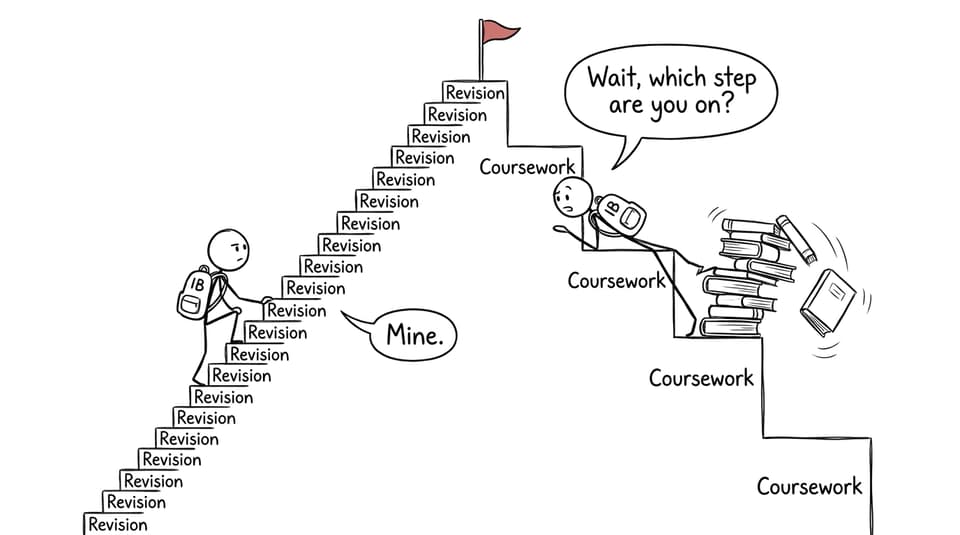
Comparison confuses activity with progress
The student studying for four hours is not necessarily learning more than someone completing a focused 45-minute session. Beautiful notes do not prove that their owner can retrieve the content. An early draft may still have a weak argument.
Visible activity is easy to compare. Actual learning is quieter.
Ask instead: What can I do now that I could not do last week? Perhaps you can explain a concept without prompts, solve a problem with fewer errors, or structure an evaluation more clearly. These signals reveal movement in your learning.
RevisionDojo can make that movement visible. Use Study Notes to clarify an idea, Flashcards to test recall, and the Questionbank to apply it. This sequence replaces "Am I ahead?" with "What does my evidence show?" The guide to using an IB Question Bank effectively explains how mistakes can direct practice.
Use classmates as information, not scoreboards
Comparison is not always harmful. A classmate can reveal a useful method or misunderstanding. The difference lies in how you use that information.
Unhelpful comparison says, "They understand everything, so I must be bad at this." Useful observation is narrower: "Their introductions state the argument earlier. I can practise that."
Notice the specific behaviour without labels such as gifted or naturally organised. Decide whether it suits your schedule, responsibilities, and subject priorities. Then test one small change for a week. Keep it if it improves recall, feedback, or consistency; remove it if it only makes your day busier.
Build a private scoreboard
Track actions within your control and connected to learning:
- Learning: topics understood or Flashcard sets reviewed
- Application: questions attempted, essays outlined, or problems solved
- Feedback: errors corrected, comments applied, or answers improved
Add one wellbeing measure, such as sufficient sleep or stopping work at the planned time. Recovery supports the attention and judgement good work requires.
The RevisionDojo IB Study Planner can turn priorities into a daily schedule. The low-stress IB study schedule provides another practical structure.
A realistic September-to-November strategy
September: establish a baseline
Identify subjects needing maintenance and those requiring rebuilding. Complete short diagnostic sets instead of guessing from classroom confidence. Reserve a weekly coursework block before deadlines become urgent. Build a plan you can still follow on a tired Wednesday.
October: tighten the feedback loop
Move from passive review into application. Use the Questionbank, written responses, and Grading tools to identify recurring weaknesses. Ask AI Chat for clarification when a misconception blocks progress.
Use the Coursework Library to understand expectations without copying examples. When feedback remains unclear, ask a teacher or RevisionDojo Tutor for specific next steps. The guide to IB tutoring versus self-study can help you judge when support is worthwhile.
November: consolidate instead of panicking
Do not answer comparison by automatically adding hours. Revisit common mistakes, maintain short Flashcard sessions, and use selected Mock Exams or Predicted Papers when timed practice suits your stage.
If you feel behind, read RevisionDojo's guide to the fear of falling behind in IB. The objective is not to catch every classmate. Finish the term knowing what you understand, what needs work, and what comes next.
Set boundaries around comparison triggers
You do not need to join every grade discussion. Saying "I am focusing on my own feedback" is enough. Mute anxious group chats during study blocks, avoid preparation debates immediately before assessments, and choose study partners who solve problems instead of spreading panic.
If checking another student's progress leaves you scattered, ashamed, or unable to begin, step away and complete one concrete action. If stress disrupts sleep, appetite, concentration, relationships, or ordinary functioning, involve a trusted adult or qualified health professional. Revision techniques are not substitutes for mental health support. RevisionDojo's overview of managing excessive IB stress explains when a reset may be needed.
Let evidence replace the imaginary race
Fall term becomes harder when every conversation feels like a ranking. The escape is precision: choose a task, complete it, check the result, and correct the weakness.
RevisionDojo brings that cycle together through Study Notes, Flashcards, Questionbank, AI Chat, Grading tools, Predicted Papers, Mock Exams, Coursework Library, and Tutors. Its IB preparation workflow helps turn uncertain effort into visible evidence.
Your classmate's timeline belongs to them. Your job is quieter and more useful: understand more, respond to feedback, and keep going.