


The moment IB Stress stops being “normal”
It usually starts small. A student stays up “just this once” to finish an IA paragraph. Then it happens again. Soon, the house has a new background sound: the click of a keyboard at 1:17 a.m., and the quiet panic of thinking every task is urgent.
That’s the tricky thing about IB Stress: it can look like dedication right up until it becomes depletion. For IB students preparing for exams, some pressure is expected. But if stress is eating your sleep, mood, memory, or motivation, it’s no longer fuel. It’s friction.
This guide helps you tell the difference--and gives you a simple, student-friendly way to lower IB Stress without pretending IB is easy.
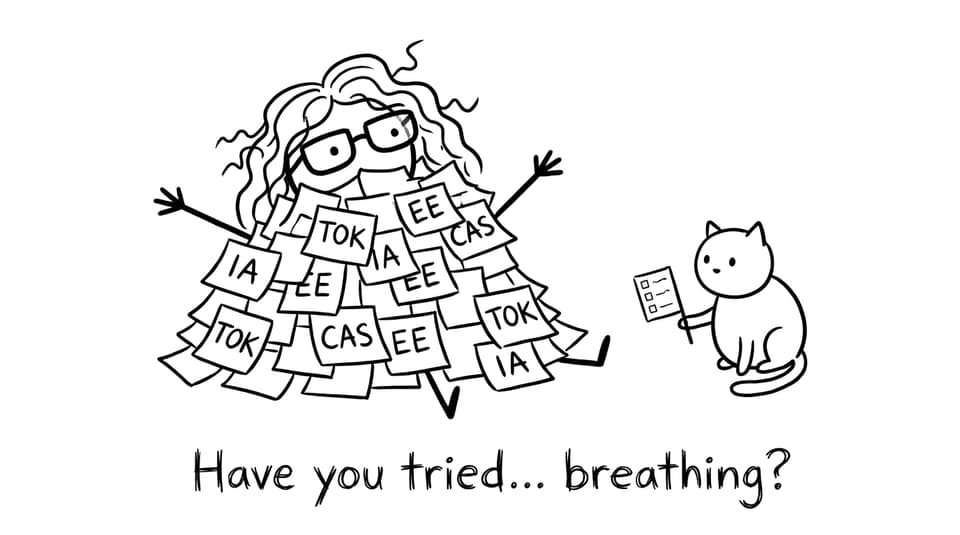
A quick IB Stress checklist (60 seconds)
Use this quick scan. If you tick 3 or more, your IB Stress is probably in the “needs a reset” zone.
-
Sleep is getting worse (hard to fall asleep, early waking, constant tiredness).
-
You feel emotionally “brittle” (snapping, crying easily, shutting down).
-
You can’t start work even when you want to (avoidance, doom-scrolling, paralysis).
-
Physical symptoms show up (headaches, stomach aches, frequent colds).
-
Your revision is long but low-quality (rereading, rewriting, no marks gained).
-
You’ve stopped enjoying things that used to feel like you.
Stress is not a personal failure. It’s a signal your system needs adjusting.
Why IB Stress feels heavier than other school pressure
IB stacks deadlines in a way that can feel like you’re carrying six different lives at once: six subjects, Higher Level depth, Internal Assessments, TOK, CAS, and the Extended Essay. Even if you’re organized, the volume creates a constant sense of “I’m behind.”
And IB Stress gets louder near exams because the work changes shape. You stop just learning content and start needing performance: timing, command terms, paper strategy, and accuracy under pressure.
If your revision plan doesn’t match that reality, you can work hard and still feel unsafe.
A helpful read when you want perspective is How Stressful Is IB? Managing Stress in the IB Program.
Red flags that your IB Stress is too high (student edition)
Your body is paying the bill
High IB Stress often shows up physically first. If you’re getting sick more, feeling nauseous before studying, or living on adrenaline, your body is telling you the pace isn’t sustainable.
Your brain won’t “hold” information
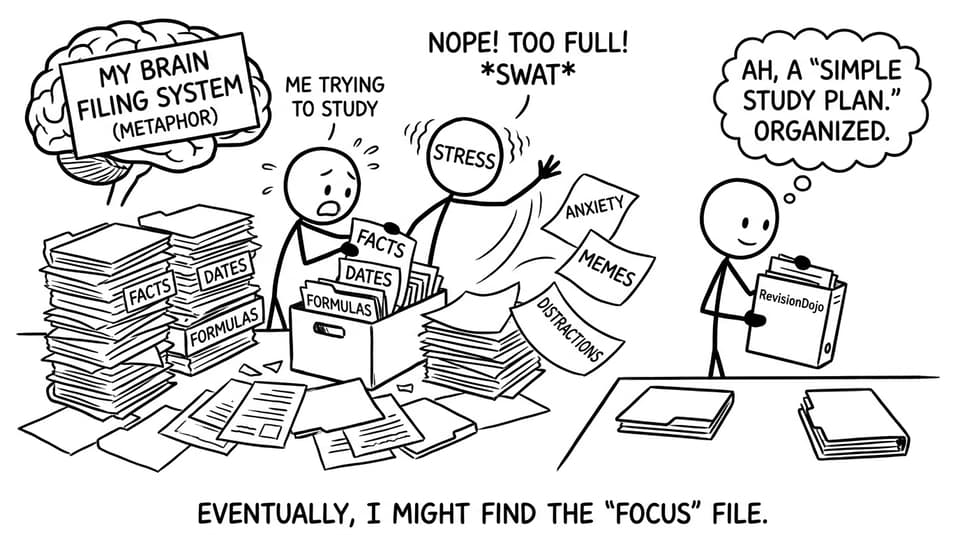
Stress crushes working memory. You read a page and nothing sticks. You do a question and forget a step you knew last week. That’s not laziness. That’s overload.
Your revision is becoming a ritual, not a result
This is a common IB pattern: rewriting notes for comfort, highlighting for control, and telling yourself “at least I studied.” But IB Stress drops when you can see evidence: marks, accuracy, and fewer repeated mistakes.
If you want a proof-based mindset shift, bookmark Why You Feel Not Ready for IB Exams (Even If You Are).
The calm fix: reduce IB Stress by building “evidence loops”
The fastest way to lower IB Stress isn’t more hours. It’s fewer unknowns.
An evidence loop is simple:
-
Learn one tiny idea (not a whole chapter).
-
Practice exam-style questions.
-
Get feedback (what earns marks, what doesn’t).
-
Log one mistake rule (“Next time, I will…”).
-
Retake a similar question 48 hours later.
RevisionDojo is built around that loop, which is why it’s so effective for IB students preparing for exams:
-
Use the RevisionDojo Questionbank to practice targeted exam-style questions by topic.
-
Add daily recall with Flashcards inside RevisionDojo | IB & MYP Resources.
-
Use AI Chat when you’re stuck so confusion doesn’t turn into an hour-long spiral.
-
Use Grading tools for rubric-aware feedback on written responses.
-
Use Predicted Papers and Mock Exams to make timed performance feel familiar.
-
Use the Coursework Library to stop guessing what “good” looks like.
-
Use Tutors when you need a human to triage the plan.
For practical stress tactics alongside study structure, see Exam Stress Management Tips for IB Candidates.
Two study moves that reliably lower IB Stress this week
Swap “revise subject” for “revise paper skill.”
“Revise Chemistry” is infinite. “Do 10 energetics questions and fix my error pattern” is startable.
Do one timed block early (even if you feel unready).
Timed practice turns fear into data. Start with 25-40 minutes, then review.
To make timed rehearsal realistic, explore IB Predicted Papers and the deeper breakdown in IB Predicted vs Specimen Papers: What They Mean.
A closing thought: make IB Stress smaller, not you
You don’t beat IB Stress by becoming tougher. You beat it by becoming clearer: clearer tasks, clearer feedback, clearer evidence of progress.
If you want one place to run that calmer system, build your loop inside RevisionDojo using Questionbank, Study Notes, Flashcards, AI Chat, Grading tools, Predicted Papers, Mock Exams, the Coursework Library, and Tutors.
When you turn stress into data, the work stops feeling like a storm and starts feeling like a path. And IB Stress becomes something you manage--not something that manages you.
To see how families and students use it end-to-end, visit RevisionDojo for Parents.