
The fear that shows up at 1:17 a.m.
You're in bed, phone face-down, mind loud anyway. Tomorrow you have a quiz, your IA draft is "almost done," and someone in your class casually mentions they finished revision for two topics already. And suddenly the thought arrives, clean and sharp:
I'm falling behind in IB.
In IB, this fear is so common it's almost a hidden subject. Not because students are weak, but because the program is designed to stretch time: six courses, coursework, deadlines, and exams that reward precision. The workload is real, and so is the emotional math of comparing yourself to everyone else.
This post is for IB students preparing for exams who feel behind, even when they're trying. We'll normalize the feeling, explain why your brain creates it, and then turn it into a plan you can actually use.
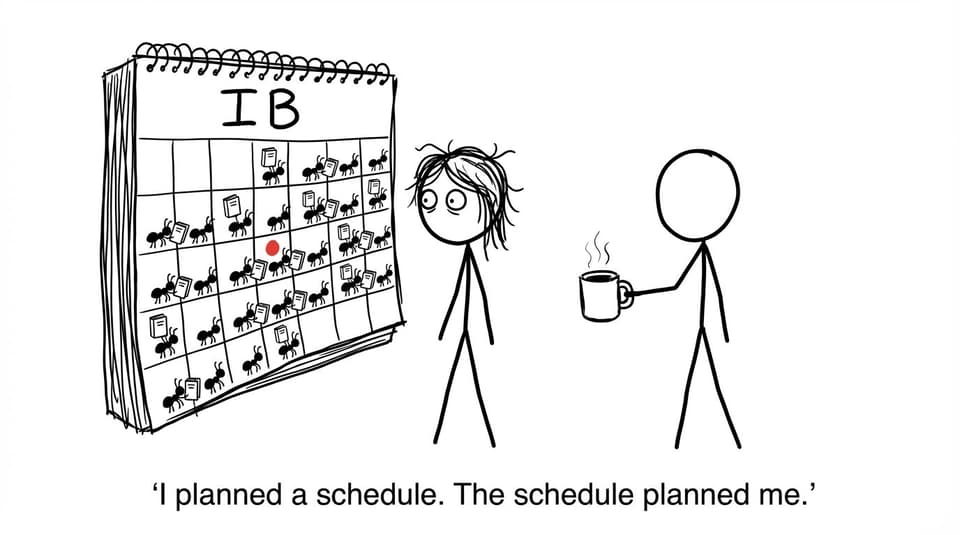
A quick IB "am I behind?" checklist
Before you diagnose yourself, run this simple checklist. It's not motivational. It's diagnostic.
- Are you confusing workload with progress? (Hours studied isn't the same as marks gained.)
- Are you switching tasks constantly? (Decision fatigue looks like "I did nothing.")
- Are you revising passively? (Rereading feels safe; questions feel honest.)
- Are you measuring yourself using someone else's timeline?
- Are you missing a feedback loop? (If you never test yourself, you can't feel improvement.)
If you said yes to two or more, you may not be "behind" in IB. You may be stuck in a system that doesn't show you proof.
Why falling behind in IB feels personal (even when it isn't)
IB multiplies deadlines, so your brain multiplies danger
Humans are not built to hold six subjects plus long-term projects in our heads without anxiety. IB adds IAs, the EE, TOK, and constant evaluation. That doesn't just create work. It creates unfinishedness.
Unfinished tasks linger in your attention like open tabs you can't close. Even when you're studying, your brain keeps whispering that something else is overdue.
If you want language for this stress (and strategies that actually work), read How to cope with IB exam stress and anxiety.
Comparison turns normal pacing into panic pacing
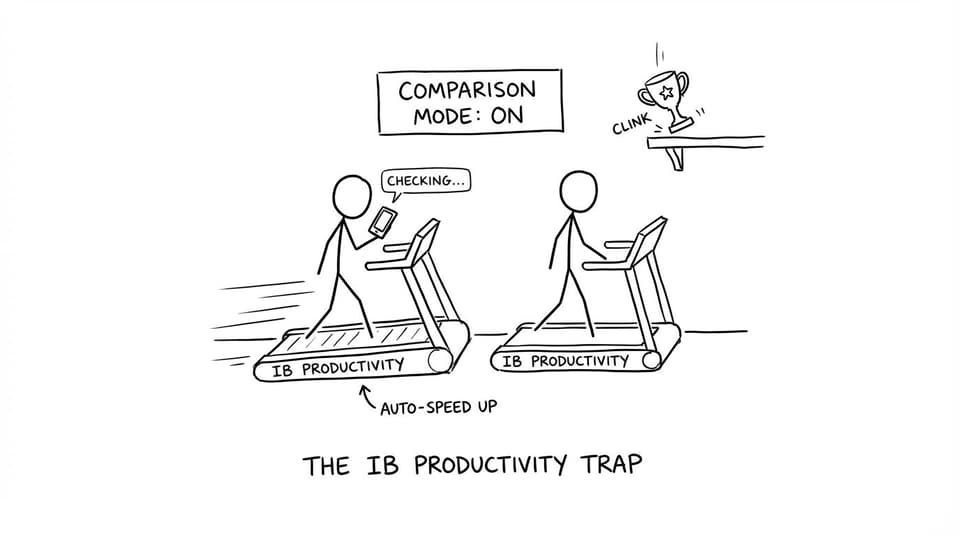
In IB, comparison is oddly efficient. One sentence from a classmate can undo two hours of focused work. Not because they're ahead, but because your brain translates their progress into your risk.
The problem is that you never see the full picture: their weak subjects, their messy drafts, their missed practice, their stress. You only see the highlight reel.
What "behind" actually means in IB exam season
In practice, IB students use "behind" to describe three different situations:
You're behind on content
You genuinely haven't covered some topics. This is real, but solvable. The fix is ruthless prioritization and question-led revision.
You're behind on exam technique
You "know" the topic, but marks don't show it. Usually this means command terms, structure, and markscheme patterns. This is where timed practice and feedback change everything.
You're behind on clarity
You've studied a lot, but nothing feels solid. This happens when revision is scattered: too many resources, too much switching, and not enough retrieval.
A helpful companion here is IB motivation in exam season because it focuses on building measurable progress instead of relying on feelings.
The calm way to catch up: a 3-part IB reset plan
This is the part most students skip. They try to "work harder" instead of "work cleaner." In IB, catching up is mostly about reducing friction.
Rebuild certainty with one tight loop
Use a simple loop that turns anxiety into evidence:
- Study Notes for 10-15 minutes (just enough to understand)
- Questionbank for 25 minutes (to prove what you know)
- Review mistakes for 10 minutes (to extract rules)
- Flashcards for 5-10 minutes (to keep facts alive)
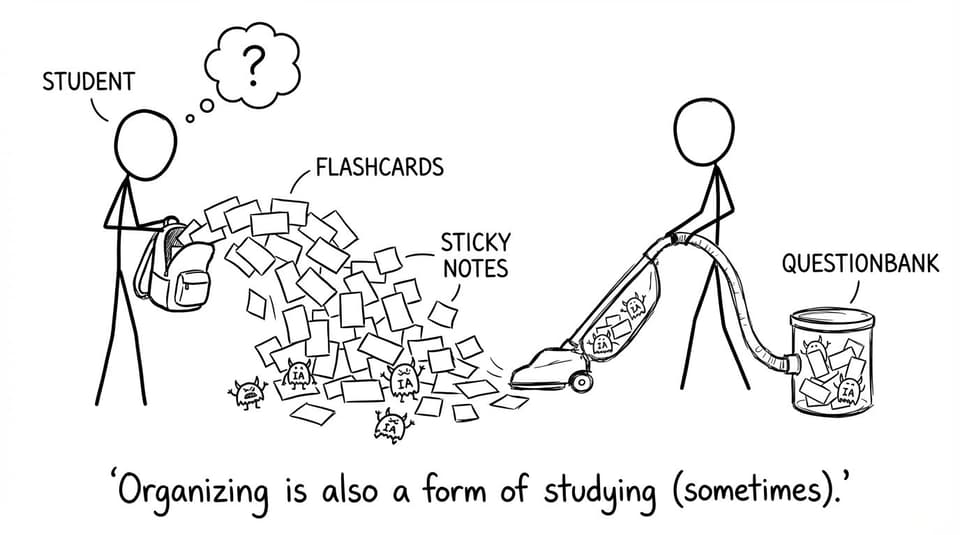
RevisionDojo is built around this exact workflow: Study Notes for clarity, Questionbank for practice, Flashcards for retention, and AI Chat for fast explanations when you get stuck. If you want the bigger picture, see RevisionDojo app: the smarter way to prep for IB exams.
Use AI Chat like an "unstuck button," not a shortcut
When you feel behind in IB, confusion becomes expensive. One confusing concept can derail an entire study session.
That's when AI Chat is useful: ask it to explain one sub-skill, test you with quick questions, or show what an examiner would reward. The point is momentum. Not perfection.
Simulate pressure early so it stops feeling mysterious
A lot of "I'm behind" panic is really "I haven't practised under exam conditions." When you've only revised in comfortable settings, the exam feels like a different universe.
Use Mock Exams and Predicted Papers to make the pressure familiar. Then use grading feedback to choose what to do next. If calm is your struggle, keep How to stay calm during IB exams bookmarked.
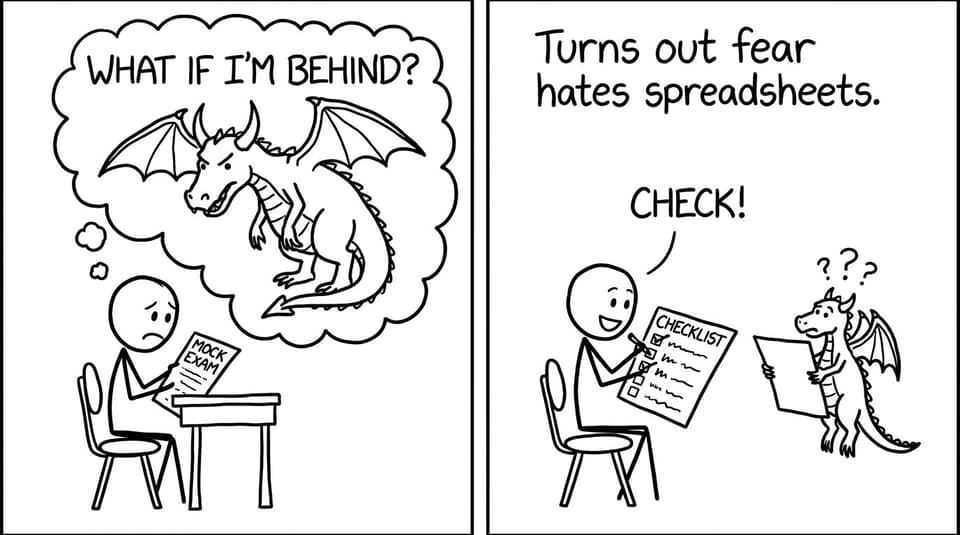
How to stop the "always behind" feeling (without lowering your goals)
Replace vague goals with visible metrics
In IB, vague goals create dread: "revise chemistry" has no finish line. Your brain hates endless tasks.
Instead, track something measurable:
- 20 questions completed
- Accuracy % by topic
- One command term mastered (explain vs evaluate)
- One essay improved using feedback
When progress is visible, fear quiets down.
Plan for energy, not just time
Most IB schedules fail because they assume you'll be the same person every day. You won't.
Build two modes:
- High-energy day: timed questions, full responses, heavier topics
- Low-energy day: flashcards, short question sets, fixing one mistake pattern
This is how you stay consistent without burning out.
Reduce coursework noise so exams feel simpler
Sometimes exam stress is actually coursework stress leaking into everything else. If your IA or EE feels like a black box, your brain treats it as unfinished danger.
That's where RevisionDojo's Grading tools and Coursework Library help: they reduce uncertainty and show you what strong work looks like, faster. If you're struggling with structure, this is useful: How to plan an IB IA without falling behind.
A realistic 7-day "catch up" template for IB students
Use this when you feel behind in IB and need traction.
Day 1: audit and choose
Pick one subject. Do 30 questions in Questionbank. List your top 3 weak topics based on results.
Day 2: rebuild one weak topic
Study Notes (15 min) + targeted questions (25 min) + flashcards (10 min).
Day 3: technique day
Do structured responses. Use AI Chat to check what marks you're missing. Save "error rules."
Day 4: mixed practice
Do a mixed set across weak topics. Focus on accuracy and command terms.
Day 5: timed block
Run a timed mini-mock. Review patterns: timing errors, misreads, recurring content gaps.
Day 6: patch day
Drill only what the mock exposed. Short, specific, repeatable.
Day 7: recovery + light review
Flashcards and light questions only. Plan next week.
This template works because it's not trying to "finish IB." It's trying to restore control.
Closing: the quiet truth about IB
The fear of falling behind in IB isn't a sign you're failing. It's a sign you care, and you're working inside a system that constantly suggests there's more you could be doing.
But IB doesn't reward panic. It rewards repeatable habits: clear notes, targeted questions, honest feedback, and timed practice that turns the exam into something familiar.
If you want a calmer way forward, build your loop inside RevisionDojo: use Study Notes for clarity, Questionbank for proof, Flashcards for retention, AI Chat for momentum, and Mock Exams plus Predicted Papers for confidence under pressure. Add Grading tools, the Coursework Library, and Tutors when you need deeper feedback.
You're not behind. You're just at the part of IB where the next small, correct step matters more than the next big, emotional one.