
The question every arts student asks in Week 3
Somewhere early in the Diploma Programme, you notice a pattern: the students who chose IB Group 6 Arts light up when they talk about class, then quietly panic when they look at the calendar.
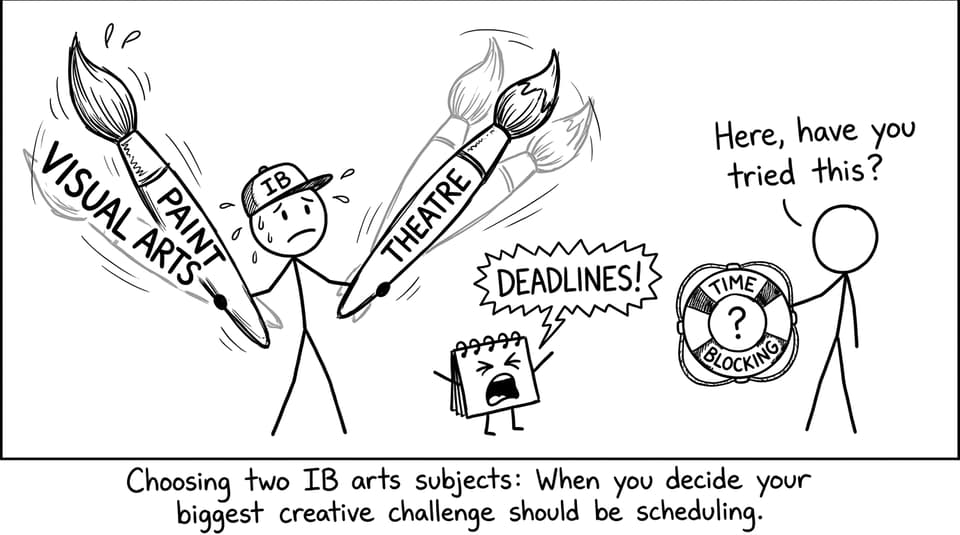
Then a new thought appears: What if I took more than one arts subject? Film and Theatre. Music and Visual Arts. Not because it looks impressive, but because one medium isn’t enough to say what you want to say.
Yes, it can be possible to take multiple IB Group 6 Arts subjects. But the real question is whether you can do it without sacrificing your grades, sleep, or sanity.
Quick checklist: the IB rules in plain language
Before you commit, ground the decision in what the Diploma actually requires.
-
The IB Diploma Programme has six subject groups.
-
You typically take six subjects total.
-
Most students choose one subject from IB Group 6 Arts (Film, Theatre, Music, Dance, Visual Arts).
-
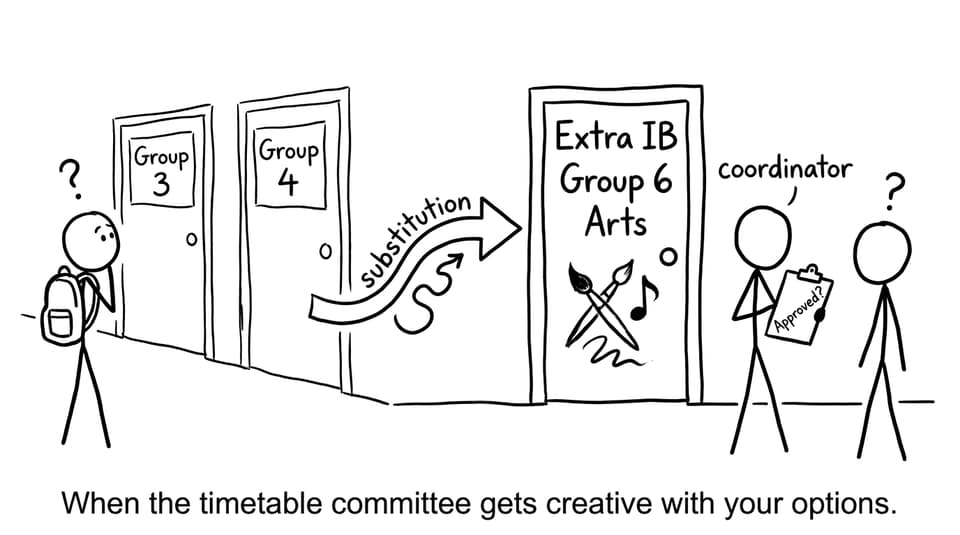
If you want more arts, you may be able to take an additional IB Group 6 Arts subject by substituting it for a Group 3 (Individuals and Societies) or Group 4 (Sciences) subject.
-
Your final option (depending on your school) is to take a seventh subject, which can create scheduling and workload issues.
If you want broader context on what counts as Group 6 and what the courses involve, see What Is a Group 6 Class in IB?
How taking multiple IB Group 6 Arts subjects actually works
Substitution: the most common path
The simplest way to study multiple IB Group 6 Arts subjects is substitution.
You take one arts subject as your official Group 6 pick, and then replace your Group 3 or Group 4 choice with another arts subject. This is why you’ll hear students say they’re “doing two Group 6s,” even though one of them is technically filling a different group slot.
Example combinations:
-
Visual Arts + Theatre (Theatre substitutes Group 3 or Group 4)
-
Music + Film (Film substitutes Group 3 or Group 4)
This is the decision that should be made with your IB coordinator, because schools differ in staffing, timetable blocks, and which substitutions they’ll approve.
The “seventh subject” reality check
Some students try to add another IB Group 6 Arts subject on top of the standard six.
This can work, but it’s often where schedules collapse: rehearsal overlaps with labs, portfolio time eats weekends, and suddenly your “extra subject” becomes the thing that quietly lowers everything else. If your goal is strong exam performance, treat a seventh subject as an exception, not the default.
Why students choose multiple IB Group 6 Arts subjects
Studying multiple IB Group 6 Arts subjects can be a smart choice when it matches your long-term direction.
You build range, not just volume
Two arts subjects can give you portfolio depth and creative flexibility. You’re not repeating the same skill twice. You’re learning two different languages of expression, each with its own criteria, reflection style, and process.
If you want performance-specific guidance, IB Film vs IB Theatre: Which Group 6 Subject Is Right for You? helps you compare workload and fit.
You develop exam-season endurance (in a different way)
Arts subjects can be less about last-minute memorization and more about consistent output: process journals, drafts, rehearsals, experiments, reflections. That rhythm can train discipline that transfers into your written subjects.
For strategies on scoring well, read Scoring in IB Group 6 Subjects: Strategies and Insights.
The hardest part: workload math during exam prep
Two IB Group 6 Arts subjects can be amazing. They can also be time-expensive.
Here’s the practical fix: treat creativity like training, not like inspiration.
-
Use a weekly schedule where arts work has fixed blocks.
-
Decide what “done” means for the week before you start.
-
Keep one session per week reserved for catching up, not creating.
If you need a realistic benchmark for hours, use How Many Hours a Week Should You Study for IB Group 6?.
And for the bigger exam-prep mindset (especially if you’re balancing portfolios with timed papers), borrow the workflow from What 45/45 IB Students Do Differently.
How RevisionDojo helps if you’re doing multiple IB Group 6 Arts
When you take multiple IB Group 6 Arts subjects, the real risk is not talent. It’s leakage: tasks that sprawl, revisions that never end, and feedback that arrives too late.
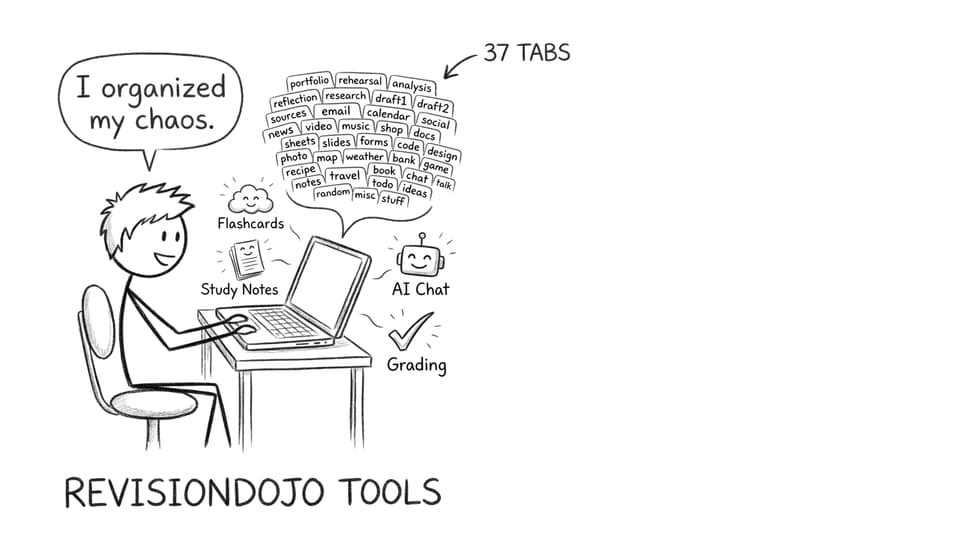
RevisionDojo keeps your work contained and moving:
-
Study Notes to clarify theory and artistic context quickly
-
Flashcards for key vocabulary, conventions, and artist references
-
AI Chat to unblock analysis and reflection when you’re stuck
-
Grading tools to tighten writing against criteria (especially reflective components)
-
Mock Exams and Predicted Papers to keep exam subjects sharp while arts coursework ramps up
-
Coursework Library for examples and standards (see Coursework and IB Coursework Examples)
-
Tutors when you need fast, human-level direction
If you want the big-picture system for exam season, RevisionDojo App: The Smarter Way to Prep for IB Exams lays out a clean routine.
The bottom line
Taking multiple IB Group 6 Arts subjects can be one of the most meaningful versions of the Diploma Programme, if you choose it deliberately, plan for the workload, and protect your exam subjects with structure.
If you’re leaning toward multiple IB Group 6 Arts options, use RevisionDojo to keep everything in one system: learn faster with Study Notes, retain with Flashcards, ask AI Chat when you’re stuck, and stay exam-ready with Mock Exams and Predicted Papers. The goal isn’t to do more. It’s to do the right things, repeatedly, until your creativity shows up as marks.