
In the last week before an IA is due, most IB students do the same thing.
They tighten algebra, redraw graphs, rewrite conclusions. They chase the feeling that the mathematics is finally “good enough.”
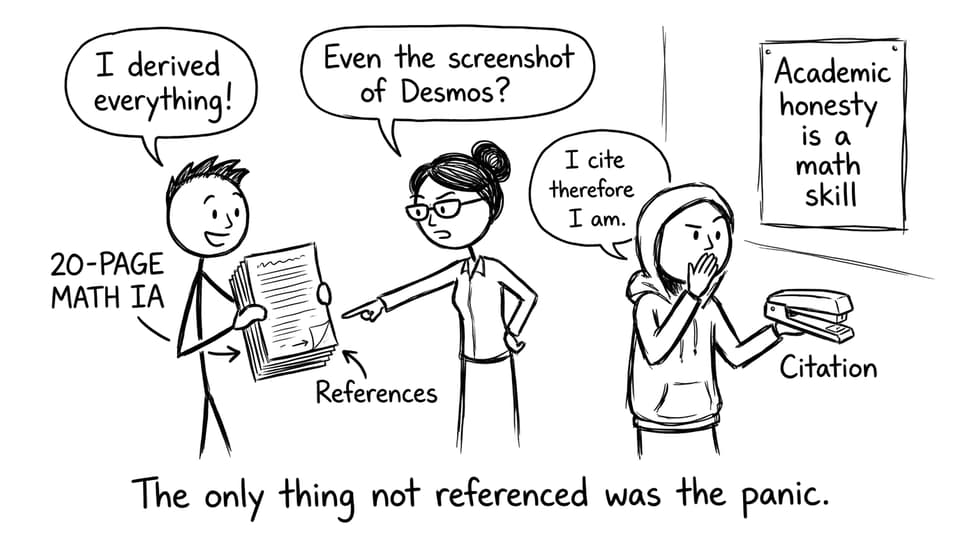
And then, right at the end, they discover a quiet problem: the work looks original, but the influences are invisible. A definition copied into notes months ago. A regression method learned from a website. A screenshot from a graphing tool. A dataset downloaded at midnight.
In an IB Math IA, referencing is not decoration. It’s part of academic honesty, part of communication, and part of sounding like someone who understands where ideas come from.
A quick checklist for IB Math IA referencing
Use this as your fast “final scan” before you export the PDF.
-
Every non-original idea has an in-text citation.
-
Every in-text citation appears in your bibliography (and vice versa).
-
You chose one style (APA/MLA/Chicago/Harvard) and used it consistently.
-
Every table/diagram/screenshot that isn’t fully yours is credited.
-
Websites include author/organisation, title, date (or n.d.), and access date.
-
Tools/software are acknowledged (and cited if your school requires it).
If you need a broader IA citation framework, compare your work to RevisionDojo’s guide on IA citations best practices and the more general walkthrough How to cite sources correctly in your IA.
Why IB expects referencing in a Math IA
The IB doesn’t treat mathematics as a citation-free zone. Your IA is assessed partly on how clearly you communicate your thinking, and referencing is a key part of that clarity.
Proper referencing does four useful things at once:
-
It proves academic honesty: you show what you borrowed and what you created.
-
It lets the examiner verify your foundations (definitions, models, assumptions).
-
It strengthens your reflection: you can explain why you chose a method, not pretend you invented it.
-
It protects you from accidental plagiarism, which is often caused by messy notes rather than bad intent.
For the bigger integrity picture, RevisionDojo’s articles on ethical research and referencing and why academic integrity matters in the IB are worth a quick read.
What you must cite in an IB Math IA (and what you usually don’t)
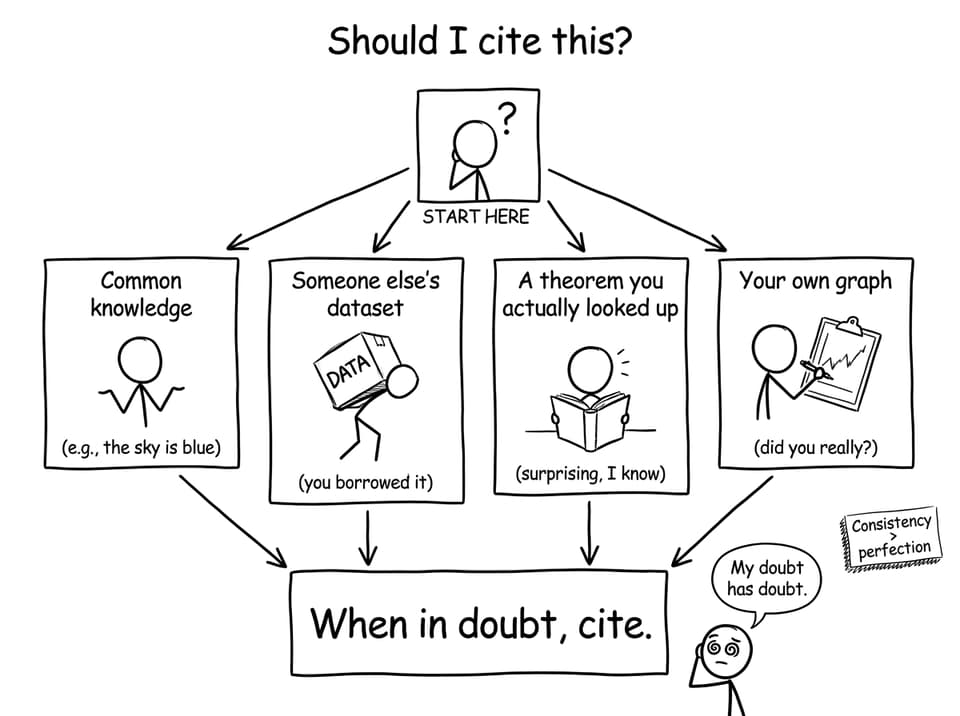
Math creates a specific kind of confusion: some formulas are “common knowledge,” while others are standard but still source-specific in how you found or explained them.
You should cite these (almost always)
-
A definition you paraphrased from a textbook, revision site, or video.
-
A theorem or result you looked up because you weren’t sure of the statement.
-
A method you followed (for example, a particular regression approach or numerical technique).
-
Any dataset you did not collect yourself.
-
Any image, diagram, table, or screenshot not made entirely by you.
-
Any tool or platform that materially shaped your output (graphing, CAS, spreadsheets).
You usually don’t cite these
-
Standard course formulas you can reasonably treat as IB syllabus knowledge (for example, quadratic formula).
-
Steps of algebra you personally carried out.
-
Graphs you created yourself from your own calculations (though you should still label the tool used if relevant).
When you’re unsure, the safest rule in an IB context is simple: cite. Examiners don’t penalize you for a few extra citations; they can penalize you for missing ones.
Choosing a citation style: the IB only cares about consistency
The IB does not force one single referencing style for the Math IA. Schools often recommend a standard style (APA is common), but the exam reality is this: the examiner wants to be able to find your source quickly.
Pick one style and stick to it.
Practical tip for math writing
Many students overthink style and underthink completeness. A complete reference matters more than a perfectly italicized comma. Your bibliography entries should reliably include:
-
Author or organisation
-
Year (or n.d.)
-
Title
-
Publisher/site
-
URL (for online)
-
Access date (for online)
If you also want to polish communication and presentation, pair this with RevisionDojo’s guidance on formatting your IB Math IA professionally.
How to write in-text citations in a Math IA without breaking the flow
A good IB Math IA reads like a guided tour: you explain what you’re doing, then you do the mathematics, then you interpret what it means. Citations should support that story, not interrupt it.
Use “math-friendly” citation placement
-
Cite at the end of the sentence where the borrowed idea appears.
-
If you introduce a model, cite immediately after naming it.
-
If you adapt a method, cite the source once when you introduce it and again when you discuss the adaptation.
Examples (templates you can copy)
-
“I model the cooling process using Newton’s Law of Cooling (Author, Year).”
-
“This transformation follows the approach in Author (Year), but I adjusted the parameters to fit my dataset.”
-
“The dataset was obtained from Organisation (Year) and filtered to include only …”
That last line is quietly powerful in IB marking terms, because it signals authorship: you didn’t just download data, you processed it.
Citing data, graphs, and technology (the area most students forget)
In practice, the most common referencing gap in an IB Math IA is not a missing theorem citation. It’s visuals and technology.
Datasets
If you use secondary data, cite the original source and describe:
-
what the variables are,
-
what units they use,
-
what cleaning you performed,
-
and whether there are limitations (missing values, sampling bias).
If you’re unsure how to present that clearly, RevisionDojo’s article on preparing for IA data analysis helps you frame data work in examiner-friendly language.
Screenshots and graphs from tools
If you include a screenshot from GeoGebra/Desmos/spreadsheets, treat it like any other external artifact. In a caption, state the tool used, version (if known), and what you did.
This matters because the examiner is judging your mathematical communication, not just your final curve.
A simple workflow: reference as you go, not at the end
The easiest way to lose IB marks is to do great work, then reconstruct your sources from memory.
Here’s a calmer workflow.
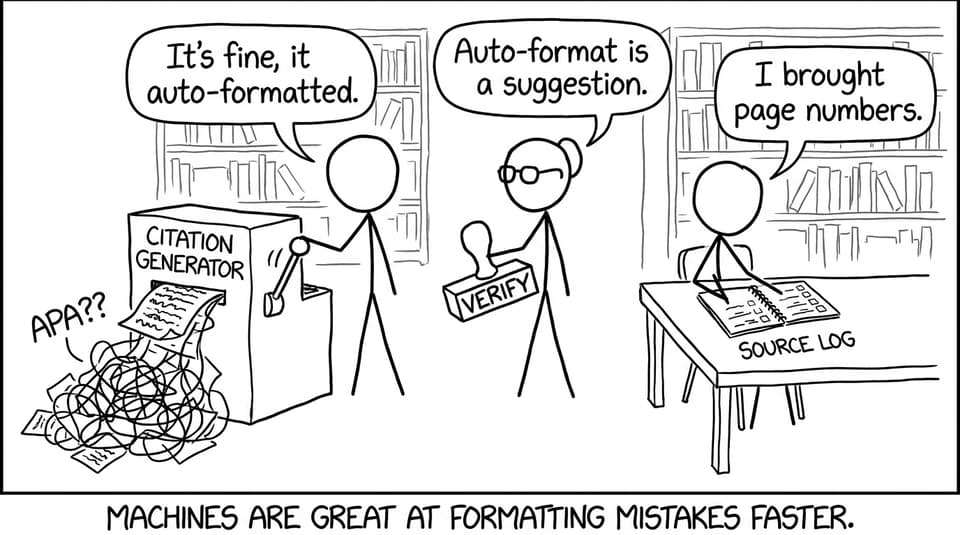
Build a “source log” while researching
As you read, paste the full details into a running document:
-
URL
-
page title
-
author/organisation
-
date
-
one sentence on what you used it for
That final bullet is the secret. It turns your bibliography from a list into a map.
Add in-text citations during drafting
Don’t wait. If a paragraph contains an outside idea, cite it immediately. Later, when you revise the paragraph, the citation stays attached like a name tag.
Cross-check before submission
Do one final match:
-
Every (Author, Year) appears in the bibliography.
-
Every bibliography entry is actually used in the text.
To see how strong IAs handle this, it helps to study real samples. RevisionDojo’s article on using IA exemplars to improve your IB Math IA is a good place to start.
Common referencing mistakes IB students make (and quick fixes)
“I have a bibliography, so I’m done.”
A bibliography without in-text citations is like a map without labels. In an IB IA, you need both.
Fix: Add citations where ideas appear, not only at the end.
Mixing citation styles mid-document
This happens when students copy references from different generators.
Fix: Choose one style and standardize. Consistency is what the IB rewards.
Forgetting to cite visuals
Students cite articles but forget the graph they inserted.
Fix: Add a caption with a source, and include the source in the bibliography.
Citing “Wikipedia” as the main source
Wikipedia can help you understand, but examiners prefer reliable sources.
Fix: Use Wikipedia to find the original references, then cite those.
Bringing it home: referencing is part of the mathematics
In the IB, the Math IA isn’t only “can you calculate?” It’s also “can you communicate responsibly?” Proper referencing proves you can.
If you want an IA workflow that feels less chaotic, build your source log early, cite as you draft, and do one final cross-check before submission. Then use RevisionDojo as your all-in-one support system: study with Study Notes and Flashcards, test precision with the Questionbank and Mock Exams, get unstuck with AI Chat, and polish your draft with the Grading tools, Coursework Library, and Tutors. Even your exam prep stays aligned when your IA habits are aligned.
Because in the end, a strong IB Math IA isn’t just correct. It’s credible.