

If you have ever stared at your Internal Assessment and your Extended Essay and thought, “What if I just… reuse this idea?” you are not lazy. You are human.
The IB asks you to run two marathons that start in the same season. And when your brain finds a topic you actually like, it wants to hold onto it like a life raft.
So, can your IA have the same topic as your EE?
Yes, sometimes the IA can live in the same topic neighborhood as your EE. But if your IA and EE start sharing the same sentences, the same analysis, or the same investigation, you are walking into a duplication problem that can trigger academic integrity concerns.
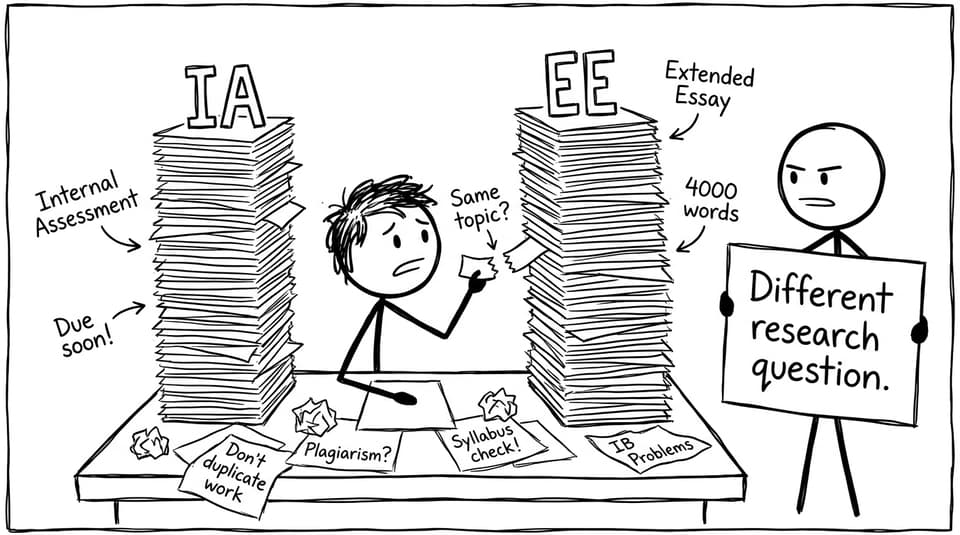
The simplest rule: same area can be OK, same work is not
The cleanest way to think about this is: topic overlap is not automatically banned. Duplication of work is.
IB assessment components are meant to be distinct. Your IA is designed to show subject-specific skills within a tight scope and rubric. Your EE is designed to show sustained, independent research and argument over a much larger word limit.
If you want the official-feeling version of this logic, read RevisionDojo’s deeper explanation of overlap and risks in Can You Copy Your Own EE Into Your IA?. It is basically a checklist for staying safe.
Quick checklist: “Is my IA too close to my EE?”
Use this before you commit to a topic:
-
Does my IA have a clearly different research question from my EE?
-
Am I collecting different data, using different texts, or applying a different method?
-
Would a reader say these pieces answer different questions?
-
Am I reusing sources (fine) instead of reusing paragraphs (risky)?
-
Can I write a one-paragraph statement titled: How my IA is different from my EE?
If you cannot pass at least three of these without mental gymnastics, redesign now, not later.
Why students get tempted to reuse an IA topic
Most students are not trying to cheat. They are trying to survive.
A good topic takes time: reading, false starts, dead ends, and that one moment where your supervisor says, “This is interesting… but.” When you finally land a strong angle for the EE, it feels efficient to build your IA in the same space.
Efficiency can be smart. But IB grading is not just about what you know. It is also about what you can produce as a standalone assessed piece.
If you want a big-picture refresher on what the IA is meant to be across subjects, see IB Internal Assessment: A Complete Guide to Success in the Diploma Programme.
When the same IA topic area is usually fine
Here is what is typically safe, as long as the execution stays separate:
Same theme, different question
Example: Your EE explores a broad debate in Economics. Your IA investigates a specific real-world case with a focused commentary-style claim. Same theme, different target.
Same subject, different method
Example: In Biology, your EE might be literature-based and analytical. Your IA might be an experiment with data processing and evaluation. Same science, different work.
Same sources, newly used
Using the same book or journal article in both the IA and EE is often academically sensible. What matters is that you re-integrate the source for a new purpose and write fresh analysis.
RevisionDojo breaks this down clearly in IA Sources for Your EE: What’s Allowed in IB?.
When sharing an IA topic becomes a problem
These are the overlap patterns that tend to cause trouble:
Reusing your own paragraphs
Even if you wrote every word, submitting the same writing twice is still duplication. Similarity detectors do not care that you are the original author.
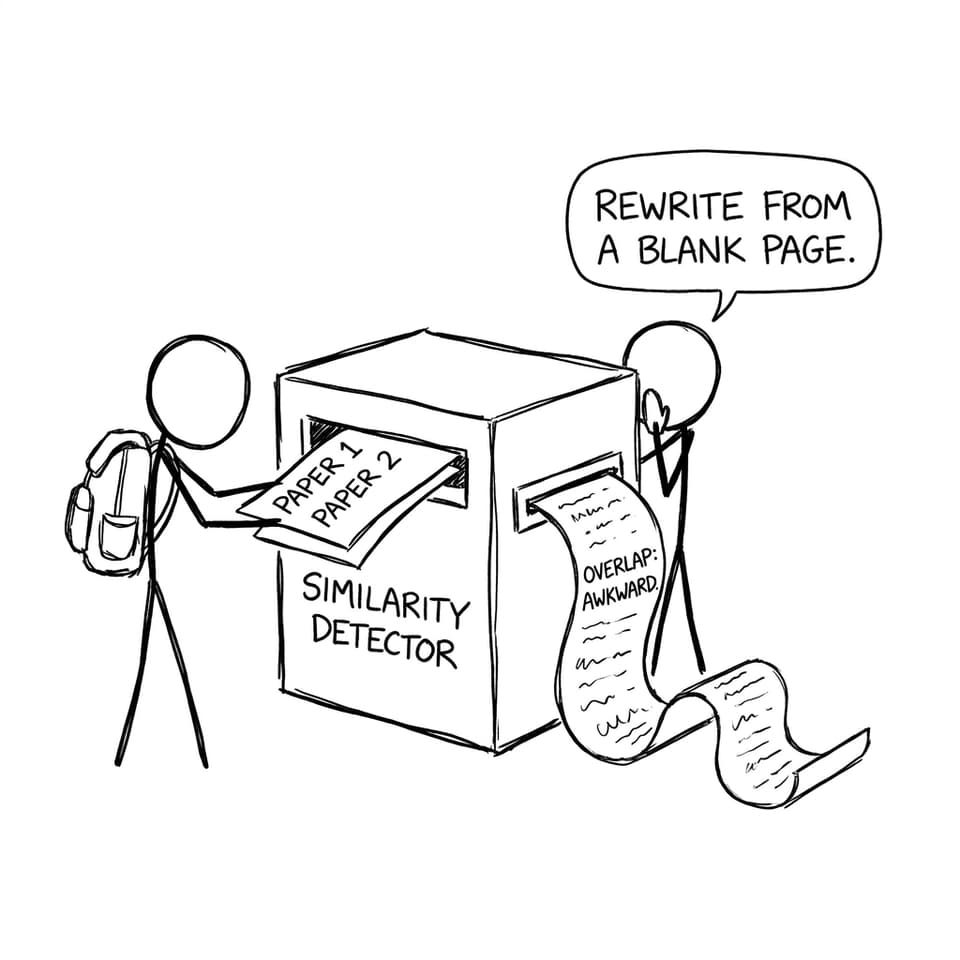
Reusing the same analysis chain
If your claim, evidence, and evaluation are essentially the same in both, your IA starts to look like a shorter EE, or your EE starts to look like a stretched IA. Neither is what examiners want.
Reusing the same dataset or investigation
This is where “same topic” quietly becomes “same work.” If your EE and IA are built on the same core data, you need explicit teacher approval and a clearly different aim. Otherwise, it is hard to prove originality.
The best mental model: same city, different route
Imagine your topic is a city.
Your IA is a short walk where the rubric tells you which streets matter. Your EE is a long, scenic route that proves you can navigate independently, read the signs, and argue where you ended up.
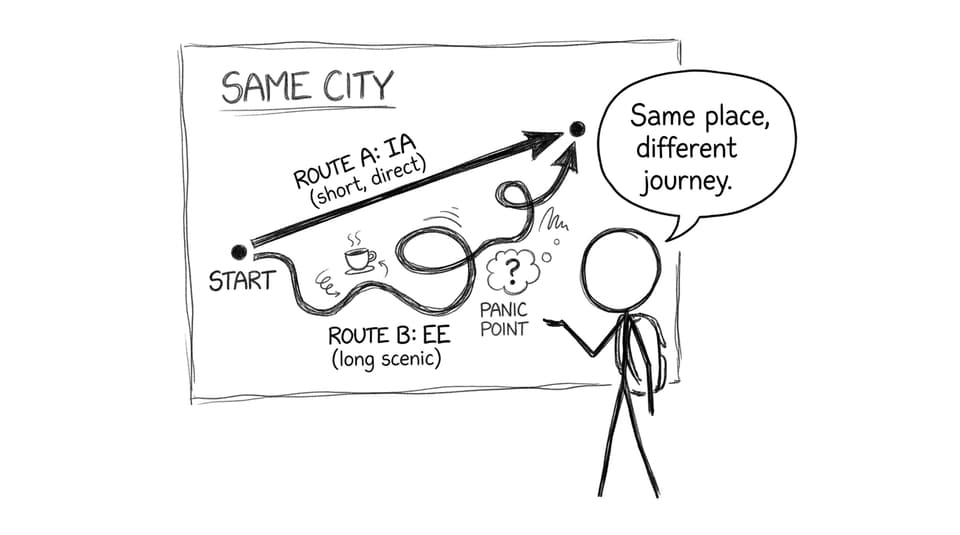
If both journeys take the same photos from the same viewpoint, you did not really take two routes.
How RevisionDojo helps you keep your IA original (without starting from zero)
RevisionDojo works well here because it supports separation: you can keep one “idea universe” while building two distinct submissions.
-
Use the Study Notes to rebuild your background understanding without copying your EE phrasing.
-
Use Flashcards to lock in definitions and case studies so your IA writing stays fresh.
-
Use AI Chat to pressure-test whether your IA research question is genuinely different.
-
Use the Grading tools to map every paragraph to the IA rubric, not to your EE outline.
-
Use the Coursework Library and IB Coursework Examples: IA, EE and TOK Exemplars to see how strong submissions stay focused.
-
If you are short on time, use Mock Exams and Predicted Papers to keep exam prep moving while the IA is in progress.
-
If you need a human checkpoint, Tutors can help you draw a clean line between IA and EE scopes.
To tighten the heart of the task, work through How to Write a Strong IA Research Question and compare it to what the EE expects in IB Extended Essay Guide: Structure, Research Question, ....
The takeaway (and a smart next step)
Your IA can sometimes share a topic area with your EE, especially if the theme genuinely motivates you. But your IA still needs its own research question, its own evidence choices, and its own analysis decisions, all built from the IA rubric, not copied from the EE.
If you want the fastest way to stay original while staying efficient, open RevisionDojo, pull up the Questionbank for your subject to keep exam prep moving, then use the IA Guides to map a fresh outline that cannot accidentally become your EE. Start with IB IA Guides: Internal Assessment Structure, Rubrics & ..., and build two projects that look like they came from the same curious student; not not the same document.