
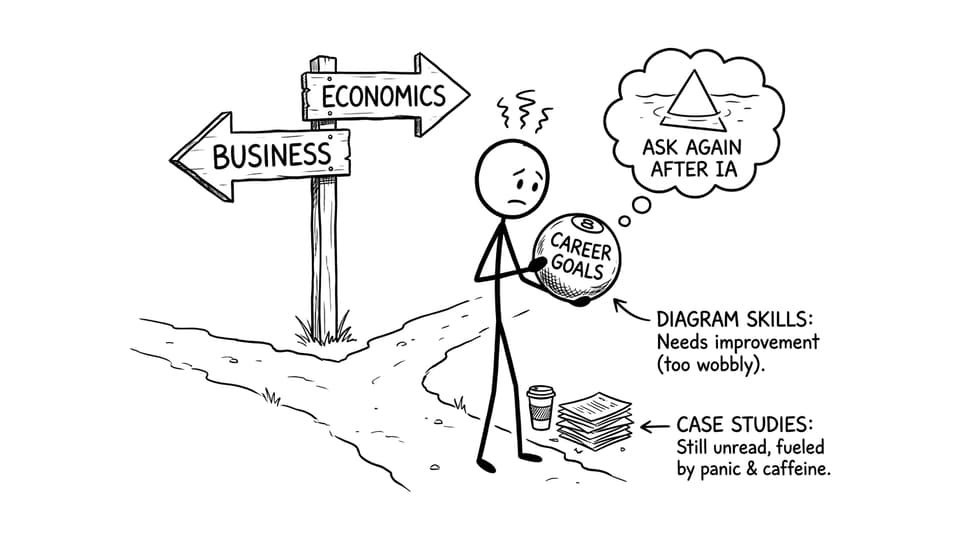
The choice often happens in a quiet moment: you are staring at your subject form, trying to predict a future you have not lived yet. One box says Business Management. Another says IB Economics. Both feel "useful." Both sound like they lead somewhere respectable. And somehow that makes the decision harder, not easier.
What most students are really asking is simpler: Which subject fits the way my brain works under exam pressure? If you are preparing for exams, that is the question that matters.
Quick checklist: Business or IB Economics?
Use this fast filter before you go deeper. If you mostly tick the left side, Business may suit you; if you tick the right side, IB Economics may feel more natural.
-
You like case studies and recommending actions vs you like models and explaining outcomes
-
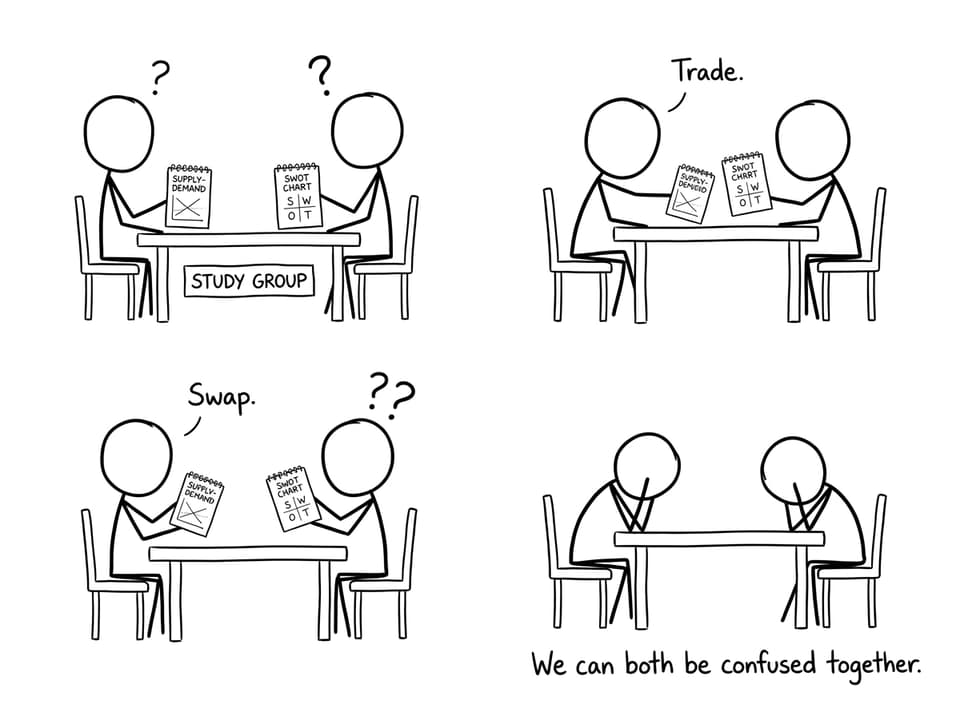
You enjoy strategy tools (SWOT, PEST) vs you enjoy diagrams (demand/supply, AD/AS)
-
You prefer qualitative judgment vs you prefer structured analysis with evaluation
-
You like thinking inside a company vs you like thinking across markets and entire economies
If you want a broader overview of what you actually study (and what comes up in exams), keep IB Economics (2025): Complete Guide to Syllabus, Exams, and IA open in another tab.
What Business Management is really training you to do
Business Management is the subject of decisions under constraints, but the constraints are usually internal: limited budgets, messy teams, competition, brand reputation, and time.
In practice, Business often rewards students who can:
-
Apply a tool or framework to a scenario
-
Write clearly, with focused recommendations
-
Stay grounded in the case study details
You will spend a lot of time thinking about marketing choices, operations, finance basics, HR issues, and strategy. If you like the feeling of reading a situation and saying, "Here is what the company should do next," Business can be satisfying.
If you are aiming for top marks, it helps to study the assessment style early. RevisionDojo's guide, How to Maximize Your Score in IB Business Management, explains what examiners reward and how to structure answers.
What IB Economics is really training you to do
IB Economics is less about the company and more about the logic underneath the world. You build simplified models (yes, diagrams), then test them against reality with examples and evaluation.
That mix is why students either love IB Economics or feel constantly one step behind it.
You will spend your time across four big areas:
-
Microeconomics: markets, market power, market failure
-
Macroeconomics: growth, inflation, unemployment, policy
-
International economics: trade, exchange rates, balance of payments
-
Development economics: inequality, poverty, sustainability
If you want a calm, structured outline of how all of this fits together, Understanding IB Economics: A Comprehensive Guide is a strong starting point.
And if you want a single foundational concept to test whether the subject "clicks," try this: can you explain demand and supply without memorizing a script? If not, start here: Define Supply and Demand: IB Economics.
The honest comparison: workload, difficulty, and exam feel
Students often ask which is "easier." The truth is that difficulty is personal, but the type of difficulty is predictable.
Business Management can feel easier at first because the language is familiar and the content seems intuitive. The challenge appears later: writing sharp, well-evidenced evaluation under time pressure.
IB Economics can feel harder early because diagrams, definitions, and evaluation must work together. But once the core models become automatic, revision becomes more systematic.
If you want a realistic breakdown of student experience, assessment differences, and what tends to surprise people, read How to Choose Between IB Economics and Business Management: Honest Comparison for Students and Is IB Business Management Easier Than IB Economics?.
Can you take both Business and IB Economics?
Sometimes the real answer is: you do not have to choose. Many schools allow students to take two Group 3 subjects by swapping out Group 6.
Taking both can work if you:
-
Like writing and structured evaluation
-
Want broad commerce coverage (firms + markets)
-
Have enough time to practice exam technique for two essay-heavy subjects
But taking both can backfire if it becomes a "safety blanket" decision that spreads your focus too thin.
If you are considering it, use Is It Possible To Take Both IB Business Management and IB Economics? as your decision guide.

How to revise for IB Economics once you commit
If you are preparing for exams, choosing IB Economics is really choosing a revision style. The subject rewards repetition that is small, frequent, and specific.
Here is a simple routine that works:
-
Build a syllabus checklist and close gaps systematically
-
Practice diagrams until labeling is automatic
-
Collect real-world examples by topic (one strong example beats five vague ones)
-
Drill timed questions weekly
A detailed plan is laid out in Methods for Effective IB Economics Revision. And if you are HL, be careful about predictable traps: Top 7 IB Economics HL Mistakes and How to Avoid Them.
On RevisionDojo, students usually pair that plan with:
-
the IB Economics Resources hub for structured content
-
the Questionbank feature to practice like it is exam week
-
Study Notes and Flashcards for active recall
-
AI Chat for quick clarification when a diagram explanation falls apart at midnight
-
Grading tools to check whether your evaluation is actually evaluative
-
Predicted Papers and Mock Exams when you need full exam pacing
-
Coursework Library and Tutors when you want guided feedback
Conclusion: choose the subject you can practice consistently
The right choice is rarely the subject that sounds impressive. It is the subject you can revise on a tired Tuesday and still make progress.
If you want to understand markets, policies, and the logic behind real headlines, IB Economics is a strong path. If you want to live inside the decisions of real organizations, Business Management may fit better. Either way, commit early, practice with feedback, and make your revision measurable.
When you are ready to turn the choice into results, start with RevisionDojo's IB Economics Resources and build your routine using Study Notes, Flashcards, AI Chat, and the Questionbank. IB Economics rewards consistency, and RevisionDojo is built for exactly that.