


Choosing IB subjects feels a bit like choosing a future version of yourself.
One day you’re excitedly circling classes that sound impressive. The next, you’re staring at a timetable like it’s a puzzle designed by someone who hates sleep. If you’re drawn to commerce, finance, or entrepreneurship, one question comes up again and again: is it possible to take both IB Business Management and IB Economics?
Yes, it can be done. And for the right student, it can be a powerful combination. But before you commit, you need to understand the IB rules, the practical timetabling realities, and what the workload actually feels like when exam season arrives.
The IB rule that makes this combination possible
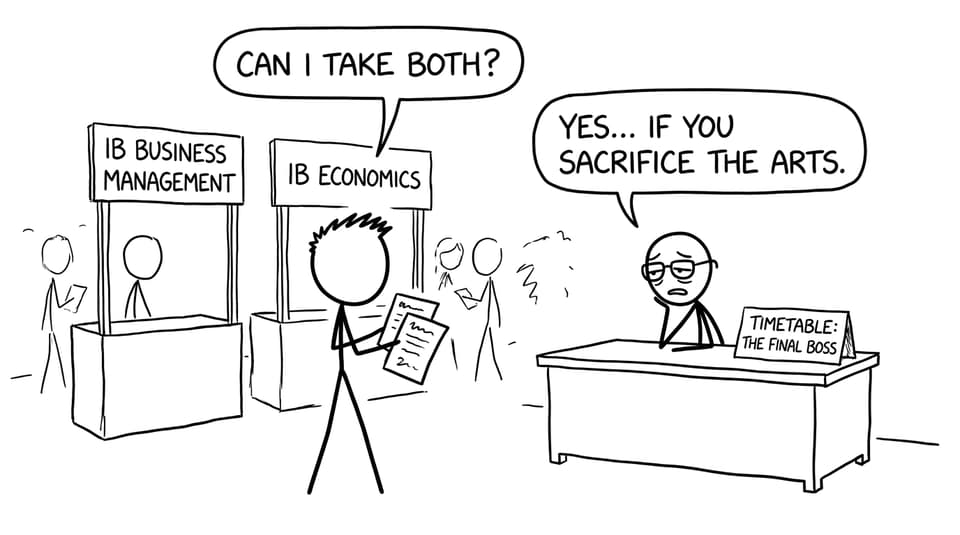
IB Business Management and Economics both sit in Group 3: Individuals and Societies. In the standard IB Diploma setup, you usually pick one Group 3 subject.
But the IB also allows a common substitution: you can replace a Group 6 (The Arts) subject with an extra Group 3 subject. That’s the main pathway that makes IB Business Management plus Economics possible.
The catch is that the IB rule is only half the story.
Your school has to offer both subjects, your coordinator has to approve the combination, and your timetable has to allow it. In some schools, Business and Economics are taught in the same block, so you can’t take both even if you want to.
If you want a quick starting point for resources once you’re approved, the subject hubs make planning easier: IB Business Management resources and IB Economics resources.
Quick decision checklist (save this before you email your coordinator)
Before you lock in IB Business Management, run this checklist:
-
Can you substitute Group 6 with a second Group 3 at your school?
-
Do Business and Economics clash on the timetable?
-
Are you taking one at HL and one at SL (common), or both at HL (heavy)?
-
Are you okay giving up an arts subject (or do you need it for balance)?
-
Do you enjoy both writing structured evaluations (Business) and working with models/diagrams (Economics)?
-
Can you handle two separate internal assessments running in parallel?
If most answers are “yes,” taking IB Business Management with Economics is realistically on the table.
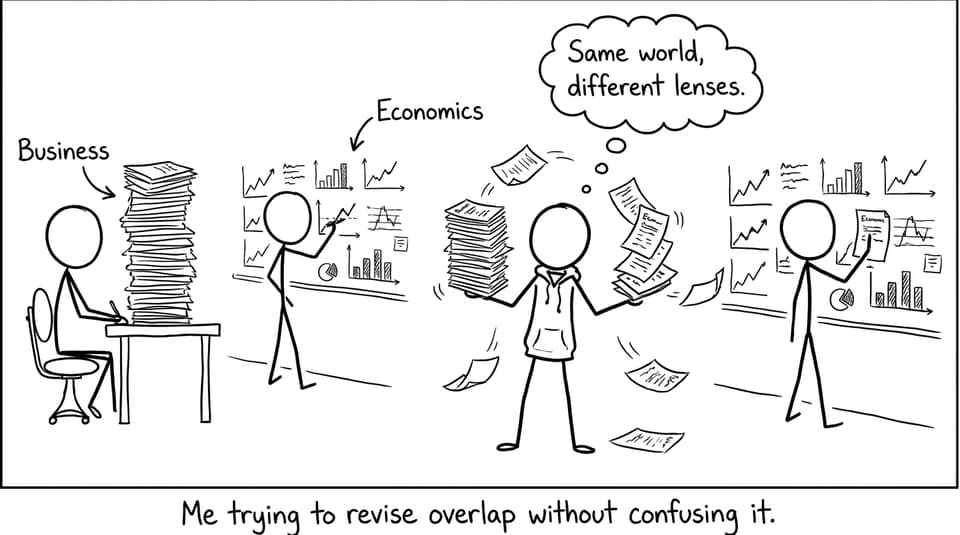
IB Business Management vs IB Economics: similar world, different lenses
Students often assume the two subjects overlap so much that doing both is redundant. In practice, they’re related, but they think differently.
What IB Business Management trains you to do
IB Business Management is about the inside of the firm: decision-making, stakeholders, strategy, operations, HR, marketing, finance. It rewards students who can take a messy real-world situation and build a clean argument.
A simple example: you’re given a case and asked whether a company should expand, change pricing, or invest in new technology. You’re judged on how well you apply tools (like break-even, investment appraisal, stakeholder analysis) to the details.
If you want to see what “applied” looks like in practice, RevisionDojo’s topic notes are useful for tightening definitions and examples, like IB Business Management 1.1 What is a business? notes and IB Business Management 3.8 Investment appraisal.
What Economics trains you to do
Economics zooms out. It’s about systems: markets, policy, trade, development, growth, inflation, unemployment, and the trade-offs governments and societies face.
It rewards precision with diagrams, clear chains of reasoning, and evaluation that weighs multiple stakeholders. If you like seeing cause-and-effect across an economy, Economics can feel like learning a new way to read the news.
For structured revision guidance, this is a strong companion read: Methods for effective IB Economics revision.
Why students choose IB Business Management and Economics together
Students who choose IB Business Management plus Economics usually do it for one of these reasons:
-
They’re considering business, finance, management, or economics at university.
-
They like both “real company decisions” and “big-picture market forces.”
-
They want two subjects that connect to current events.
-
They feel motivated by practical examples rather than purely abstract theory.
This pairing can make you sound coherent in interviews and personal statements because you can discuss both firm strategy and economic context without guessing.
The real pros (when it works, it really works)
Taking IB Business Management alongside Economics can give you:
A more complete mental model of commerce
Business helps you explain what a company can control. Economics helps you explain what it can’t.
When you write a Business answer about expansion, Economics quietly improves your instincts: interest rates, consumer confidence, exchange rates, market power. You begin to see a business as part of an ecosystem.
Stronger evaluation skills
Both subjects reward judgement. Not loud opinions, but balanced conclusions supported by evidence and constraints. That habit helps across the Diploma.
Efficiency in studying vocabulary and context
There is overlap in themes (competition, growth, sustainability). If you’re organized, that overlap becomes efficiency rather than repetition.
The cons (the part students underestimate)
The downside isn’t that the subjects are “too similar.” The downside is that they require different output under pressure.
Two different exam styles to master
IB Business Management often asks you to apply tools to a case, using the right terminology and evaluation. Economics often expects diagram accuracy, definitions, and structured arguments.
Switching between those modes can feel like changing languages mid-sentence.
Coursework calendar compression
Two IAs means two sets of deadlines, drafts, feedback cycles, and polishing. Even good students can get squeezed if both IAs peak during the same month.
Less subject variety
Dropping Group 6 can remove a creative “breathing space” from your week. Some students miss that more than they expect.
How to manage both subjects without burning out
If you decide to take IB Business Management with Economics, your biggest risk is not intelligence; it’s time.
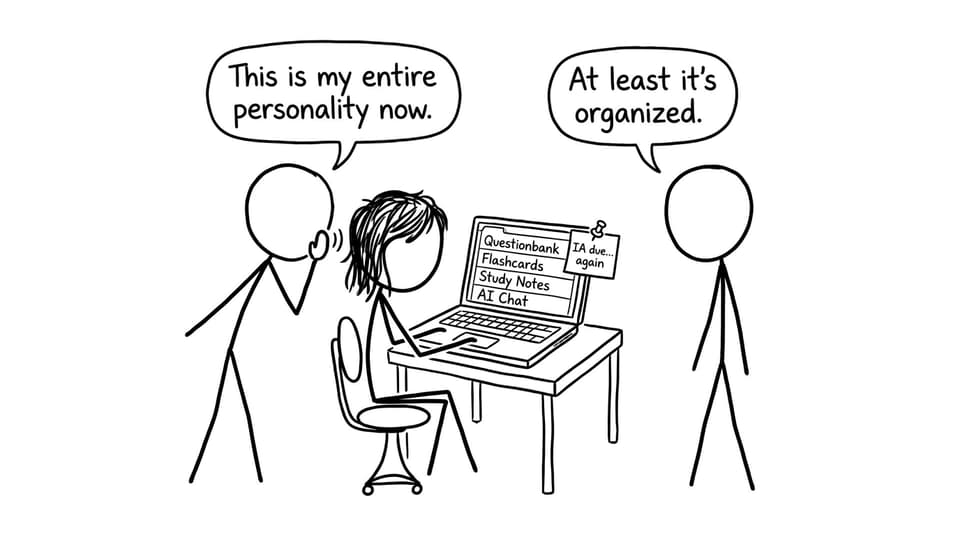
A calm strategy is to build one loop that feeds both subjects:
-
Clarify concepts with RevisionDojo’s Study Notes and the Economics hub.
-
Lock in definitions with Flashcards (short daily sessions beat long weekly ones).
-
Practice under exam conditions using the Questionbank and topic filters.
-
Get feedback fast using AI Chat and Grading tools, so mistakes don’t fossilize.
-
Simulate full papers with predicted papers and mock exams to train stamina.
RevisionDojo is built around that loop across both subjects: Questionbank, Study Notes, Flashcards, AI Chat, Grading tools, Predicted Papers, Mock Exams, Coursework Library, and Tutors. If you want to understand the full workflow in one place, start here: RevisionDojo app: the smarter way to prep for IB exams.
For Business-specific exam practice, Business Management predicted papers can help you rehearse timing and structure without guessing what to do next.
A closing thought (and a practical next step)
Taking IB Business Management and Economics together is possible, and for the right student it’s more than “allowed”; it’s genuinely useful. You learn how businesses make decisions and how economies shape the space those decisions happen in. That combination can make studying feel connected, not scattered.
If you decide to do it, make your plan simple: learn, recall, practice, get feedback, repeat. RevisionDojo is designed to run that loop in one place with the Questionbank, Study Notes, Flashcards, AI Chat, Grading tools, Predicted Papers, Mock Exams, Coursework Library, and Tutors.
Start by setting up your two subject home bases: IB Business Management resources and IB Economics resources, and build the kind of revision routine you’ll still be able to follow when deadlines get loud.