
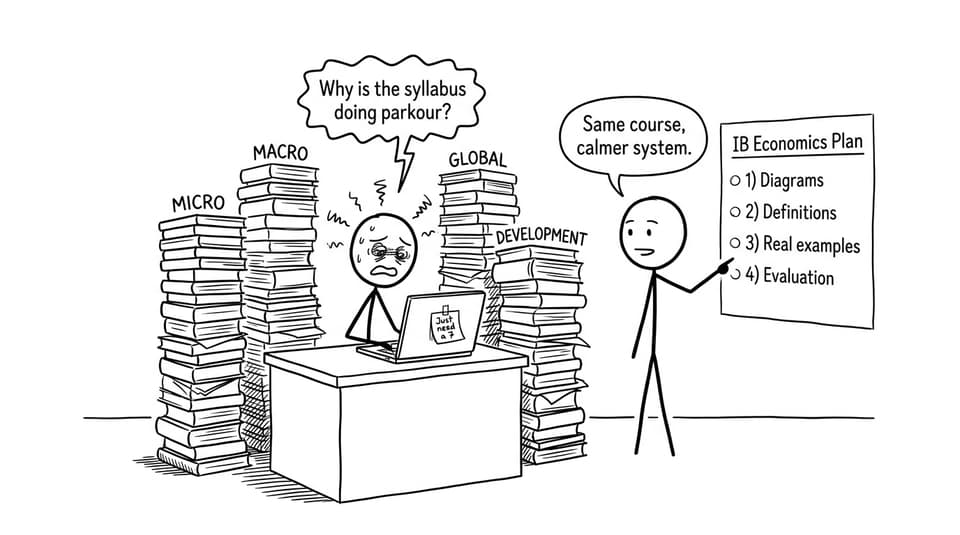
A week before exams, most IB students don’t panic because they “don’t know economics.” They panic because they can’t see the whole game.
IB Economics is full of clean models and neat diagrams, yet revision can feel like chasing papers in the wind: micro one day, macro the next, then a global policy article for your IA, then back to definitions. This guide pulls IB Economics into a single, workable map for 2025: what’s in the syllabus, how the exams work, and how to write an IA that earns marks.
IB Economics (2025) in one quick checklist
Use this as your “am I on track?” filter for IB Economics:
-
Know the four syllabus areas and the nine key concepts (so you can frame answers).
-
Practise Paper-style writing weekly: definitions, diagrams, application, evaluation.
-
Build your IA around one main concept per commentary, with one strong diagram.
-
Replace rereading with active practice using the IB Economics Questionbank.
-
Simulate full papers using Economics Predicted Papers to train timing.
IB Economics syllabus: what you actually study
The IB Economics syllabus is organised into four connected areas. They look separate in a textbook, but in exams they blend.
Microeconomics
Markets, incentives, and the classic tensions: efficiency vs equity, private vs social costs, and when intervention helps or harms. If you need a quick anchor for diagrams and terminology, start with RevisionDojo’s core hub: IB Economics Resources.
Macroeconomics
The whole-economy lens: GDP and growth, inflation, unemployment, and stabilisation policies. For fast, structured review, the Macroeconomics Study Notes help you keep definitions and policy effects consistent.
The global economy
Trade, exchange rates, balance of payments, and the real trade-offs behind protectionism. A useful starting point for this section is IB Economics: The Global Economy, where you can jump between notes, flashcards, and practice.
Development economics
How growth differs from development, what prevents progress, and which strategies are realistic. If you want an exam-ready overview of policy options, see Strategies to Promote Economic Growth and Development Notes.
Across all four, the course keeps returning to nine key concepts: scarcity, choice, efficiency, equity, economic well-being, sustainability, change, interdependence, and intervention. In IB Economics, concepts aren’t decoration: they’re how you turn “explaining” into “evaluating.”
IB Economics exams (SL vs HL): what to expect
Assessment rewards performance, not vibes. You can “understand” a unit and still lose marks if your definitions are vague or your diagram is missing labels.
SL exams
-
Paper 1: extended responses testing theory and evaluation.
-
Paper 2: data response using stimulus material.
-
Internal Assessment (IA): three commentaries on real-world articles.
HL exams
HL includes everything above, plus:
- Paper 3: quantitative methods and deeper analysis.
The best way to prepare is to rotate learning and proving. Use Economics Cheatsheets to compress each topic, then immediately apply it with timed practice from the Questionbank feature.
IB Economics IA (2025): a simple plan that matches the rubric
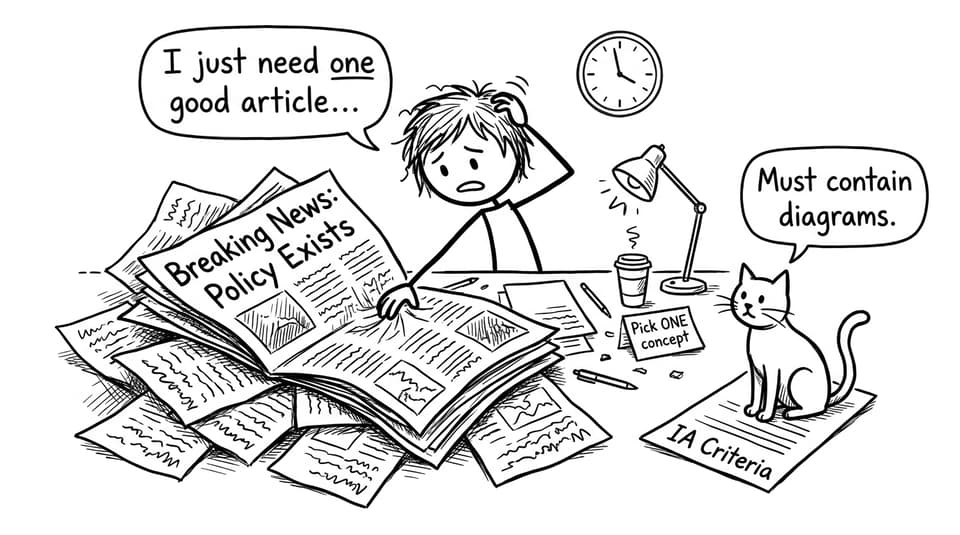
A strong IB Economics IA is not “three mini essays.” It’s three tight explanations of a real policy issue using one main concept, one clear diagram, and one balanced evaluation.
-
Choose a recent article with a specific policy (tax, subsidy, interest rate change, tariff, regulation).
-
Build your commentary around one core diagram you can explain in words.
-
Link back to one key concept (like equity or sustainability) to strengthen evaluation.
-
Keep application concrete: numbers, dates, stakeholders, and context.
If you want step-by-step guidance, start with IB Economics Internal Assessment Guide, then use IB Economics IA: 7 Tips for a High-Scoring Commentary. When you’re ready to check your work like an examiner would, run it through the IB Economics IA Grader. For modelling, the IB Economics Examples library is a calm way to see what “good” actually looks like.
FAQ
Is IB Economics hard in 2025?
IB Economics feels hard when your revision is passive, because the exams reward what you can produce on demand. You need definitions that sound like the syllabus, diagrams that show the right shifts, and paragraphs that connect policy to outcomes. The content itself is learnable, but the markscheme expects structure and precision. That’s why students often improve quickly once they practise in the right format. A reliable approach is to learn a topic, then immediately test it with exam-style prompts. On RevisionDojo, the Study Notes, Flashcards, and Questionbank are built for that exact loop in IB Economics.
What’s the best way to revise for IB Economics exams?
The best method is to revise like an athlete trains: short drills plus full rehearsals. Start by using condensed summaries (like cheatsheets) to get the model straight in your head. Then do timed practice that forces you to define, draw, apply, and evaluate. Review your mistakes by pattern: missing labels, unclear chains of reasoning, weak evaluation, or poor application. Repeat the same skill until it becomes automatic under time pressure. You can also build stamina with full-paper practice using predicted sets and mock exams. If you need a full routine, read IB Economics Revision Methods That Actually Work.
How do I score higher on the IB Economics IA?
Choose articles that make analysis easy, not impressive. The best IB Economics IA articles contain a clear policy action and measurable impacts, so you can apply theory without guessing. Keep one main concept and one main diagram per commentary, then explain the diagram in words with tight application to the article. Evaluation should weigh trade-offs: short run vs long run, different stakeholder impacts, unintended consequences, and constraints like time lags or information gaps. The most common problem is writing too broadly and losing focus on the rubric strands. To stay aligned, use the IB Economics IA Grader as a checkpoint, and compare your structure to the IB Economics Examples library.
A final note: make IB Economics feel smaller
IB Economics becomes manageable when you stop treating it like four separate subjects. It’s one toolkit applied to different scales: markets, economies, the world, and development.
If you want that toolkit organised in one place, RevisionDojo is built for IB students preparing for exams: Questionbank, Study Notes, Flashcards, AI Chat, Grading tools, Predicted Papers, Mock Exams, a Coursework Library, and Tutors. Start with the IB Economics Resources hub, then practise until your explanations feel calm and repeatable. That’s how IB Economics scores go up.