


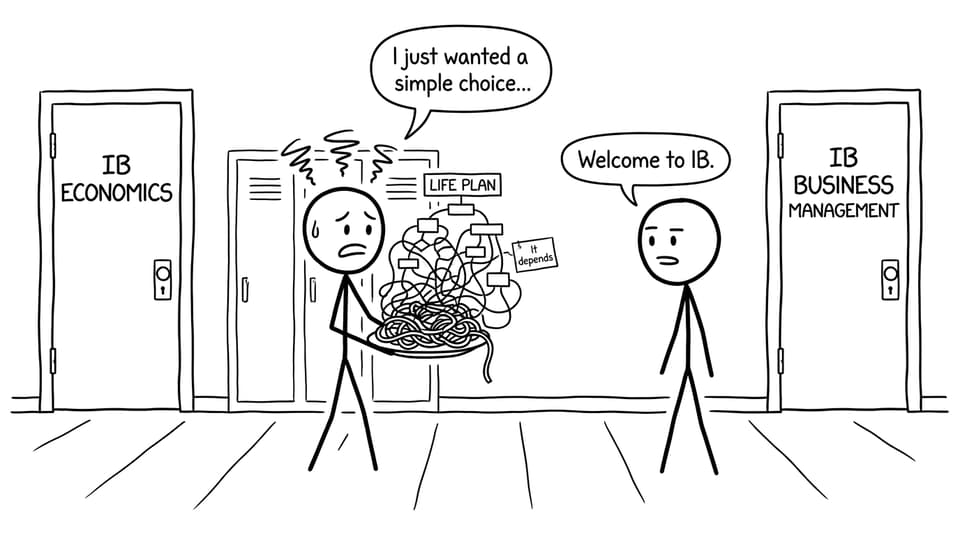
If you’re stuck between IB Economics and IB Business Management, you’re not indecisive; you’re doing something most students skip: thinking.
Because the truth is, the “right” subject isn’t the one your friend picked, or the one that sounds impressive. It’s the one you can live with on a tired Tuesday when the deadline calendar looks like a crime scene. This honest comparison is here to help you choose IB Economics or Business Management based on how you actually learn, how you’ll be assessed, and what will feel sustainable during exams.
A quick decision checklist (save this)
Use this as your 60-second filter:
-
Choose IB Economics if you like arguments, diagrams, current events, and explaining cause-and-effect.
-
Choose Business Management if you like real companies, structured tools (SWOT, Ansoff, decision trees), and practical recommendations.
-
If you hate writing under time pressure, think twice about IB Economics essays.
-
If you dislike reading long case material, think twice about Business Paper 1.
-
If you’re unsure, try one week of each: one economics essay plan + one business case answer plan.
IB Economics vs Business: what you’re really studying
IB Economics is a “why” subject
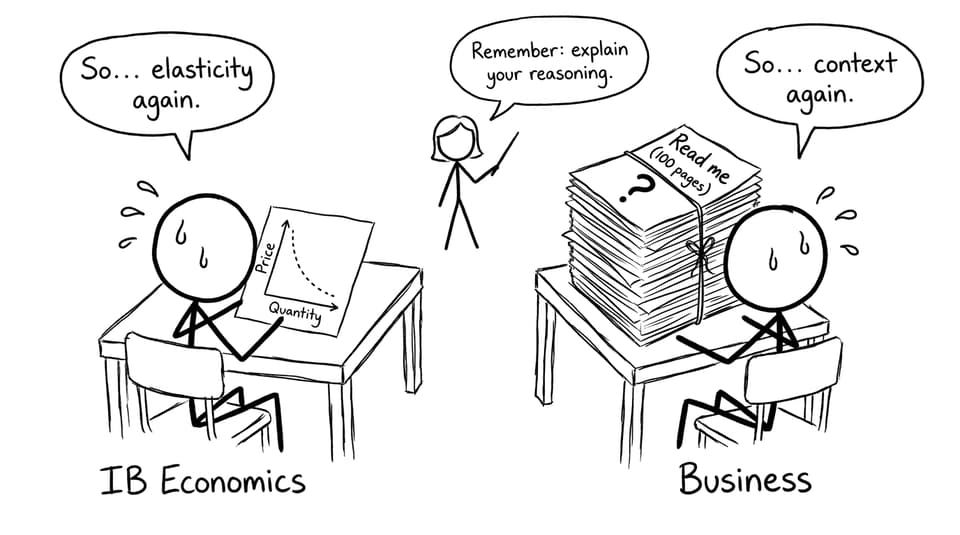
IB Economics is built around models that explain the world: why prices move, why unemployment persists, why trade creates winners and losers. You’ll spend a lot of time making clear claims, drawing clean diagrams, and evaluating policies.
If you want a calm overview of what the course contains, start with Understanding IB Economics: A Comprehensive Guide. Then, when you’re revising, Methods for Effective IB Economics Revision is the kind of checklist you’ll reuse all year.
Business Management is a “what should they do” subject
Business Management is about decision-making in context. You learn frameworks, apply them to an organization, and write recommendations that sound realistic. It’s less abstract than IB Economics, but it’s not “easy”; it rewards precision, structure, and evidence.
For a roadmap of the course and exams, see How to Maximize Your Score in IB Business Management.
Difficulty: the honest version students don’t hear
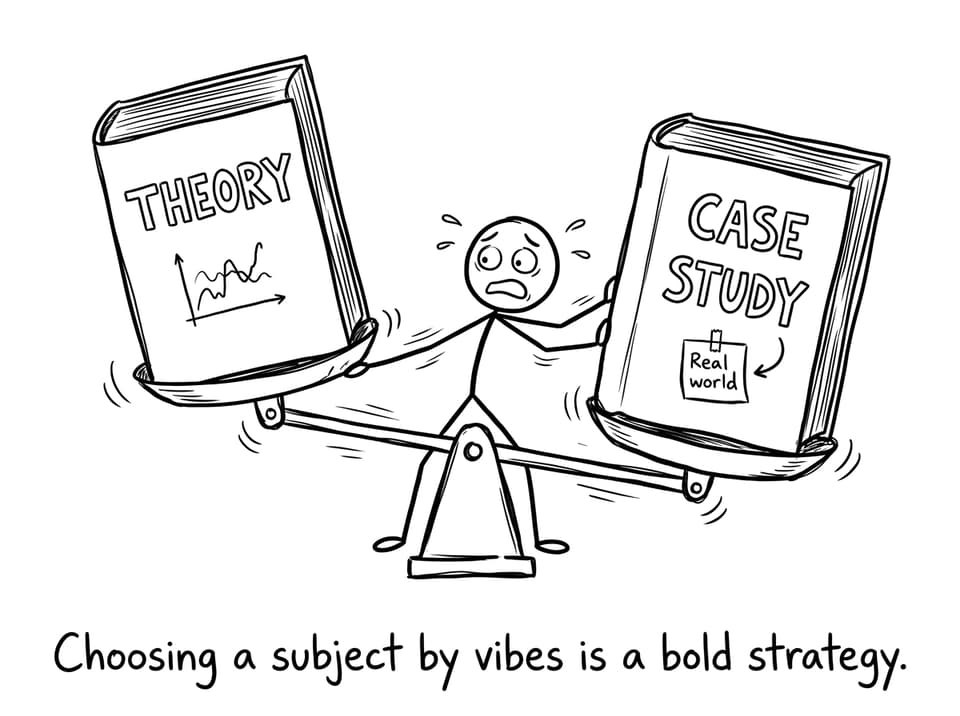
Students often call IB Economics harder because:
-
the writing is analytical and evaluative (not just descriptive)
-
diagrams must be accurate and explained
-
HL adds more quantitative pressure
If you want to avoid the usual traps, read Top 7 IB Economics HL Mistakes and How to Avoid Them. And if you’re building fundamentals, Define Supply and Demand (IB Economics) is a quick win that pays off across multiple topics.
Business Management can feel more accessible at first, but high marks require sharp application: you must tie every point back to the case, not float above it. For many students, the challenge is discipline, not difficulty.
Assessments: what your grade is actually made of
IB Economics assessments (what to expect)
In IB Economics, you’ll meet essay questions, data response, and (at HL) more quantitative work. The Internal Assessment typically asks you to write economics commentaries based on real-world articles. It’s not about sounding smart; it’s about being specific.
To build that specificity, use Step-by-Step Approach to Writing IB Economics Essays and keep IB Economics IA: 7 Tips for a High-Scoring Commentary open while you draft.
Business Management assessments (what to expect)
Business assessments lean into structured responses and case-driven writing. The Business IA is more like a mini consulting report: focused question, real evidence, justified recommendation.
Two strong starting points:
University goals: which subject “signals” what?
A simple way to think about it:
-
Economics/finance/public policy: IB Economics (often especially helpful at HL)
-
Business/management/marketing: Business Management fits naturally
-
Entrepreneurship: either can work, depending on what you’ll enjoy enough to master
Universities rarely reward misery. A strong grade in the subject that matches your brain often beats a weaker grade in the subject you chose for optics.
If you’re still unsure, do this one-week trial
Give yourself seven days and test the daily reality:
-
Do 5 exam-style prompts in the IB Economics Questionbank and see if the diagrams feel satisfying or draining.
-
Build one timed mini mock using RevisionDojo’s Mock Exams and Grading tools, and notice what stresses you: ideas, structure, or speed.
-
For Business, outline one case answer using the frameworks from your notes and ask: do you enjoy “making a recommendation,” or does it feel like guessing?
If you want one home base for both subjects, start at RevisionDojo. The difference maker isn’t motivation; it’s systems: Study Notes when you’re lost, Flashcards when you forget, AI Chat when you need a fast explanation, and Tutors when you’re stuck in a loop.
Conclusion: choose the subject you can practice daily
The best choice isn’t the subject that sounds impressive in a group chat. It’s the one you’ll practice consistently when exams get close.
If your mind enjoys models, trade-offs, and writing clear arguments, IB Economics will reward you. If you prefer real organizations, structured tools, and recommendations that sound like the real world, Business Management will feel more natural.
When you decide, commit, then let RevisionDojo carry the weight: Questionbank practice, Study Notes for clarity, Flashcards for recall, AI Chat for fast help, Grading tools for feedback, Predicted Papers and Mock Exams for exam readiness, a Coursework Library for IA support, and Tutors when you want a human roadmap. IB Economics (or Business) gets easier when your preparation stops being random.