


September often begins with clean notebooks and reasonable intentions. By October, the calendar is carrying coursework deadlines, tests, CAS commitments, and the first signs of exhaustion. November arrives, daylight changes, and an evening that once felt spacious begins to disappear before dinner.
For IB students, building a fall routine that protects sleep means working backward from a consistent wake-up time, scheduling demanding work earlier, and creating a firm stopping point at night. The goal is not a perfect timetable. It is a repeatable system that prevents schoolwork from expanding into the hours your body needs for recovery.
Most teenagers aged 13-18 should regularly get 8-10 hours of sleep, according to the American Academy of Sleep Medicine. Personal needs vary, but sleep should be treated as a fixed part of the schedule rather than whatever remains after studying.
Your fall sleep checklist
Use these anchors from September through November:
- Set a realistic wake-up time and work backward for an 8-10 hour sleep opportunity.
- Keep weekday and weekend wake times reasonably close.
- Complete difficult revision and coursework earlier in the evening.
- Stop heavy academic work 60 minutes before bed when possible.
- Use a short shutdown ritual to capture unfinished tasks.
- Keep the final part of the evening quiet, dim, and predictable.
- Review the routine every Sunday without redesigning your entire life.
This fits a balanced IB daily routine, but begins with a different assumption: sleep is an appointment, not a reward.
Why fall can quietly disrupt IB sleep
Academic demands often accelerate while daylight contracts. Depending on where you live, darker mornings or evenings may make it harder to feel alert when your schedule requires it. Some regions also change their clocks during autumn, while others do not.
The greater problem is cumulative. One late night seems harmless. Three become a pattern. Saturday turns into a long recovery sleep, Sunday night becomes restless, and Monday feels like travel fatigue despite going nowhere.
Teenagers also tend to experience a biological shift toward later sleep and wake times. An early school schedule does not erase that tendency. It simply makes a late bedtime more expensive. This is why sleep and IB performance belong in the same conversation. Sleep supports alertness and learning, while insufficient sleep is associated with attention and learning problems. More revision time is not automatically better revision.
Build the routine backward from morning
Most students begin with bedtime. A stronger routine begins with the time you must wake.
Suppose you need to get up at 6:45 a.m. Count backward to identify a realistic sleep window. Place a wind-down period before it and a study cutoff before that.
| Anchor | Example time | Purpose |
|---|---|---|
| Wake up | 6:45 a.m. | Stabilizes the day |
| Lights out | 10:30 p.m. | Creates a sufficient sleep opportunity |
| Wind-down begins | 9:45 p.m. | Reduces stimulation |
| Heavy study ends | 9:15 p.m. | Keeps work away from bedtime |
The exact times matter less than the sequence. Adjust them for your commute, family responsibilities, and school schedule. Do not quietly subtract sleep to preserve an imaginary ideal.
A stable wake time also stops each weekend from becoming a different time zone. Minute-perfect consistency is unnecessary, but large shifts can make Sunday night harder. The guide to a practical IB sleep routine can help if your schedule needs a gradual reset.
Move demanding IB work earlier
A bedtime boundary works only when important work has somewhere else to go. Place your most demanding task in the first serious block after school or during the early evening.
A useful sequence is to decompress and eat, complete one 45-60 minute priority block, take a genuine break, and finish with a shorter secondary block. The priority task should produce something visible: ten corrected questions, one coursework subsection, an essay plan, or a reviewed error log. “Study Biology” is too vague to contain. “Complete and correct ten genetics questions” has an ending.
RevisionDojo can shorten this loop. Use Study Notes to clarify one topic, then apply it through the Questionbank. Turn recurring mistakes into Flashcards, and ask AI Chat one precise question when confusion blocks progress. This follows the logic of active recall for IB students: retrieve, check, correct, and stop.
Create a closing ritual
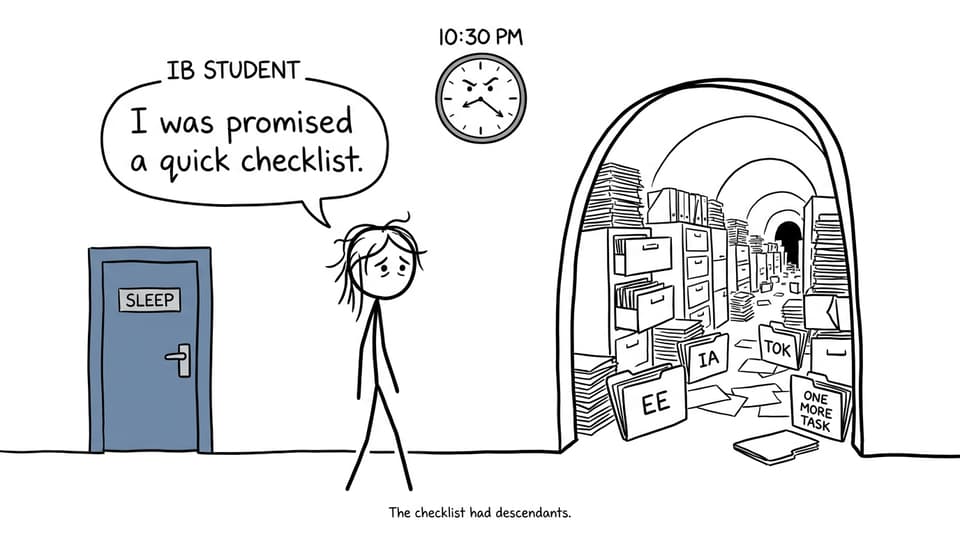
Sleep is often delayed less by work than by the fear of forgetting it. A five-minute shutdown gives unfinished work a safe place to wait:
- Write tomorrow's three most important actions.
- Record loose thoughts about an IA, EE, TOK task, or test.
- Pack the books and equipment you need.
- Close every academic tab and leave the desk.
If deadlines repeatedly invade the night, use these IB time management strategies to divide projects into smaller actions. RevisionDojo's Coursework Library, Grading tools, and Tutors can also make feedback clearer when confusion, rather than time, is the underlying problem.
Keep late evening lighter
The final hour should not contain a fresh HL concept, an open-ended essay rewrite, or a full timed simulation. Reserve Mock Exams and Predicted Papers for earlier sessions. Use late evening for packing, showering, reading, gentle stretching, or a brief Flashcards review with a fixed ending.
Screens are not identical. A calm audiobook differs from an urgent group chat about tomorrow's assessment. If a complete screen cutoff is unrealistic, reduce brightness, silence notifications, and keep the phone away from the bed. Notice your response to caffeine too, and avoid using it late in the day to compensate for repeated sleep loss.
Adjust without chasing perfection
In September, establish three anchors: wake time, study cutoff, and shutdown ritual. In October, add buffer blocks so delayed coursework does not automatically become midnight work. In November, seek daylight after waking when available and keep meals, movement, study, and sleep cues consistent.
There will still be late events, illness, and difficult deadlines. One disrupted night does not mean the routine failed. Return to the usual sequence as soon as reasonably possible. If you regularly cannot sleep, wake repeatedly, or experience severe daytime sleepiness, speak with a parent, school counselor, or qualified healthcare professional.
The deeper lesson is that rest can be productive in the IB. RevisionDojo serves as the ultimate IB resource by bringing Study Notes, Flashcards, the Questionbank, AI Chat, Grading tools, Predicted Papers, Mock Exams, the Coursework Library, and Tutors into one workflow. The value is not merely having more material. It is reducing the friction that keeps students working after useful learning has ended.
A good fall routine rarely feels dramatic. It feels like closing the laptop while more remains, trusting tomorrow's plan, and discovering that consistency carries you further than exhaustion.